

Kingston, Ontario is beloved for its limestone architecture, layered military and political history, and relaxed waterfront promenades along Lake Ontario and the mouth of the St. Lawrence River. Travelers who fall for its blend of historic streets and harbor views often look for other places with a similar feel: human-scale towns where ships once shaped the skyline, heritage buildings line the streets, and the water is never far away. The following destinations in Canada and the United States offer a comparable mix of history and waterfront scenery, each with its own distinct character.
Cobourg, Ontario: Victorian Streets and a Classic Lakefront
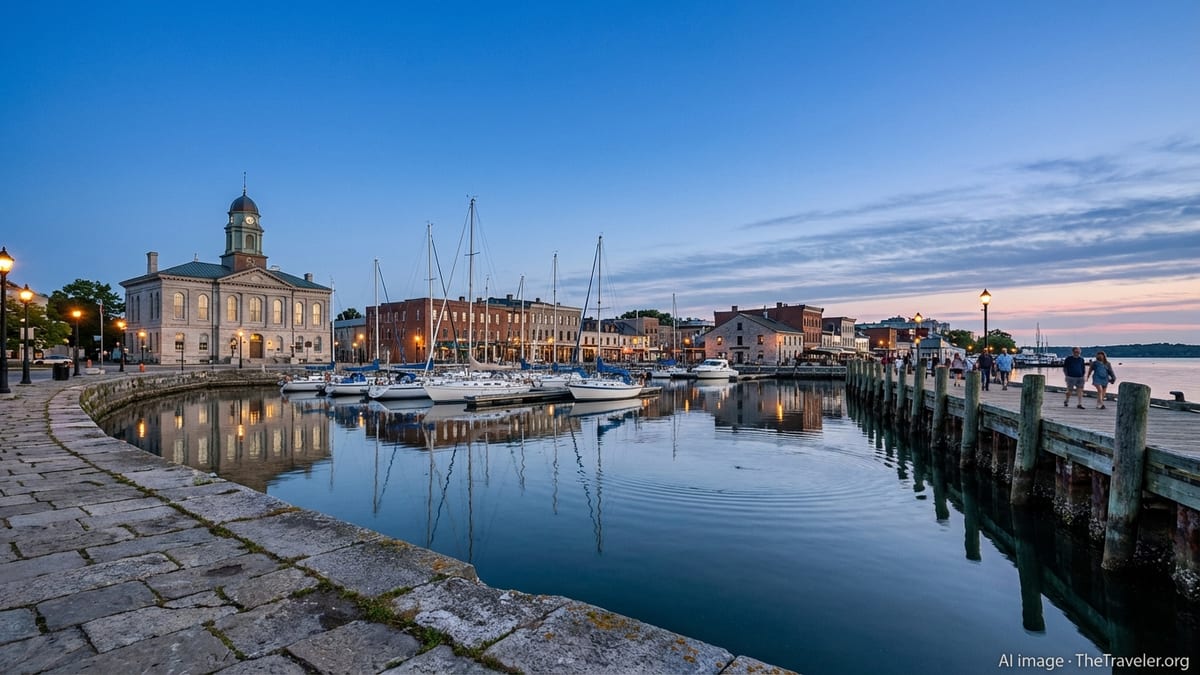
About a ninety-minute drive west of Kingston along Highway 401, Cobourg sits on the same Lake Ontario shoreline and delivers a familiar mix of civic history and beach-town ease. The town grew as a 19th-century port, and its historic core still reflects that era, with restored brick storefronts, churches, and small museums set a short walk from the marina. The result feels a bit like a more compact Kingston, where the transition from main street to waterfront is measured in minutes rather than miles.
Cobourg’s standout landmark is Victoria Hall, a grand Palladian-style public building that has anchored civic life for more than a century and a half. Around it, the downtown streets remain walkable and low-rise, with independent shops and casual restaurants filling heritage buildings instead of glass towers. For visitors who enjoy Kingston’s balance of small-town scale and dignified architecture, Cobourg offers a similar experience with a slightly sleepier pace.
Along the water, Cobourg Beach and its adjoining parklands create one of the most accessible lakefronts in Ontario. The harbor functions as a marina, and in summer it fills with recreational boats while festivals and events spill out along the shore. Sunsets can be particularly striking, with sailboat masts silhouetted against the western sky in much the same way you see them from Kingston’s waterfront. It all adds up to a destination where history and lake views are as central as they are in Kingston, just with more sand between your toes.
Saint Andrews by the Sea, New Brunswick: Tides, Wharves, and Loyalist History
On the opposite side of the country, Saint Andrews by the Sea in New Brunswick offers a maritime answer to Kingston’s freshwater charm. One of the oldest settlements in the province, the town was heavily shaped by Loyalist arrivals in the late 18th century, and their influence is still evident in the clapboard houses, modest churches, and grid of streets that descend toward the harbor. Like Kingston, it wears its age openly, with heritage plaques, preserved facades, and a walkable core that invites slow exploration.
Where Kingston’s waterfront feels defined by its harbor walls and marina basins, Saint Andrews looks out onto Passamaquoddy Bay and the Bay of Fundy, where the tides famously rise and fall by several meters. The constantly shifting waterline changes the view throughout the day: at low tide, boats rest in the mud beside the wharves; at high tide, the harbor fills and the town regains its classic postcard image of working docks framed by distant islands. That tidal drama adds an extra layer of spectacle that visitors used to Kingston’s more stable lake level may find especially compelling.
On land, Saint Andrews’ main streets are lined with boutiques, galleries, and seafront restaurants housed in historic buildings similar in age, if not in style, to Kingston’s 19th-century streetscapes. A short stroll away, formal gardens and older resorts speak to the town’s long history as a seasonal refuge for wealthier visitors. For travelers who love Kingston’s sense of layered time and its easy harbor access, Saint Andrews offers a maritime variant where history, working waterfront, and sea air converge.
Portsmouth, New Hampshire: Brick Lanes and a Deep Harbor Past
Across the border in the United States, Portsmouth, New Hampshire is often cited as one of New England’s most atmospheric coastal towns, and it has much in common with Kingston’s historic downtown. The compact center is dense with brick buildings and 18th- and 19th-century architecture, including warehouses and merchants’ houses that speak to its past as a busy Atlantic port. Narrow streets radiate out from Market Square, and many of them still carry the names they held when wooden sailing ships dominated the riverfront.
Portsmouth’s waterfront along the Piscataqua River echoes Kingston’s mix of civic spaces and working harbor. Piers, small parks, and green spaces such as riverside gardens provide clear views of the river, where tugboats, pleasure craft, and small commercial vessels share the channel. Much like Kingston’s promenade, the walkways here make it easy to drift between the historic streets and the water’s edge without ever needing a car. The sense of proximity between daily life and the river is a defining feature of both cities.
Museums and preserved sites in Portsmouth also appeal to travelers who appreciate Kingston’s fortifications and historic institutions. Heritage houses, maritime exhibits, and walking tours interpret everything from the colonial era to the age of clipper ships. While the architectural language is more distinctly New England, the overall effect is familiar: a layered port city where history is not confined to a single attraction but woven into the fabric of the streets, all within sight of the water.
Hudson, New York: Riverfront Views and a “Dictionary” of Architecture
Positioned on the east bank of the Hudson River, the city of Hudson in New York State offers a riverine counterpart to Kingston’s lakefront. Its historic district stretches from the waterfront uphill through more than 40 blocks, encompassing hundreds of contributing buildings that span from the late 18th century to the early 20th century. Architectural historians have described its streets as a remarkably rich cross-section of American urban design, and visitors quickly sense that depth when they start walking along Warren Street and its side avenues.
Hudson’s origins as a planned whaling and maritime city, laid out by New England proprietors in the 1780s, will resonate with travelers who are intrigued by Kingston’s own carefully sited harbor and military installations. Many of Hudson’s early merchants invested in buildings that blend practicality with ornament, resulting in a streetscape where federal-era houses stand beside Victorian storefronts and early 20th-century commercial blocks. The result is similar to Kingston’s jumble of limestone, brick, and later infill structures that chart the city’s development over time.
Down at the river, parks and viewing areas provide broad vistas across to the Catskill Mountains and along the Hudson’s wide channel. Freight and passenger trains still move past, recalling the industrial period when the waterfront buzzed with mills, warehouses, and docks. For visitors who love standing on Kingston’s piers and watching the interplay of water, sky, and rail lines in the distance, Hudson delivers a parallel scene with a slightly different color palette and a stronger tidal influence. The town’s revival as an arts and design hub, meanwhile, lends it the same sense of creative energy that Kingston has cultivated through its university and cultural festivals.
Ashtabula Harbor, Ohio: Great Lakes Industry and Restored Streets
On Lake Erie, Ashtabula Harbor in Ohio offers another Great Lakes port that mirrors Kingston’s fusion of maritime heritage and walkable waterfront. The Ashtabula Harbor Commercial District, concentrated along Bridge Street near the river, retains much of its late 19th-century appearance, with Italianate, Queen Anne, and Neoclassical facades lining the rise toward the bridge. Many of these buildings once served coal, ore, and lumber traffic that flowed through the port, and their robust proportions recall the days when freighters, not pleasure craft, were the main users of the harbor.
Today, the district has been restored as a lively neighborhood of restaurants, small shops, and galleries, yet the industrial bones of the waterfront remain visible. The river narrows between piers and breakwaters before opening into the lake, a configuration that feels analogous to Kingston’s own channels and harbor basins. Standing on the old lift bridge, visitors can look upriver to see working docks and downriver to the open horizon, a dual perspective that will feel familiar to anyone who has watched ships maneuver off Kingston’s shoreline.
The surrounding residential historic district extends the sense of time travel, with streets of modest homes that once housed sailors, dockworkers, and shopkeepers. Like Kingston’s older neighborhoods, these blocks reward aimless walking and close observation: intricate cornices, carved stone lintels, and period porches appear at nearly every turn. For travelers who appreciate Kingston not simply for its monuments but for the everyday architecture that surrounds them, Ashtabula Harbor offers a comparable, distinctly Great Lakes experience.
Mystic, Connecticut: Maritime Museums and Riverfront Strolls
If Kingston’s maritime museums and harbor walks are what you love most, Mystic, Connecticut provides a coastal destination with a similar emphasis on seafaring history and scenic water views. Strung along both banks of the Mystic River, just inland from the Atlantic, the town has a compact center anchored by a drawbridge and a cluster of low-rise historic buildings. Wooden wharves, modest clapboard houses, and converted warehouses create a streetscape that looks older than many of the storefronts’ current uses would suggest.
The Mystic Seaport Museum, a sprawling complex of tall ships, recreated village streets, and historic shipyards, offers the same kind of immersive historical environment that Fort Henry and Kingston’s museums provide, but with an explicit focus on America’s maritime story. Visitors can walk from the museum’s piers back into town without losing sight of the river, much as you can move between Kingston’s historical attractions and its waterfront in just a few minutes. Boats slide past at a slow pace, and the interplay of masts, rigging, and reflections in the water creates a rhythm of motion that recalls Kingston’s sailboat-filled harbor.
In the town center, independent cafés, galleries, and small inns occupy buildings that date from the 19th and early 20th centuries. The pace is relaxed, with most people moving on foot between shops and the water’s edge. For travelers who value Kingston’s walkability, human scale, and ever-present water views, Mystic delivers a similar sensory mix, simply filtered through the architecture and climate of coastal New England.
St. Andrews, Ontario and the Rideau Corridor: Canal-Side Heritage
While Kingston looks out onto Lake Ontario, its historical reach extends deep into the Rideau Canal system, and several smaller communities along this corridor evoke the same balance of history and water views on a more intimate scale. Towns such as Merrickville and nearby canal-side villages cluster around lockstations, stone mills, and 19th-century warehouses, many of which have been adapted into shops, cafés, and small galleries. The sound of water spilling over dams and moving through the locks provides a constant backdrop, just as waves and boat wakes do in Kingston’s harbor.
These canal communities often preserve Victorian streetscapes remarkably well, with stone and brick buildings hugging narrow roads that lead directly to the water. Former industrial structures that once stored grain or lumber now house artists’ studios or restaurants, but their sturdy silhouettes and heavy timber framing remain intact. This continuity of form and function is similar to what you see in Kingston’s historic waterfront districts, where old warehouses coexist with modern uses.
Walking along the towpaths or modern trails beside the canal can feel like tracing a quieter cousin of Kingston’s military and commercial history. Locks, swing bridges, and engineered embankments reflect the same 19th-century drive to connect Canada’s interior with its ports, and interpretive panels along the way highlight stories that often intersect with those told in Kingston. For travelers who want to push beyond Kingston itself while retaining the blend of waterborne history, modest scale, and stone architecture, the Rideau corridor and its small towns offer a compelling extension.
The Takeaway
Part of Kingston’s appeal lies in how seamlessly it weaves together historical depth and everyday waterfront life. Streets lined with 19th-century buildings lead quickly to marinas, parks, and promenades, and the city’s role in regional trade and defense is still visible in its limestone walls and harbor layout. Visitors who respond to that combination often find themselves seeking destinations that offer a similar interplay of architecture, narrative, and water.
From Cobourg’s Victoria-era institutions and sandy Lake Ontario shoreline to Saint Andrews’ tidal wharves, Portsmouth’s brick lanes, Hudson’s riverfront vistas, Ashtabula Harbor’s industrial Great Lakes charm, Mystic’s maritime village, and the Rideau Canal’s lockside communities, there is no single replica of Kingston. Instead, there is a constellation of places that echo portions of its character. Each town and small city layers history onto a waterfront setting in its own way, whether through preserved streetscapes, restored docks, or museums that interpret a seafaring past.
Planning a trip around these destinations allows travelers to trace broader patterns in North American history: how trade routes shaped settlements, how industry rose and declined along harbors, and how communities today are reimagining their waterfronts for public enjoyment. For anyone who has walked Kingston’s shoreline at dusk and wished for more places like it, the towns highlighted here offer many variations on the same enduring theme: water, history, and human-scale streets that invite you to slow down and look closely.
FAQ
Q1. What makes a destination feel similar to Kingston, Ontario?
Destinations comparable to Kingston typically combine a historic core, well-preserved 18th or 19th-century architecture, and a walkable waterfront where daily life and water views intersect.
Q2. Are these Kingston-like towns generally walkable?
Yes. Most of the places highlighted have compact centers designed long before cars were common, so streets, shops, and waterfront paths are easy to explore on foot.
Q3. Do I need a car to visit these destinations?
A car offers flexibility, especially for side trips, but many of these towns are reachable by regional train or bus. Once you arrive, much of the experience is pedestrian-focused.
Q4. How do the waterfronts differ between lake and ocean towns?
Lakefront towns like Cobourg and Ashtabula Harbor tend to have calmer waters and marinas, while coastal places such as Portsmouth and Saint Andrews experience tides, swells, and more visibly working harbors.
Q5. Are these destinations suitable for families?
They generally work well for families, with safe walking environments, parks, and casual dining. Specific offerings vary, so it is worth checking ahead for children’s museums, beaches, or playgrounds.
Q6. When is the best time of year to visit towns similar to Kingston?
Late spring through early fall usually offers the most pleasant weather for waterfront walks and outdoor dining, though shoulder seasons can be quieter and more affordable.
Q7. Can I experience maritime history without being on the ocean?
Yes. Great Lakes ports such as Ashtabula Harbor and river towns like Hudson have rich maritime and shipping histories even though they are not on the open sea.
Q8. How do these destinations compare in size to Kingston?
Some, like Portsmouth and Hudson, are small cities, while others, such as Cobourg and Saint Andrews, are more like large villages. All feel human-scaled rather than metropolitan.
Q9. Are there guided tours that focus on history and waterfronts?
Many of these towns offer walking tours, boat excursions, or museum-led programs that interpret their harbor, industrial, or military past, particularly during the main visitor season.
Q10. How can I combine several Kingston-like towns in one trip?
Building a regional itinerary works well. For example, you might pair Kingston with Cobourg and Rideau Canal villages, or plan a New England loop that links Mystic, Portsmouth, and nearby coastal communities.