

More news on this day
Travelers passing through Detroit Metropolitan Wayne County Airport are facing another day of disruption, with publicly available tracking data indicating 106 delayed departures and four cancellations affecting multiple U.S. carriers and routes on Wednesday.
Get the latest news straight to your inbox!
Wide Impact Across Major and Regional Carriers
The latest interference to air travel at Detroit is affecting a cross-section of the U.S. airline market, with network giants and regional operators all appearing among the disrupted departures. Flight tracking boards show delays and cancellations involving Delta Air Lines, its regional partners SkyWest and Endeavor Air, as well as low cost operator Spirit Airlines and several other carriers serving the hub.
Delta and its regional affiliates handle a large share of Detroit’s daily schedule, so even a limited number of cancellations can create knock-on effects across connecting banks. Regional flights operated under the Delta Connection brand, many of them flown by SkyWest and Endeavor Air, are particularly exposed to tight turn times and crew rotations, making them vulnerable when earlier segments run late.
Spirit Airlines, which has expanded its Detroit presence in recent years, is also seeing its point to point network affected. Disruptions on individual aircraft rotations can cascade quickly across the day, shifting delays from one city pair to another as aircraft and crews attempt to recover.
Other domestic carriers serving Detroit, including additional regional operators and legacy airlines, are showing scattered delays, contributing to a crowded departure board where late departures significantly outnumber on time operations.
Routes to Kansas City, Nashville, Cleveland and Beyond Affected
The disruptions are not confined to a single direction or distance from Detroit. Departures linking the Michigan hub with Kansas City, Nashville, Cleveland and other short and medium haul destinations are among those impacted, according to live airport status boards and independent tracking platforms.
Flights to Midwestern cities such as Kansas City and Cleveland serve a mixture of business travelers and connecting passengers continuing to the West and Northeast. When those services depart late, passengers risk missing onward connections, increasing rebooking pressure on later flights and adding to congestion at customer service points.
Nashville and other Southern destinations also feature prominently in Detroit’s daily schedule and have seen delays ripple through morning and midday operations. For passengers bound for leisure trips or time sensitive events, even comparatively short delays can cause significant disruption, especially when alternative same day options are limited.
Because Detroit functions as a connecting hub as well as a major origin and destination airport, each delayed departure has the potential to affect travelers far beyond the city pair listed on the board. Missed connections, aircraft repositioning and crew scheduling adjustments can extend the impact to airports that are not experiencing local weather or operational problems of their own.
Operational and Weather Factors Combine
While a precise, single cause for the day’s pattern of disruption is not immediately clear, published airport and aviation data suggest a mix of operational challenges and broader system factors are at play. Across the United States, delays frequently stem from a combination of aircraft routing issues, crew availability, air traffic control constraints and localized weather, any of which can trigger a chain reaction through hub airports like Detroit.
Historical consumer reports from the U.S. Department of Transportation highlight that carriers such as Delta, SkyWest and Spirit typically record the majority of their disruptions in categories linked to air carrier operations, the national aviation system and late arriving aircraft. Even on days without extreme storms, relatively modest weather or congestion in busy airspace corridors can slow traffic flows enough to cause rolling knockbacks in departure times.
Regional jets serving shorter routes are particularly sensitive to that pattern, because they often operate multiple legs in quick succession. A delay on an early morning segment into Detroit can reverberate through several subsequent flights, affecting cities like Kansas City, Nashville and Cleveland as the aircraft and crew cycle through their schedules.
In parallel, any unexpected maintenance findings or crew timing limitations can force last minute adjustments. Those issues, when layered onto already tight operating margins, make it more difficult for airlines to recover on the same day once delays start to accumulate.
What Detroit Travelers Are Experiencing
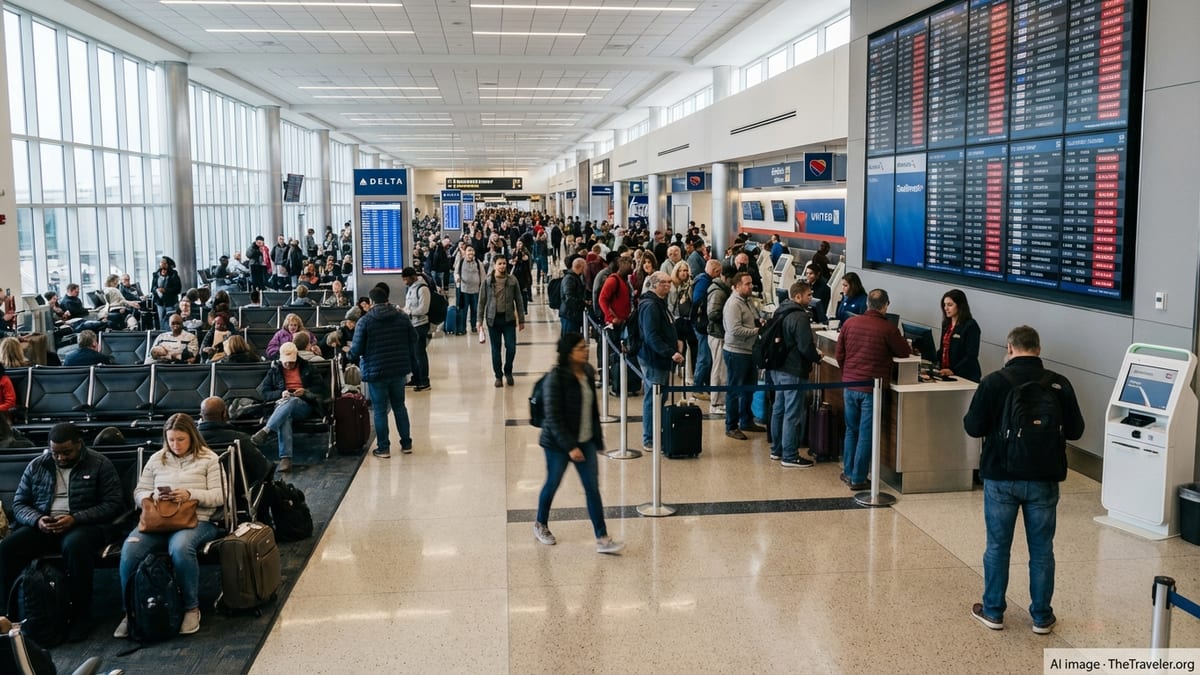
For passengers at Detroit, the visible result is a departure board dominated by yellow and red status markers rather than green on time indicators. Many flights are leaving later than scheduled, while a smaller number are listed as canceled, prompting rebookings onto already busy later departures.
Travelers connecting through Detroit are especially affected, as even moderate delays on inbound flights can leave too little buffer for tight connections. Some are being re-accommodated on alternative routings through other hubs, adding travel time and complexity to journeys originally planned as simple one stop itineraries.
Publicly available information indicates that wait times at check in counters and gate podiums can lengthen when multiple departures encounter issues at once. Passengers seeking seat changes, standby options or clarification on new arrival times often converge on the same limited staff resources, slowing the flow of assistance even when airlines deploy additional personnel.
In the terminals, irregular operations also contribute to crowding around power outlets and seating areas as travelers extend their dwell time. Retail and food concessions can see surges in demand as people wait out rolling delays, while ground transport providers may need to adjust for shifting arrival patterns when late night flights land much later than intended.
Advice for Passengers Flying Through Detroit
With 106 flight delays and four cancellations already recorded, travelers booked to fly through Detroit are being advised by publicly available guidance and aviation tracking platforms to monitor their flight status closely before leaving for the airport. Same day updates through airline apps and airport information screens remain the most immediate way to track changing departure times and gate assignments.
Passengers holding tight connections through Detroit may benefit from looking for earlier feeder flights where possible or selecting itineraries with longer layovers when booking new travel. Industry data on delay patterns show that additional connection time can significantly reduce the risk of missed onward flights during periods of widespread disruption.
For those already at the airport, checking in digitally and arriving at the gate well ahead of revised boarding times can help protect their place on flights that are attempting to depart as soon as crews and aircraft are ready. When cancellations occur, travelers who respond quickly through mobile rebooking tools or self service kiosks generally have access to a wider range of remaining options.
While the current wave of interference at Detroit may ease as the day progresses and airlines work to realign schedules, the incident underscores the continuing sensitivity of the U.S. air travel system. Even a relatively small number of cancellations combined with more than one hundred delays at a single major hub can ripple widely across the national network, affecting passengers far beyond the city’s immediate catchment area.