

More news on this day
Holiday travelers moving through Dallas Fort Worth International Airport on Easter Saturday faced a chaotic start to the long weekend as more than 100 flights were delayed or canceled amid stormy weather and already strained spring schedules.
Get the latest news straight to your inbox!
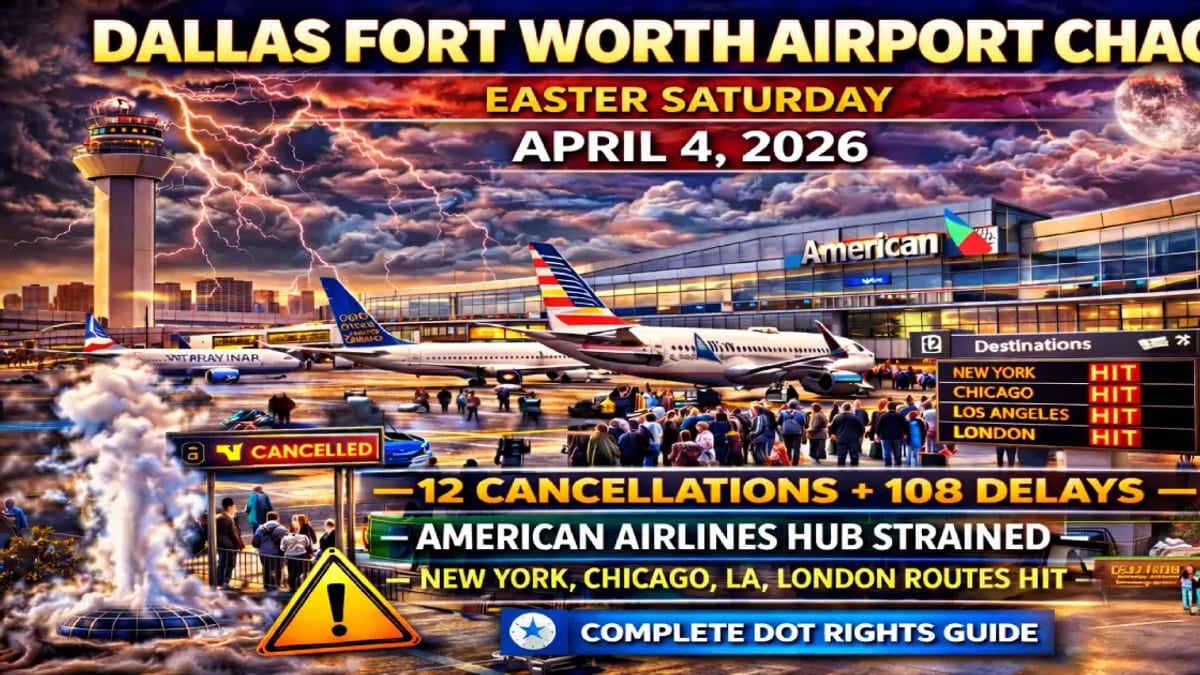
Stormy Skies and Holiday Crowds Collide
The disruptions at Dallas Fort Worth International unfolded as scattered thunderstorms and unstable spring conditions swept across North Texas, creating a difficult operating environment for one of the nation’s busiest hubs. Reports from regional outlets indicate that bands of heavy rain and lightning pushed through the Metroplex during peak departure periods, triggering spacing requirements in the air and slower movements on the ground.
The timing could hardly have been worse. Easter weekend sits near the height of the U.S. spring travel surge, when school holidays, family visits and early warm weather trips converge. Industry tracking data for early April already shows elevated delay volumes at major hubs across the country, with Dallas Fort Worth repeatedly appearing among airports with the highest share of affected flights.
At Dallas Fort Worth, preliminary tallies from flight-tracking services for Easter Saturday pointed to more than 100 combined delays and cancellations, with the vast majority clustered around the morning and early afternoon banks. While that figure falls short of the most severe events the airport has endured in recent years, it was enough to ripple through connections and strand travelers across multiple terminals.
Publicly available arrival and departure boards showed delay windows stretching from 45 minutes to well over two hours on some routes, particularly those feeding into or out of weather-affected regions in Texas and the broader South Central United States.
American’s Superhub Bears the Brunt
Dallas Fort Worth serves as the primary superhub for American Airlines, and operational data from recent Texas weather events underscores how dependent the region’s air traffic is on the carrier’s ability to keep its complex schedule intact. Earlier this spring, tracking analyses of a statewide disruption showed American accounting for well over a hundred individual delays at Texas airports in a single day, far outpacing any competitor.
On Easter Saturday, a similar pattern emerged. Available schedules and day-of-performance data indicate that American and its regional affiliates operated the bulk of the flights impacted at Dallas Fort Worth, with smaller carriers experiencing knock-on delays as they waited for aircraft or gate space to free up. Flights on American’s regional partners, which often turn aircraft quickly on shorter routes, appeared especially vulnerable to cascading hold times as weather and congestion combined.
For travelers, that translated into missed connections on eastbound transcontinental routes, rolling departure estimates on popular leisure services to Florida and Mexico, and extended waits on short-haul links to nearby cities such as Austin, San Antonio and Oklahoma City. Passengers arriving from outstations where weather was clear often found themselves held at gates or on taxiways in North Texas as air traffic managers slowed the flow of arrivals into the congested hub.
Because Dallas Fort Worth feeds so much of American’s national and international network, disruptions there tend to reverberate broadly. Industry analysts note that even a few hours of reduced arrival and departure capacity can create scheduling challenges that extend well into the evening, particularly when aircraft and crews are already tightly allocated during busy holiday periods.
Ground Stops, Capacity Cuts and Systemwide Ripples
Weather impacts at Dallas Fort Worth rarely occur in isolation. Earlier in March, a round of strong storms forced a temporary ground stop at the airport, resulting in hundreds of delays as air traffic managers held departures and arrivals until conditions improved. Similar tactics appeared to be used over Easter weekend, with published Federal Aviation Administration status updates showing intermittent traffic management initiatives that effectively reduced hourly throughput.
When traffic managers impose these measures, arrivals are spaced farther apart for safety, and departing flights may be held at the gate or on taxiways until slots open in the national airspace system. On a normal day, Dallas Fort Worth has enough buffer in its schedule to absorb some of that friction. On a peak holiday Saturday, with nearly every seat sold and connection banks tightly packed, the impact is magnified.
Industry-wide data for early April indicates that spring storms across multiple hubs, including in Texas, contributed to hundreds of cancellations and thousands of delays nationwide in recent days. While the bulk of those issues were concentrated in the most weather-exposed airports, even secondary markets without storms on the radar experienced knock-on effects as crews and aircraft were diverted, delayed or out of position.
Travelers connecting through Dallas Fort Worth on Easter Saturday reported via social platforms and local coverage that rebooking options were limited on many routes later in the day, as subsequent flights filled with displaced passengers. Some airlines opened limited fee waivers or flexible rebooking windows for affected travelers, although these policies varied by carrier and route.
Passengers Navigate Crowded Terminals and Tight Options
Inside the terminals, the operational strain translated into long lines at customer service counters, packed gate areas and scarce seating around power outlets. Photos and accounts shared in local media and on social channels showed families camped out on the floor near gate podiums, while departure screens cycled through a familiar mix of status messages such as “Delayed,” “Gate Hold” and “Flight Time Pending.”
Given the holiday context, many of those affected were traveling in groups or with children, compounding the stress of extended waits. Retail and dining outlets inside the terminals saw steady traffic throughout the day, but travelers reported that some locations ran low on popular grab-and-go items as delays stretched longer and more people remained behind security.
Ground transport was affected as well. Rideshare pickup areas and taxi queues experienced uneven surges as clusters of delayed flights finally departed or arrived in bursts. Rental car counters, already busy with Easter weekend demand, saw additional pressure from passengers opting to abandon delayed flights in favor of long drives to nearby cities when practical.
Airport planning documents and past performance analyses suggest that Dallas Fort Worth has invested heavily in terminal expansion, roadway improvements and new technology to manage high volumes, but the Easter Saturday episode highlighted how quickly even a modern mega-hub can become strained when weather and peak demand collide.
Resilience Questions as Spring Travel Peaks
The Easter Saturday disruption adds to a growing list of recent high-impact events at Dallas Fort Worth, ranging from winter storms that prompted advance cancellations in January to severe weather systems that forced ground stops and large delay totals earlier in March. Federal aviation statistics for the most recent fiscal year identify Dallas Fort Worth among the U.S. airports with the highest absolute number of cancellations, reflecting both its size and its exposure to volatile regional weather.
Aviation analysts point out that, while overall cancellation rates across major U.S. hubs have improved compared with several years ago, extreme peaks on busy travel days remain common, particularly when multiple storm systems line up over the central and eastern United States. In that environment, a single day with more than 100 disrupted flights at a hub like Dallas Fort Worth is increasingly viewed as a symptom of broader systemic pressures rather than an isolated failure.
For travelers, the lesson is familiar but increasingly urgent. Industry guidance and consumer advocates consistently recommend building extra connection time into itineraries that pass through weather-prone hubs during spring and winter, monitoring forecasts closely in the 48 hours before departure and considering earlier or nonstop flights where possible to reduce exposure to knock-on disruptions.
As the spring break and Easter period gives way to the summer travel rush, Dallas Fort Worth’s Easter Saturday chaos offers a fresh reminder that even routine thunderstorms can quickly snarl operations when schedules are saturated. With leisure demand expected to remain strong and airlines running near capacity on peak days, the margin for error at large hubs is likely to remain thin in the months ahead.