

More news on this day
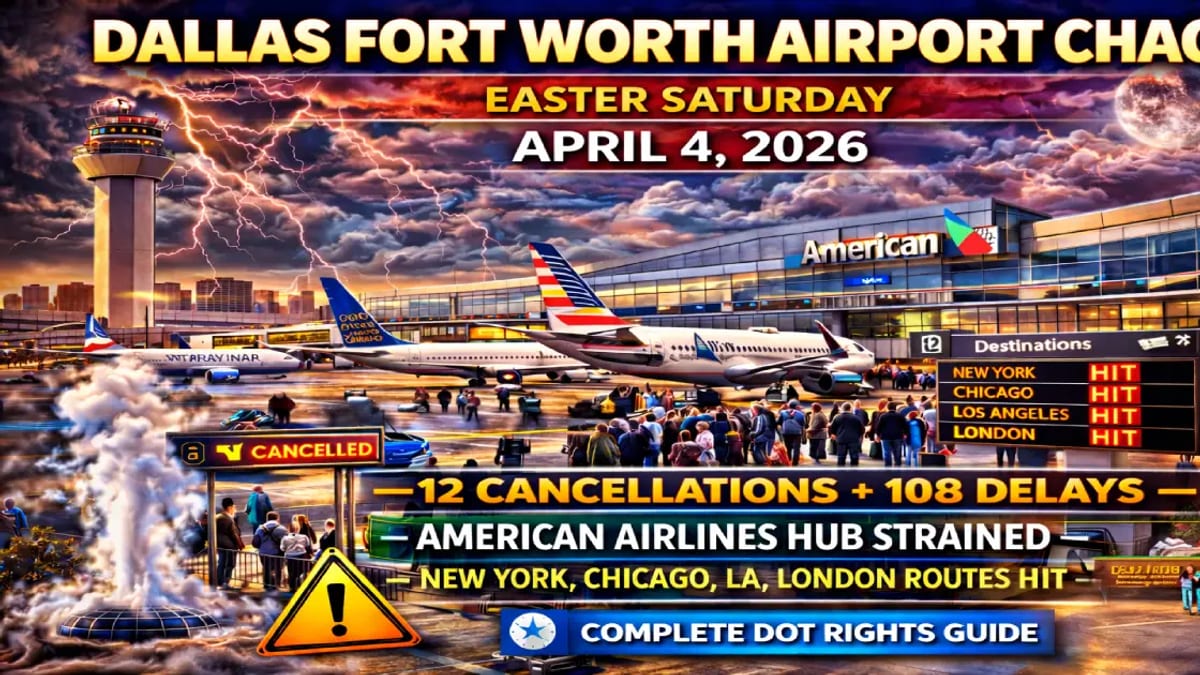
Holiday travelers faced an unexpectedly turbulent Easter Saturday at Dallas Fort Worth International Airport as more than 100 flight delays and cancellations rippled through one of the nation’s busiest hubs, disrupting connections and complicating family travel plans across the country.
Get the latest news straight to your inbox!
Storm Systems and Holiday Crowds Converge
Preliminary data from flight-tracking services indicated that by late afternoon on Easter Saturday, Dallas Fort Worth International Airport had recorded more than 100 combined delays and cancellations, placing it among the most disrupted airports in the United States for the holiday period. The numbers continued to fluctuate through the evening as airlines adjusted schedules and repositioned aircraft.
Weather models showed unsettled conditions across large swaths of the central United States over the Easter weekend, with pockets of strong storms and low cloud ceilings affecting key air corridors that feed into and out of North Texas. Publicly available aviation data and meteorological summaries pointed to a familiar pattern for the airport, where fast-forming thunderstorms and shifting wind patterns can quickly force ground delays and traffic management programs.
The timing could hardly have been worse. Easter Saturday falls within one of the peak travel windows of the spring season, overlapping with school holidays and early spring break trips. Industry statistics for recent years show that DFW routinely handles close to 200,000 passengers per day during busy holiday stretches, magnifying the impact when even a modest percentage of flights is disrupted.
Operational planning guidance from federal aviation authorities describes how, during such weather events, flights bound for DFW may be metered or held at origin airports to manage arrival flow, while departures can face extended waits for new takeoff slots. The result for travelers is often a rolling wave of missed connections, overnight rebookings, and unexpected expenses.
DFW’s Role as a National Chokepoint
Dallas Fort Worth International ranks among the top three busiest airports in the world by passenger volume, and recent federal air traffic reports identify it as one of the leading U.S. hubs for total annual cancellations. That scale means that any disruption in North Texas can rapidly echo across airline networks, particularly for domestic routes that rely on DFW as a central connecting point.
According to publicly available flight-operations data, many of the delays and cancellations on Easter Saturday were concentrated among large network carriers that operate fortress hubs at DFW, along with their regional affiliates. When weather or congestion constrains arrivals, airlines often reduce frequencies on shorter routes, consolidate lightly booked flights, or cancel late-night legs to reset aircraft and crew for the following day.
Industry analysts note that the impact extends well beyond Texas. A single bank of delayed DFW departures can affect travelers on routes ranging from smaller Midwest and Southeast cities to major coastal destinations, as passengers arriving late into Dallas miss connecting flights and must be rebooked on already crowded itineraries. Downline airports frequently report spikes in late-evening arrivals and baggage issues when a hub like DFW falls behind schedule.
Recent federal data on air traffic trends has also highlighted how DFW’s rapid growth has strained capacity at peak times. While runway infrastructure and modernized airspace procedures have increased throughput, periods of intense demand, such as Easter weekend, leave little margin when storms or technical glitches appear.
Travelers Confront Packed Terminals and Tight Rebookings
With more than 100 flights disrupted, images and accounts circulating on social media throughout the day showed crowded gate areas, long customer-service queues, and families spread out across terminal floors waiting for updated departure times. Some travelers reported being automatically rebooked on flights departing on Easter Sunday or even later, particularly on routes that operate only a few times per day.
Published travel coverage in recent years has underscored how quickly a modest wave of cancellations at DFW can saturate nearby hotels and rental car inventories, forcing passengers to make difficult choices about whether to stay in the terminal, arrange alternative ground transport, or reroute through other hubs. On Easter Saturday, similar patterns appeared to emerge, with travelers describing difficulty finding same-day alternatives out of North Texas.
Consumer advocates point out that holiday disruptions can be especially stressful because journeys often involve family gatherings, religious observances, or once-a-year vacations. When flights do not operate as scheduled, travelers may lose prepaid lodging nights, miss events, or face additional childcare and work complications once they return home.
Airlines operating through DFW typically encourage customers to use mobile apps to track flight status and, when large-scale disruptions occur, may temporarily relax change-fee policies or offer limited waivers on fare differences. However, during high-demand periods such as Easter weekend, available seats on alternate flights can be scarce, and many passengers still end up spending long hours in the terminal.
Patterns of Disruption at a Weather-Sensitive Hub
While Easter Saturday’s troubles were unwelcome for travelers, they fit into a broader pattern at Dallas Fort Worth, where severe and fast-changing weather has repeatedly triggered operational challenges. Over the past two years, published reports have documented multiple ground stops and large waves of delays at the airport tied to winter storms, powerful thunderstorm lines, and even non-weather technical outages.
In one recent case, telecommunications issues affecting air traffic systems led to hundreds of delays and nearly 200 cancellations in a single day at DFW and Dallas Love Field, according to national wire service reporting. Separate coverage of spring and summer storms has described days when more than 500 flights were delayed and well over 100 canceled across the Dallas airspace as hail, lightning, and high winds made takeoffs and landings unsafe.
Federal aviation data released this year shows that cancellations at the largest U.S. airports declined overall in the most recent fiscal period, yet DFW still ranked among the top hubs in absolute numbers of flights scrubbed. Analysts attribute this to a combination of high traffic volume, complex hub-and-spoke scheduling, and the meteorological volatility of North Texas, particularly during transition seasons such as March and April.
For travelers, that pattern means that Easter, Memorial Day, Labor Day, and other holiday weekends that fall during storm-prone months carry an elevated risk of disruption when using DFW as a connection point, compared with airports in regions that experience more stable spring weather.
What Travelers Can Do Ahead of Future Holiday Weekends
The Easter Saturday disruptions at DFW are likely to prompt some travelers to rethink how they plan future holiday trips through major hubs. Travel advisories and consumer guides commonly recommend building longer connection times when routing through weather-sensitive airports, especially during transitional seasons or historically busy weekends.
Experts in airline scheduling and passenger rights note that while travelers cannot control weather or air traffic constraints, they can take steps to reduce the impact. These include choosing earlier departures, avoiding the last flight of the day on critical legs, and monitoring forecast discussions and airport delay maps in the days leading up to a trip.
Publicly available airport planning documents for DFW emphasize efforts to expand terminal amenities, add seating and concessions, and improve digital wayfinding tools, all intended to make long waits more manageable. Even so, Easter Saturday showed that when storms and heavy traffic converge, passengers can still find themselves facing long lines, crowded spaces, and uncertain departure times.
With spring and summer travel ramping up, the Easter weekend chaos at DFW serves as another reminder that the nation’s largest hubs remain vulnerable to sudden operational shocks. For many passengers caught in the middle of the latest disruption, the experience underscored how a single day of delays and cancellations at a key connecting airport can ripple through an entire holiday.