

More news on this day
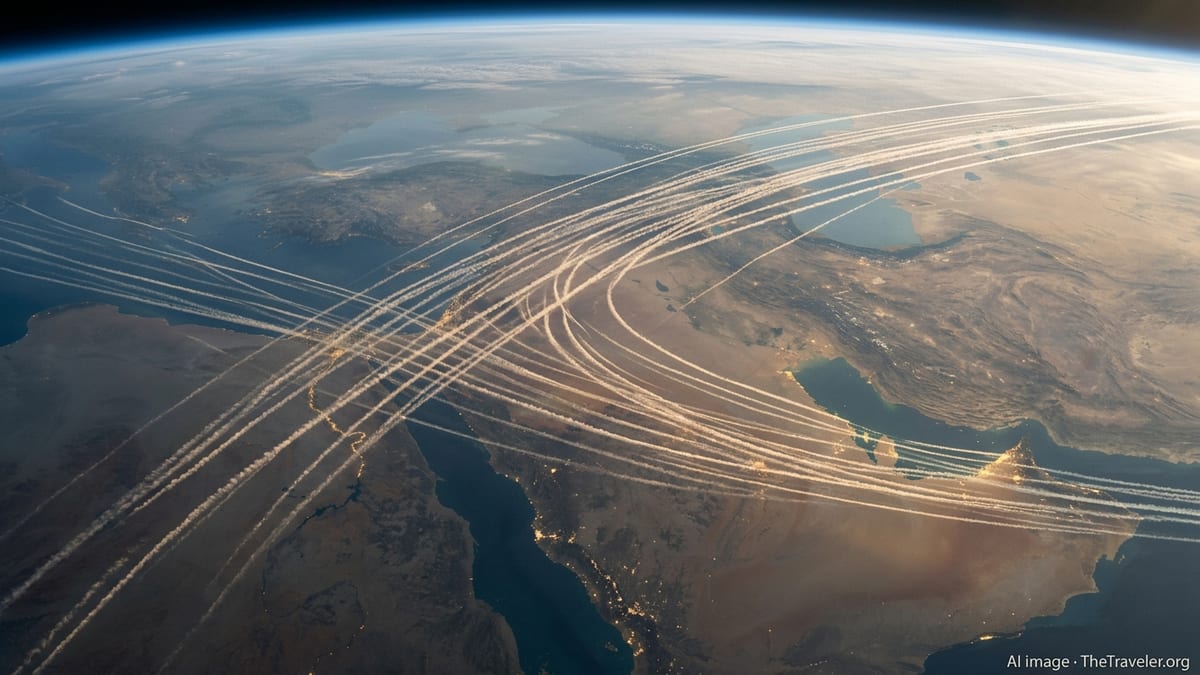
India’s aviation regulator has ordered airlines to steer clear of multiple high-risk airspaces across the Middle East, including Jordan, Bahrain, Lebanon, Qatar, the United Arab Emirates and Israel, as escalating regional tensions and recent strikes have transformed one of the world’s busiest flight corridors into a complex patchwork of closures, detours and rolling cancellations.
Get the latest news straight to your inbox!
What the DGCA’s Emergency Advisory Actually Says
India’s Directorate General of Civil Aviation has issued a safety advisory instructing Indian carriers to avoid the airspace of 11 countries in West Asia and the Persian Gulf region. According to widely reported details of the notice, the list covers Iran, Israel, Lebanon, the United Arab Emirates, Saudi Arabia, Bahrain, Oman, Iraq, Jordan, Kuwait and Qatar. The advisory, framed around the risk to civil aviation in Middle East and Persian Gulf airspace, is described as a precautionary response to a sharp escalation in regional conflict and missile activity.
Publicly available information shows that the advisory took effect immediately and is currently valid until 2 March 2026, unless revised earlier. The document urges airlines to refrain from operating within the affected airspaces and to rely on detailed risk assessments and established contingency procedures for any unavoidable operations in adjacent regions. The language closely mirrors guidance from the European Union Aviation Safety Agency, which has described the same region as a high-risk environment for civil aviation due to the potential for long-range missile launches and military activity.
The Indian regulator’s move comes in the wake of joint United States and Israeli strikes on Iran and subsequent Iranian drone and missile attacks targeting American and allied facilities across the region. These developments have prompted multiple states, including Jordan and Gulf countries, to tighten airspace controls, issue their own risk notices and, in some cases, temporarily close skies to overflights. The DGCA advisory seeks to align Indian operators with the most conservative interpretation of current conflict-zone guidance.
Jordan and Regional Neighbours Tighten Their Skies
Jordan’s inclusion on the DGCA’s high-risk list reflects its proximity to recent missile and drone trajectories rather than a direct conflict with civil aviation. During recent flare-ups, Jordan’s civil aviation authorities have on occasion restricted or briefly closed segments of national airspace as a precaution, reopening once risk assessments permitted. According to regional media coverage, those closures were primarily driven by the transit of military projectiles and the activation of joint air defence networks rather than any targeted threat to commercial flights.
Elsewhere in the Levant and Gulf, a similar pattern has emerged. Reports from airline hubs in the United Arab Emirates, Qatar and Bahrain indicate that carriers have had to suspend or curtail operations to destinations in Iran, Iraq, Jordan, Lebanon and Israel at various moments as host states adjusted airspace permissions. In some cases, hub airports have temporarily paused departures and arrivals while traffic was rerouted or stacked around the periphery of closed flight information regions, leading to extensive knock-on delays and diversions across Asia–Europe traffic flows.
Published coverage from regional aviation analysts notes that Lebanon and Israel continue to be treated with particular caution because of their exposure to cross-border rocket and missile fire and their location on the frontline of several active fault lines. Airlines are therefore not only avoiding direct services to these markets but also treating overflight routes near their borders with heightened scrutiny. Jordan, which lies immediately east of Israel and the Palestinian territories, is affected both by defensive missile intercepts over its territory and by the need to host rerouted air traffic skirting higher-risk zones further west.
How Rerouting Is Reshaping Long-Haul Travel
The DGCA’s instruction to avoid 11 Middle East airspaces has immediate operational consequences for Indian and international airlines that rely on traditional West Asia corridors to connect South and Southeast Asia with Europe, Africa and the Americas. According to recent tallies reported by Indian and business media, more than 170 flights linked to India were cancelled over a short period as carriers recalibrated schedules, and many more were significantly delayed. Major Indian airlines have temporarily suspended services to several Middle Eastern destinations and reduced frequencies on some European routes while they work through alternate routings and crew duty constraints.
Rerouting around the affected airspaces can add hundreds of nautical miles to a typical India–Europe or India–North America journey. Operators are using more northerly tracks that skirt conflict zones via Central Asia, the Caucasus or southern Europe, or more southerly options that loop over the Arabian Sea and then into Africa. These longer paths increase fuel burn, require additional contingency fuel and can push aircraft and crew close to duty-time limits, which in turn can force extended ground times or unscheduled technical stops.
Travelers are already encountering the visible impact of these changes in the form of extended block times, last-minute schedule shifts and crowded departure halls at major hubs. Passenger reports from airports in India and the Gulf describe busy transfer zones as airlines consolidate disrupted flights, with some carriers arranging relief services on select long-haul links where demand and aircraft availability permit. While safety protocols remain the overriding priority, airline planners are having to balance operational resilience with commercial pressure on key trunk routes that underpin much of global east–west travel.
What Passengers Flying via the Middle East Should Expect
For travellers with upcoming itineraries touching the Middle East, the current situation means planning for uncertainty and building flexibility into journeys. Airlines operating from India and other Asian markets are offering rebooking options, full refunds in some cases and periodic updates through their official channels. However, publicly available reports show that schedule changes often roll out in waves as new airspace notices are issued or extended, so disruption can appear with limited warning even after an initial adjustment seems settled.
Passengers whose flights would normally overfly Iran, Iraq, Jordan, Israel or neighbouring airspaces without landing should also anticipate potential changes. Even when a destination remains open, the need to route around conflict zones can lengthen flight times and compress connection windows at European or Asian hubs. Travel experts cited in recent coverage advise allowing longer minimum connection times, avoiding tight back-to-back itineraries and monitoring flight status frequently in the 24 hours before departure.
Insurance considerations are another factor. Some travel insurance policies treat conflicts and war-related disruptions differently from standard operational delays. International consumer reporting suggests that travellers should review policy wording closely to understand coverage for missed connections, extended hotel stays, or alternative transport arrangements if a route becomes unviable at short notice. Where coverage is limited, booking flexible or refundable fares may provide an extra layer of protection.
Why Aviation Authorities Are So Cautious About Conflict Zones
The broad geographic scope of the DGCA advisory underscores how conservative regulators have become about conflict-zone overflights in the decade since several high-profile aviation incidents highlighted the potential consequences of flying near active fronts. International safety frameworks now lean heavily on precaution, with agencies such as the European Union Aviation Safety Agency and national civil aviation authorities issuing detailed conflict-zone information bulletins whenever missile or drone activity could intersect with air traffic corridors.
According to recent technical guidance, the primary concern is not only direct targeting of civilian aircraft, which remains rare, but the possibility that long-range weapons, air defence systems or misidentified radar tracks could inadvertently affect high-altitude traffic. In complex theatres like the Middle East, where multiple state and non-state actors operate advanced weapons systems in overlapping airspace, this risk is magnified, especially during periods of high tension when the pace of launches and intercepts accelerates.
As a result, regulators and airlines use layered risk assessments that consider weapon ranges, known launch sites, previous trajectories and the proximity of military bases and strategic infrastructure. When those assessments cross certain thresholds, the default response is to avoid the relevant airspaces entirely, even at significant commercial cost. For travellers and the broader tourism sector, the near-term effect is disruptive, but aviation safety specialists argue that such caution has become a necessary element of operating global air networks in an era of increasingly unpredictable regional conflicts.