

More news on this day
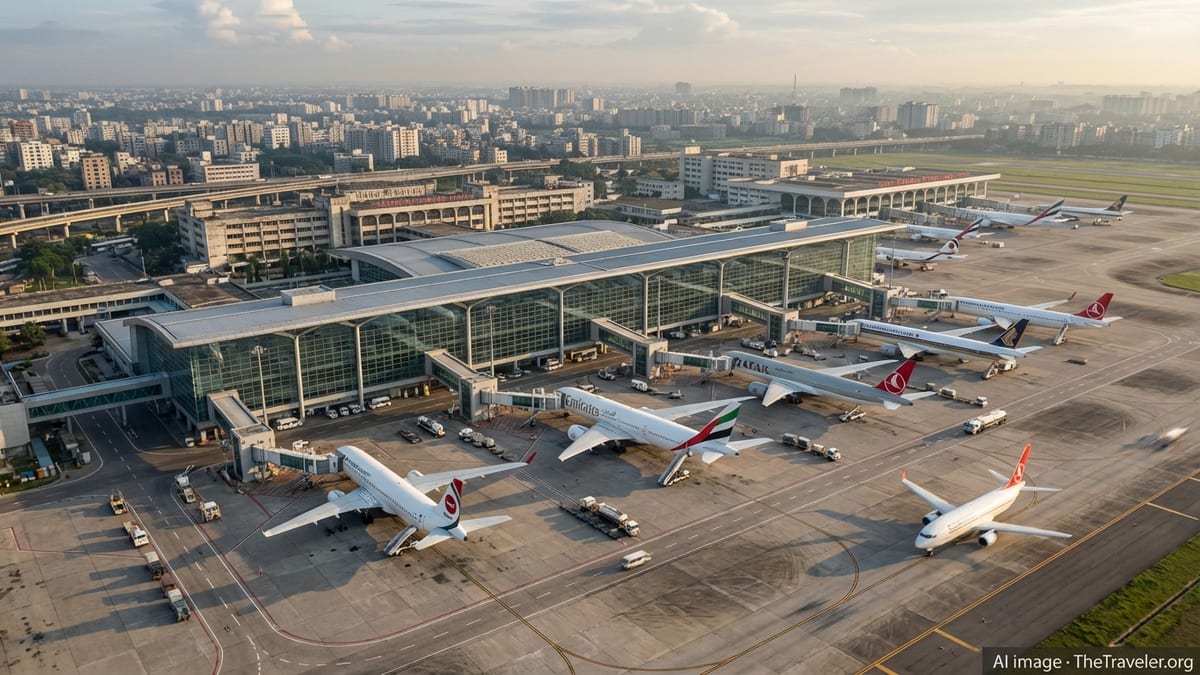
Dhaka’s Hazrat Shahjalal International Airport is edging closer to a full opening of its vast new third terminal, a JICA-backed project that could upend regional traffic flows between South Asia and East Asia and reposition the Bangladeshi capital on the global aviation map.
A Delayed Megaproject Nears the Finish Line
Nearly a decade after it was first approved, Dhaka’s new third terminal is finally pushing toward full-scale operations, with government officials now talking in terms of months rather than years. The sprawling facility, part of a multi-billion-taka expansion financed largely through soft loans from the Japan International Cooperation Agency, has already undergone a soft inauguration but is still in the final stages of operational readiness.
Recent briefings by the Civil Aviation Authority of Bangladesh indicate that physical construction is effectively complete and attention has shifted to staffing, system calibration and signing a long-term operation and maintenance deal with a Japanese-led consortium. Bangladeshi authorities have publicly insisted that they want service quality at the new terminal to match leading Asian hubs, in part to justify the cost of the project and ensure the JICA loans can be serviced through future aviation revenues.
When the terminal is fully opened, overall passenger capacity at Hazrat Shahjalal International Airport is expected to triple to around 24 million travellers a year, with cargo capacity jumping to roughly half a million tonnes. For global travellers, that scale matters: it is the difference between Dhaka remaining a constrained origin-and-destination market and emerging as a serious regional connection point between South Asia, Southeast Asia and North Asia.
JICA’s Fingerprints on Dhaka’s New Gateway
Japan’s role in Dhaka’s aviation future goes far beyond financing blueprints. JICA has been central to the design, funding and technical supervision of the third-terminal project, while Japanese engineering giants have led key construction packages. The involvement of Japanese partners has helped import design standards, passenger-flow concepts and systems integration more familiar to travellers used to Tokyo or Osaka than to an overburdened South Asian gateway.
At the same time, JICA has been more vocal in recent years about bureaucratic delays, cost escalations and coordination challenges affecting several large Bangladeshi projects, including the third terminal. Japanese officials have warned that persistent indecision could affect the pace and ambition of future lending. That dynamic helps explain why Dhaka is pushing hard to finalise an operating contract with a Japanese consortium and demonstrate that the terminal can be run on commercial, efficiency-focused lines.
For international passengers, the upshot is that Dhaka’s new gateway is likely to reflect a hybrid: Japanese-influenced hardware and processes layered onto a fast-growing but still capacity-stretched South Asian aviation system. How smoothly that blend works in practice will be one of the key things global travellers will want to watch as operations ramp up.
Tokyo Links and a Shifting South Asian Aviation Map
The most immediate international beneficiary of Dhaka’s expanded capacity is expected to be Japan itself. Bangladeshi expatriate communities, apparel trade ties and investor flows have already created sustained demand between Dhaka and Tokyo, and the new terminal offers scope for airlines to add frequencies and experiment with new Japanese and North Asian city pairs once more gates and slots are available.
Today, many Bangladeshi and regional travellers heading to Japan route via hubs such as Singapore, Doha or Kuala Lumpur. A fully functional third terminal, coupled with improved ground access from Dhaka’s elevated expressway network, could support more nonstop or one-stop itineraries using Dhaka as the primary South Asian gateway for Japan-bound traffic. That would subtly redraw the regional map, shifting some flows away from Gulf and Southeast Asian hubs and toward a Dhaka–Tokyo axis.
More broadly, aviation planners in South Asia are watching to see whether Dhaka can carve out a niche as a mid-range connector: shorter stage lengths to East and Southeast Asia than from many Indian interiors, competitive labour and handling costs, and a large pool of migrant and business travellers. If the third terminal delivers on promises around turnaround times, baggage handling and transfer convenience, airlines could start to schedule Dhaka as a spoke for secondary South Asian cities and as a feed point into Japanese and East Asian networks.
Operational Hurdles, Safety Questions and Passenger Experience
Despite the optimism, there are significant caveats global travellers should keep in mind. Bangladesh’s aviation authorities still face criticism over delays in contracting a professional operator, allegations of cost overruns and questions about how fast thousands of staff can be trained to run a facility designed to international hub standards. Industry stakeholders have warned that any gap between design capacity and real-world performance could quickly translate into queues, missed connections and inconsistent service.
Safety and resilience challenges also loom in the background. Dhaka’s main airport has become increasingly hemmed in by dense urban development and high-rise construction, prompting concerns from aviation experts about obstacle clearance and approach safety. Disruptive incidents, from fires to weather-related shutdowns, have in the past forced diversions of Dhaka-bound flights to other regional airports, underlining the need for robust contingency planning even as the new terminal opens.
For travellers, that means the early months of full operation are likely to involve a mix of impressive new infrastructure and teething problems. Check-in halls, immigration zones and baggage systems are being designed for high throughput, with more counters, e-gates and screening capacity than the older terminals. But the real test will be how consistently those systems function during peak hours, holiday surges and regional weather disruptions that frequently ripple across South Asia’s airspace.
What Global Travellers Should Watch in the Coming Year
For frequent flyers, tour operators and corporate travel planners, the next 12 to 18 months will be pivotal in determining whether Dhaka’s third terminal becomes a reliable transit option or remains primarily a capacity release valve for local traffic. Key signals to monitor include the signing and implementation of a long-term operating contract, announcements of new or expanded Dhaka–Tokyo and broader Japan services, and early data on on-time performance and baggage-handling reliability from the new facility.
Travellers considering itineraries that route through Dhaka should pay close attention to how quickly airlines begin marketing through-connections and whether minimum connection times fall as operators gain confidence. If major carriers start scheduling tight connections via the third terminal, it will be a sign that behind-the-scenes processes are working well enough to support hub-style operations.
Equally important will be feedback from passengers themselves. Reports on transfer signage, security screening times, availability of lounges, quality of food and retail options, and the ease of moving between international and domestic sections will shape perceptions far beyond Bangladesh’s borders. As Dhaka bids to reposition itself as a bridge between South Asia and Tokyo and the wider East Asian market, the lived experience of global travellers passing through its new gateway will ultimately determine whether the ambitious JICA-backed project truly shifts the region’s aviation map.