

More news on this day
Thousands of air travelers across the United States are facing mounting delays and uncertainty as a prolonged budget standoff over Homeland Security funding disrupts airport security operations and raises the prospect of partial airport closures in the weeks ahead.
Get the latest news straight to your inbox!
Homeland Security Funding Lapse Enters Tense New Phase
The ongoing lapse in funding for the Department of Homeland Security, which began on February 14, 2026, has evolved into a sustained partial shutdown that is increasingly visible to travelers at airport checkpoints. Publicly available information shows that Transportation Security Administration employees are among the DHS staff required to work without pay, a situation now stretching past the one month mark.
The political dispute centers on immigration enforcement policy and the broader Homeland Security appropriations bill. Congressional negotiators have repeatedly failed to unlock full-year funding, leaving TSA and other security agencies operating on emergency footing. According to budget summaries and legislative records, proposals to separate TSA funding from more contentious border and immigration provisions have stalled, extending uncertainty for both aviation workers and passengers.
As the impasse drags on, travel industry analysts note that the current disruption is layered on top of long-running staffing challenges at U.S. airports. Previous shutdowns and years of strained hiring pipelines for security screeners and air traffic controllers have left limited cushion in the system, making it harder for airports to absorb additional stress from unpaid work and rising absenteeism.
Recent congressional testimony and advocacy letters highlight concerns that forcing critical security staff to work indefinitely without pay risks both morale and retention. Observers warn that, even if funding is eventually restored, rebuilding staffing levels and experience could take many months, particularly at smaller airports that already struggle to recruit and retain personnel.
Long Lines, Closed Checkpoints and Warnings of Airport Closures
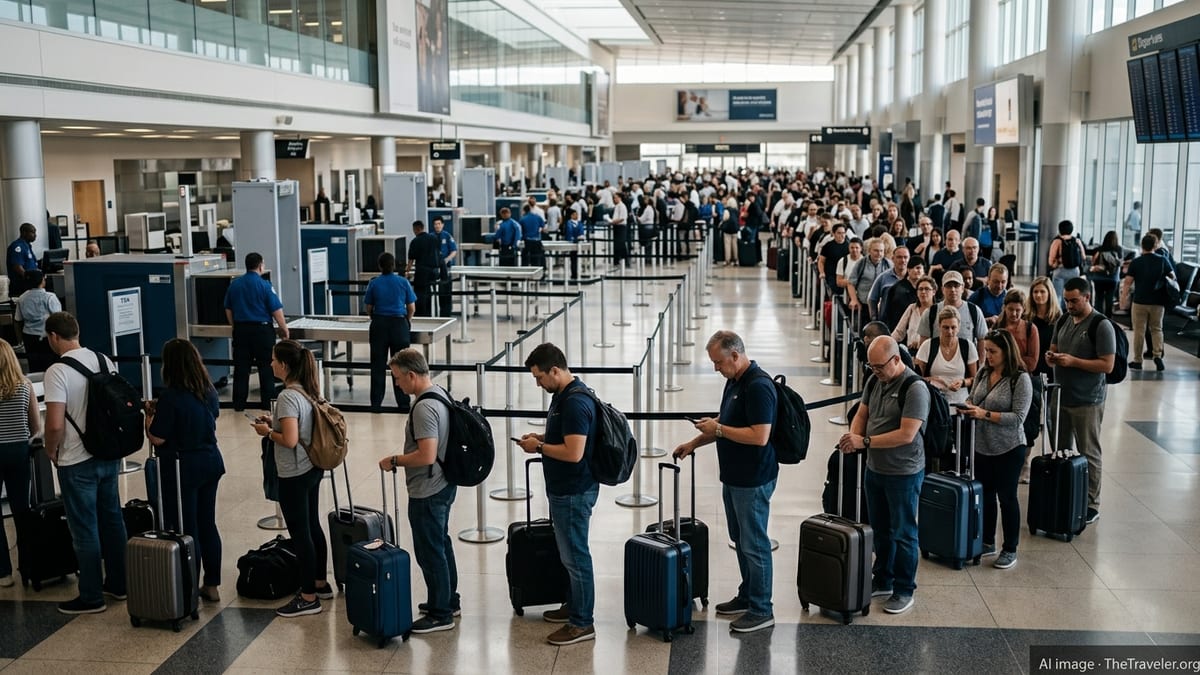
Travelers are already encountering the most concrete effects of the shutdown in front of security checkpoints. Local and national coverage indicates that wait times at major hubs such as Atlanta and Houston have stretched to hours at peak periods, with airlines advising passengers to arrive as much as four or five hours before departure to avoid missing flights.
At Philadelphia International Airport, several security checkpoints have been periodically closed because of staffing shortages, reducing capacity and funneling more travelers through a smaller number of open lanes. Reports indicate that more than one in five TSA officers at the airport called out on some days in late March, intensifying crowding and compounding delays for connecting passengers.
Airports and airlines have responded with a mix of mitigation measures. Some hubs have consolidated checkpoint operations to concentrate available staff, while others have deployed non-screening personnel to help manage lines and direct passengers. In certain cities, airport authorities have offered meal vouchers, transit passes or parking assistance to TSA staff in an effort to soften the impact of missed paychecks and encourage employees to keep reporting to work.
Federal transportation officials have begun to publicly warn that the trend may not be sustainable. Public remarks summarized by outlets such as Reuters and USA Today describe a scenario in which smaller regional airports, already operating with thin staffing, could face temporary closure of some or all security screening if absenteeism continues to climb. Such closures would effectively suspend commercial air service at those locations until funding is restored or staff levels stabilize.
Ripple Effects Across the National Air Travel Network
The strain on TSA operations is also feeding into broader disruptions across the national aviation system. Academic research on post-pandemic security bottlenecks has found that delays at high-volume airports can propagate through the network, increasing the likelihood of missed connections and downstream flight disruptions. The current shutdown appears to be reinforcing those patterns, as security slowdowns at major hubs ripple out to smaller destinations.
Carriers have begun adjusting schedules and issuing flexible travel waivers on select routes where bottlenecks are most severe. While flights themselves continue to operate, extended security lines mean more passengers are arriving at gates late or not at all, leading to higher rates of rebooking and stand-by travel. Travel advisers are urging passengers to build additional buffer time into connections that pass through the most affected airports, particularly during early morning and late afternoon peaks.
Meanwhile, air traffic control facilities are still recovering from the effects of the broader government funding turbulence that began in late 2025. Earlier shutdowns led to postponed hiring and training for new controllers and forced existing staff into mandatory overtime. Although those agencies are funded under different appropriations than TSA, the combined effect of controller shortages and security bottlenecks has made it harder for the system to absorb weather disruptions or other routine stresses without cascading delays.
Industry groups representing airlines, airports and aviation workers have issued a series of public statements warning that repeated funding lapses make it difficult to plan long-term investments in staffing, technology and infrastructure. They argue that even short shutdowns can have enduring effects on safety culture and operational resilience when they recur frequently or coincide with peak travel periods.
Travelers Adjust Plans as Summer Season Looms
The timing of the Homeland Security budget standoff is particularly sensitive for the travel sector, which is already planning for a busy late spring and summer season. Travel data providers report that domestic demand remains strong, with bookings for June through August tracking near or above last year’s levels. Persistent uncertainty over airport operations has left airlines and passengers alike weighing contingency plans.
Some travelers are shifting itineraries away from the most heavily affected hubs when possible, choosing alternative connections or driving to less congested airports. Others are opting for longer layovers to hedge against potential security delays. Travel advisers recommend scheduling early-day departures, when lines may be shorter and there is more slack later in the day to accommodate rebooking if something goes wrong.
For international visitors, the situation poses a reputational challenge for the United States as a destination. Tourism organizations have emphasized in public comments that security remains in place and flights are operating, but acknowledge that images of crowded checkpoints and frustrated travelers can deter future trips or push visitors to connect through foreign hubs instead.
Within the United States, there is growing concern that any move to temporarily close screening operations at smaller airports would disproportionately affect rural communities and regional economies. In those areas, local airports often serve as critical connectors for business travel, medical transport and tourism. If even a handful of such facilities were forced to suspend passenger screening, residents could be left facing long drives to the nearest functioning hub.
Uncertain Path Forward in Washington
As of late March, negotiations in Congress show little sign of a swift breakthrough. Public reporting from legislative sessions indicates that attempts to pass a stand-alone bill to restore TSA and related Homeland Security funding have encountered resistance from lawmakers who want to keep leverage over broader immigration policy changes.
Draft appropriations summaries circulated in recent weeks outline potential funding levels for TSA that would support additional security technology and staffing initiatives, but those provisions remain locked inside a larger Homeland Security package that has not cleared both chambers. Analysts following the process suggest that any eventual deal is likely to involve trade-offs on border enforcement tools and oversight mechanisms in exchange for reopening shuttered programs and paying unpaid workers.
For now, airport operators, airlines and TSA employees are preparing for the possibility that the current conditions could stretch further into the spring. Contingency planning has shifted from short-term schedule tweaks to more structural questions about how to keep essential security functions running if a significant share of trained staff leave for other jobs.
With each passing day of the shutdown, the tension between political brinkmanship in Washington and the practical realities of keeping passengers moving safely through U.S. airports becomes more acute. The outcome will shape not only the immediate travel experience, but also the resilience of the country’s aviation system heading into one of the busiest travel seasons of the year.