

More news on this day
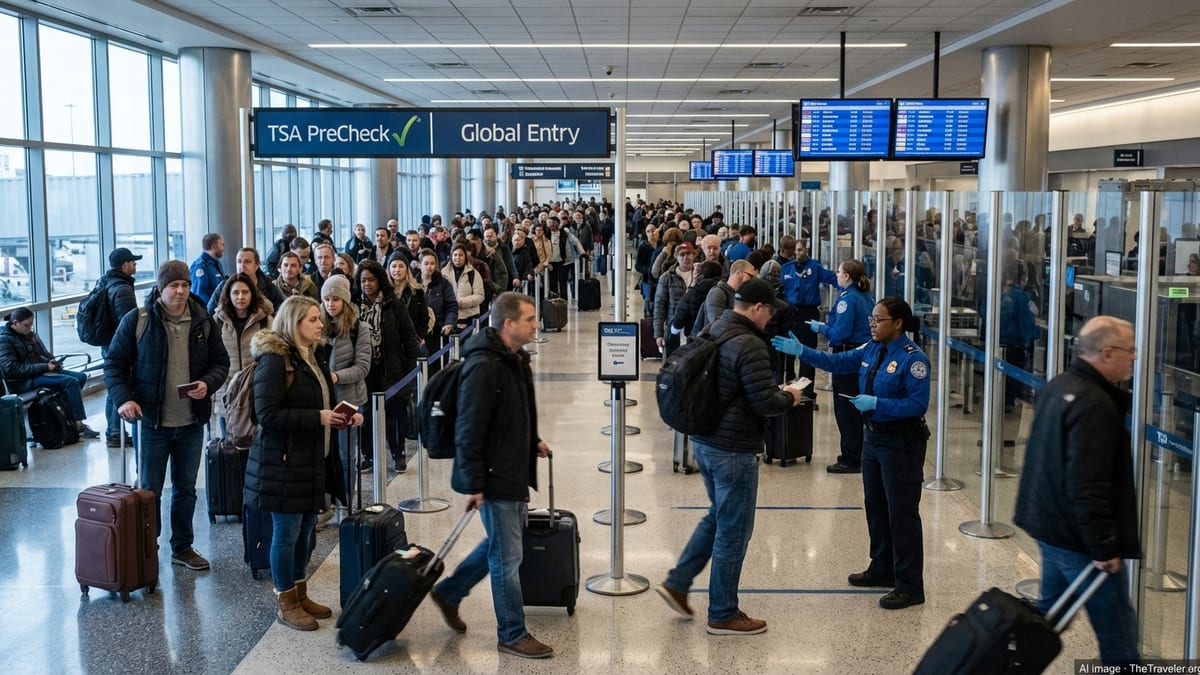
Millions of U.S. air travelers are bracing for longer lines and fresh uncertainty after the Department of Homeland Security moved Sunday to suspend the popular TSA PreCheck and Global Entry programs nationwide, the most visible sign yet of how a deepening Department of Homeland Security shutdown is rippling through the aviation system.
What Exactly DHS Is Suspending and When It Takes Effect
The Department of Homeland Security confirmed that both TSA PreCheck and Global Entry are being paused as of Sunday, February 22, 2026, at 6 a.m. Eastern, in response to a lapse in funding that has left the agency operating under partial shutdown conditions. The decision affects domestic travelers who rely on expedited security lanes at U.S. airports and international passengers who use automated kiosks and dedicated lanes to speed through U.S. customs and immigration checks.
Transportation Security Administration officials say travelers enrolled in PreCheck will no longer see the familiar designation on their boarding passes while the program is suspended. Instead, they will be funneled into standard security lines with the broader traveling public, subject to regular screening procedures, including shoe removal and separate laptop checks. At land borders and international arrivals halls, U.S. Customs and Border Protection officers are preparing to shut down Global Entry kiosks and reassign staff away from trusted traveler queues.
DHS insists the changes are temporary and framed them as a resource triage measure during the shutdown, rather than a permanent rollback of expedited screening. However, officials have not provided a concrete date for restoration, saying only that operations will resume once Congress and the White House resolve the budget impasse and full funding for the department is restored.
How the 2026 DHS Shutdown Triggered the Travel Clampdown
The suspension comes more than a week into a targeted shutdown that has hit only the Department of Homeland Security, after funding for the agency ran out on February 14, 2026. Lawmakers in Washington have been locked in a standoff over immigration enforcement and accountability for federal agents following high-profile fatal shootings, with Senate Democrats demanding policy changes as a condition for renewing DHS funding and Republicans resisting new restrictions.
While much of DHS, including frontline border and immigration operations, can continue for a time using mandatory funding and fee revenue, programs that depend on discretionary appropriations or are considered nonessential have quickly come under pressure. TSA PreCheck and Global Entry, both categorized as trusted traveler programs that offer expedited services to a subset of passengers, fell squarely into that category once the shutdown dragged on.
DHS Secretary Kristi Noem has argued that, with the department in a funding crisis, staff must be shifted away from what she described as “courtesy and special privilege” services and toward basic screening and security for the widest possible share of the traveling public. The shutdown is the third to hit DHS during the current Congress, and analysts say the latest confrontation is already proving more disruptive for the aviation sector than earlier episodes because it directly touches travelers’ day-to-day experience at checkpoints.
What Travelers Will See at Airports and Borders This Week
For travelers, the most immediate change will be at the security checkpoint. Airports that had grown accustomed to siphoning frequent flyers into PreCheck lanes now expect more passengers funneled into standard lines, especially during the morning and evening rush. Industry groups warn that major hubs could see waits jump sharply during peak periods, particularly at airports that already struggle with congestion and staffing gaps.
Passengers arriving from overseas will also feel the impact when they land at U.S. gateways. Global Entry kiosks that normally allow preapproved travelers to scan their passports and breeze past the main immigration queues are being shuttered for the duration of the funding lapse. Those travelers will be directed into regular lines, adding more volume to already busy customs halls at airports such as New York’s JFK, Los Angeles International and Miami International.
Travel agents and airline customer-service teams report a spike in questions from elite frequent flyers and business travelers who built their routines around expedited screening. Airlines are advising passengers to arrive earlier than usual, in some cases suggesting at least two hours in advance for domestic flights and three hours for international departures, even at airports that did not previously require that much lead time outside of peak holidays.
Who Is Affected: Current Members, Applicants and Renewals
The suspension reaches across the entire trusted traveler ecosystem, though its effects will vary depending on where travelers are in the enrollment cycle. Existing TSA PreCheck and Global Entry members will retain their underlying status, but they will not receive the practical benefits of that status at the airport or port of entry while the programs are offline. Their membership clocks will continue to run, meaning months lost to the shutdown will still count against the typical five-year validity period.
For travelers who have already applied but not yet completed the process, DHS has signaled that interviews, background checks and new approvals may be delayed or temporarily halted. Enrollment centers operated by TSA and CBP are bracing for reduced staffing or intermittent closures during the shutdown, making it harder for applicants to secure appointments. That could create a backlog that persists even after funding is restored, especially at high-demand locations in large metropolitan areas.
Pending renewals are another gray area that is likely to frustrate frequent travelers. Under normal conditions, some members whose renewals are in progress are allowed to keep using benefits for a grace period while their applications are processed. With the programs themselves paused, those courtesy extensions may offer little practical value, since the expedited lanes and kiosks they depend on are not in operation. Legal and travel experts say affected travelers should keep copies of their approval emails and account records in case questions arise later about membership timelines.
How Long Could the Suspension Last and What Comes Next
The duration of the freeze on TSA PreCheck and Global Entry will hinge entirely on how quickly Congress and the White House can break the impasse over DHS funding. Previous shutdowns have ranged from a few days to more than a month, and negotiators have yet to signal a clear path forward in this latest confrontation. With lawmakers currently on recess, there is little expectation of an immediate breakthrough.
Policy analysts note that the programs can be switched back on relatively quickly once funding is restored, since much of the infrastructure for PreCheck and Global Entry, from enrollment databases to airport signage, is already in place. The bigger challenge is likely to be catching up on pent-up demand for interviews, renewals and new applications, as well as recalibrating staffing at busy airports that have reshuffled personnel to manage the shutdown.
There is also a political dimension to the question of what comes next. Some lawmakers critical of the suspension have floated proposals that would attempt to firewall trusted traveler programs from future shutdowns by shifting more of their funding to user fees or placing them under different budget rules. Others argue that such steps could weaken congressional oversight or create a patchwork of protections that still leaves other critical DHS services vulnerable when budget showdowns escalate.
Airlines, Unions and Airports Sound the Alarm
The aviation industry has reacted with uncommon unity to the suspension. Major U.S. carriers and their trade groups have warned that abruptly shutting down expedited screening for millions of pre-vetted customers will have knock-on effects throughout the system. Carriers say longer security lines can cascade into delayed departures, missed connections and higher costs as airlines scramble to rebook stranded passengers and reposition aircraft and crews.
Airport authorities share those concerns, particularly at large hubs that already operate near capacity. Many airports have invested heavily in infrastructure designed around separate trusted traveler lanes and kiosks, and they now face the task of reconfiguring passenger flows almost overnight. Some are reallocating signage, stanchions and staff to expand general screening areas, but they acknowledge that there is only so much they can do without additional federal personnel.
Worker unions representing TSA officers and CBP agents have used the moment to highlight the strain on frontline staff. With most employees required to work without pay during the shutdown, officers are being asked to handle rising passenger volumes in standard lanes while also absorbing new duties as trusted traveler functions wind down. Union leaders warn that low morale and financial stress could drive more sickouts or attrition if the funding standoff persists, potentially compounding delays.
What Travelers Can Do Now to Minimize Disruption
While individual travelers cannot influence the broader budget fight, there are practical steps they can take to navigate airports and border crossings more smoothly while TSA PreCheck and Global Entry are suspended. Travel planners advise building in extra time, particularly for early-morning flights on Mondays and Fridays, when business travel peaks. Choosing flights at off-peak hours, when possible, can also help reduce exposure to the longest lines.
Travelers may want to pay closer attention to airport choice when flying to or from multi-airport cities. Secondary airports that typically see fewer passengers and shorter lines could become more attractive while expedited screening is offline, even if it means a slightly longer drive or fewer nonstop options. Checking real-time wait-time estimates posted by airport authorities or airline apps before leaving for the airport can provide a rough gauge of current conditions.
At international arrivals, passengers can speed their own processing by having documents ready and forms completed, keeping mobile phones charged for digital declarations where available, and following staff instructions to help keep lines moving. Frequent international travelers who previously relied on Global Entry kiosks may want to factor additional time into connections, particularly at tightly banked hubs where missed onward flights can strand passengers for hours.
The Broader Risk to Trusted Traveler Programs
The sudden suspension of TSA PreCheck and Global Entry has raised questions about the long-term resilience of trusted traveler programs that millions of passengers have come to view as a near-essential part of modern air travel. The shutdown has underscored how programs built to enhance efficiency and security can still be vulnerable to political stalemates that have little to do with aviation operations themselves.
Security experts point out that trusted traveler systems were designed not only for convenience but also to allow security agencies to focus more resources on unknown or higher-risk passengers. If the incentives for enrollment are weakened by repeated suspensions or prolonged processing delays, participation could plateau or decline, undercutting that risk-based model. Conversely, visible disruptions like those expected this week could pressure lawmakers to treat such programs as higher priorities in future budget negotiations.
For now, DHS officials are stressing that the shutdown has not altered the underlying vetting standards or security posture for enrolled travelers. But with no clear timeline for resolving the funding lapse, the suspension of TSA PreCheck and Global Entry has become a high-profile symbol of how Washington’s political brinkmanship is colliding with the everyday realities of travel in 2026.