

More news on this day
The U.S. Department of Homeland Security’s push to acquire a nearly 70 million dollar “luxury” jet for deportations and senior officials’ travel is provoking sharp criticism from human rights advocates, aviation experts, and foreign partners, raising fresh questions about how the United States conducts removals and what message it sends to the world’s travelers.
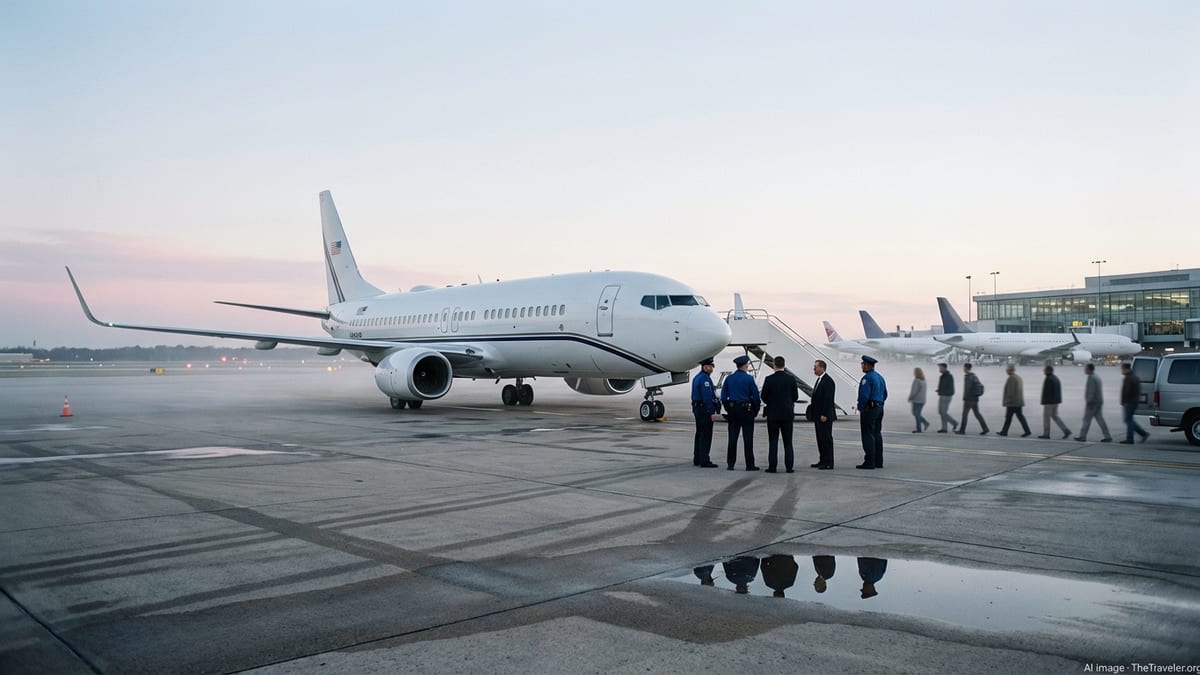
Inside the Plane DHS Wants to Turn Into a Deportation Workhorse
According to current and former officials, Immigration and Customs Enforcement has asked budget officials in Washington to approve the purchase of a Boeing 737 Max 8, initially leased and described by some within Homeland Security as a luxurious aircraft, for roughly 70 million dollars. The plane, now the focus of intense political and public scrutiny, was originally configured with premium interiors, including lie-flat seating and private sleeping spaces more commonly associated with corporate jets than mass transport for shackled detainees.
DHS has said at least one of the bedrooms is being removed in favor of additional seats so the aircraft can support high-capacity deportation missions. Yet the very fact that the cabin began life as a high-end, business-jet style space has fueled the “luxury deportation jet” label now ricocheting through headlines and social media. Critics argue that attempting to retrofit such a plane into an enforcement platform is less about efficiency and more about entrenching an aggressive deportation posture backed by bespoke government hardware.
Officials familiar with the deliberations say the aircraft is also expected to double as transport for Cabinet-level officials and other senior leaders, blurring the line between operational necessity and executive convenience. That dual role is common for military and government fleets, but in this case it is unfolding against a backdrop of heated immigration politics, widening the gap between DHS’s internal rationale and the public’s reaction.
Supporters inside the department frame the purchase as a practical upgrade, arguing that a purpose-controlled jet would be cheaper over time than a patchwork of short-term leases from commercial carriers and charter brokers. They insist that reconfiguring the interior and bringing operations in-house would standardize safety and security protocols. For now, however, the optics of buying a high-spec aircraft amid reports of grim conditions on deportation flights are overshadowing any claims of long-term savings.
From Invisible Shuttle to Front-Page Story: How Deportation Flights Work
Long before the proposed purchase, the United States was already running what amounts to a shadow airline. ICE Air Operations quietly moves tens of thousands of people every year on a global network of flights stitched together by charter companies and regional carriers. Brokers like CSI Aviation secure aircraft and crews, while operators ranging from specialist charter lines to a handful of low-cost airlines have cycled through the federal roster.
Historically, this system allowed the government to conduct mass removals without owning aircraft or displaying a visible livery that would instantly identify planes as deportation transports. Flights typically depart from secondary airports or remote corners of major hubs, often late at night or before dawn, with detainees bused in from detention centers under heavy guard. Information about routes, schedules, and passengers is sparse, and public flight-tracking data is frequently obscured or delayed at the request of operators.
Recent years have seen a marked expansion of this operation. Human rights monitors tracking tail numbers and call signs have documented record numbers of removal and “shuffle” flights, used to move detainees between domestic facilities before eventual deportation. New destinations across Latin America, Africa, and Asia have been added to the network, sometimes involving countries with fragile political conditions or strained relations with Washington.
As the scale has grown, so has the controversy. Reports from deportees describe tightly controlled cabins where passengers are handcuffed, stripped of belts and shoelaces, and given extremely limited access to toilets or medical care. Investigations have spotlighted extended use of full-body restraints and long-haul flights where air conditioning failures and maintenance problems left people fainting from heat or enduring hours in uncomfortable positions. Against that backdrop, news of a high-priced “luxury” jet entering the fleet has become a lightning rod for broader concerns about how deportation by air is carried out.
Costly Hardware in a Time of Scrutiny
The price tag attached to the proposed jet is drawing particular attention in a political environment already focused on federal spending. Chartering deportation flights is an expensive business: hourly rates can climb into the tens of thousands of dollars for high-security missions, and government auditors have previously questioned whether some contracts amount to price gouging. Companies that specialize in these flights describe them as among the most reliable and lucrative forms of charter revenue, guaranteed by long-term government agreements and protected from the seasonal swings that affect leisure travel.
Supporters of a dedicated DHS-owned aircraft argue that those costs justify a shift toward ownership. A modern, fuel-efficient narrowbody like the 737 Max 8, they contend, could perform a mix of long-range removal missions and shorter domestic transfers while eliminating the middlemen who currently broker deals between ICE and dozens of carriers. Over the life of the aircraft, proponents say, the government could bring down per-flight-hour expenses by consolidating operations.
Opponents counter that the economics are far from transparent. They point out that acquisition spending is only part of the equation. Crewing, maintenance, insurance, training, and the infrastructure required to base and service a dedicated jet all add up, and critics argue those costs have not been fully aired in public. Advocates also warn that once such an aircraft is in the fleet, political leaders could feel compelled to use it heavily to justify the investment, incentivizing more frequent and farther-reaching deportation missions.
For commercial aviation, the controversy underscores how sensitive the boundary has become between ordinary air travel and state security operations. Airlines that agree to operate deportation flights face boycotts, protests, and reputational damage. A government-owned deportation jet would not shield them entirely from criticism, but it could redraw the financial and moral landscape of which companies are involved and how visible their participation is.
Commercial Airlines Caught in the Crossfire
The rise of a potential DHS flagship comes at a moment when commercial carriers’ role in deportations is already under intense scrutiny. Over the past two years, a number of airlines have become deeply entangled with ICE Air, operating domestic transfers and international removals under charter arrangements that sit uncomfortably alongside their public-facing brands and marketing slogans about hospitality and care.
One low-cost U.S. carrier, for example, signed a multi-year deal to provide aircraft and crew for deportation flights just as it was expanding service to vacation destinations in Mexico and the Caribbean. The contract triggered a wave of local opposition in its home markets, with mayors, immigrant advocates, and university communities demanding the airline reverse course. Human rights groups documented nearly two thousand ICE flights operated by the carrier over just a few months before it eventually announced plans to exit the program under growing public pressure.
Elsewhere in the sector, charter operators and smaller airlines that rarely make mainstream travel headlines have quietly become the backbone of deportation logistics. Some have attracted accusations of profiteering or tolerating poor onboard conditions in exchange for steady government revenue. Others insist they are simply providing transportation services under contract, comparable to flying troops or disaster relief supplies, and that they follow federal safety and security directives to the letter.
The specter of a DHS-owned, quasi-exclusive deportation jet changes the calculus for both groups. Traditional airlines worry that public attention could further shift onto any remaining commercial partners, while smaller operators fear that a government aircraft could eventually displace them from a revenue stream they have come to rely on. Yet for travelers, the most immediate concern is not which tail logo appears on the tarmac, but how deportation operations intersect with the broader safety and ethics standards they expect whenever they board a plane.
Safety, Human Rights, and the Passenger Experience
The juxtaposition of a “luxury” aircraft with the often harsh realities of deportation flights has sharpened long-standing concerns about human rights in the air. Former detainees have described being strapped into full-body restraints for hours, escorted by heavily armed officers, and denied basic comforts such as blankets or regular access to water. Some have alleged physical abuse, medical neglect, or being flown out of the country despite ongoing legal appeals or health crises.
These accounts stand in stark contrast to the marketing language that often surrounds the aviation industry, which emphasizes comfort, safety, and personalized service. For paying passengers who share airports, terminals, and in some cases aircraft types with deportation operations, the idea that one set of travelers is treated as customers and another as cargo raises unsettling questions. Travel advisers say clients increasingly ask whether particular airlines participate in removals and, if so, what that implies about their corporate values.
A dedicated DHS jet could, in theory, allow the government to standardize conditions and oversight more tightly than a patchwork of charter carriers. Advocates for reform say that if the plane is approved, strict rules on restraints, medical care, and access to legal counsel should be written into its operating procedures and subject to independent inspection. They also call for cabin layouts that prioritize basic dignity, including adequate lavatories, climate control, and seating configurations that avoid excessively cramped or punitive conditions.
Yet critics doubt that a high-end airframe alone can solve systemic issues rooted in policy and enforcement culture. They warn that investing in premium metal for deportations risks normalizing an approach that treats large-scale removals as a permanent, routinized feature of U.S. border policy rather than a last-resort measure. For the global traveling public, the image of such a plane taking off under the U.S. flag could become a potent symbol of that shift.
Diplomatic Fallout and International Perceptions
Deportation flights do not operate in a vacuum. Every landing requires coordination with receiving governments, and in recent years a series of high-profile incidents has strained U.S. relations with key partners. Flights that arrived with detainees reporting extreme heat in the cabin, malfunctioning systems, or extended confinement in restraints have drawn sharp rebukes from foreign officials, who describe the treatment as degrading and inconsistent with international human rights norms.
Some governments have temporarily halted or restricted flights after particularly contentious episodes, citing public outrage at home and concerns about the condition of their returning nationals. Others have quietly negotiated changes to manifests, insisting that vulnerable groups or people with pending legal matters not be placed on certain planes. These diplomatic frictions complicate broader relationships on trade, security, and tourism, and can feed into perceptions that U.S. enforcement priorities overshadow commitments to due process and humane treatment.
The proposed DHS jet is being watched closely in capitals that already host regular removal flights. Diplomats and civil society groups say the optics of a custom government deportation plane could harden views that the United States is institutionalizing an aggressive, unilateral approach to immigration enforcement. For countries that rely heavily on inbound travel from the U.S., there is concern that public anger over deportation practices could spill over into reciprocal measures affecting visas, air service agreements, or cooperation on aviation safety.
Tourism boards and national carriers in some regions are sensitive to the possibility that images of heavily guarded deportation flights landing at their gateways could deter holidaymakers or business travelers. They worry that airports associated with frequent removals might be perceived as hostile or politically charged, undermining efforts to market themselves as welcoming, well-connected hubs.
What It Means for Ordinary Travelers
For most passengers passing through U.S. airports, deportation flights remain largely invisible. They operate at different hours, use separate boarding zones, and are shielded from public view whenever possible. Yet the policies and infrastructure behind them increasingly ripple into the wider travel ecosystem, shaping everything from airline corporate strategies to the emotional tenor of immigration checkpoints.
Travel analysts note that airlines sensitive to consumer pressure on deportation issues may pivot away from government contracts and look instead to leisure or corporate travel to fill their schedules. That can affect route maps, with capacity shifting toward high-yield vacation destinations or business hubs and away from smaller communities. In some cases, the establishment of an airport as a major deportation hub has coincided with the loss of certain commercial routes, changing local residents’ options for domestic and international trips.
At the same time, travelers from abroad are paying closer attention to how the United States handles border control. Stories of harsh deportation flights and high-profile raids can color perceptions of the U.S. as a destination, particularly among tourists who already face cumbersome visa processes or who come from countries frequently targeted by removal campaigns. A sleek, government-branded deportation aircraft would likely become a highly visible representation of those policies, whether glimpsed on the tarmac or in international media coverage.
Some industry observers caution that an overemphasis on visible symbols like the “luxury deportation jet” risks obscuring deeper structural questions about due process, detention conditions, and the scale of removals. Still, they acknowledge that images matter in travel. Just as iconic skylines and resort beaches can attract visitors, scenes of shackled passengers emerging from a gleaming government jet can repel them, shaping the stories people tell about whether they feel welcome in the United States.
Transparency, Accountability, and the Future of ICE Air
The debate over the 70 million dollar jet is unfolding alongside broader fights over transparency in deportation by air. In recent months, advocates have warned that airlines and charter partners are increasingly seeking to limit public tracking of deportation flights by requesting that routes be filtered out of consumer flight data feeds or flown under opaque call signs. That makes it harder for lawyers, journalists, and community groups to monitor who is being removed and under what circumstances.
Public exposure has already changed corporate behavior. When grass-roots monitors and human rights groups linked specific carriers and tail numbers to deportation operations, campaigns quickly followed, calling for boycotts or urging frequent fliers to cash out loyalty points. Several airlines have quietly stepped back from ICE work after such campaigns gained momentum, acknowledging that reputational risk outweighed the financial benefits.
A government-owned deportation jet would reduce the system’s dependence on commercial brands, but it would not resolve transparency concerns on its own. Advocates are pressing for clear, publicly available data on flight schedules, passenger categories, use of restraints, onboard incidents, and medical emergencies. They argue that if the United States is going to invest in a dedicated aircraft, it should also invest in robust oversight mechanisms and avenues for redress when abuses occur.
For the travel industry, the outcome of this debate will help determine whether deportation flights move further into the shadows or are brought under the same kind of public scrutiny that now applies to safety, consumer rights, and environmental impact. The fate of the “luxury deportation jet” proposal is more than an internal procurement story. It is a test of how a major travel and tourism nation balances security, sovereignty, and the values it projects every time one of its planes leaves the ground.