

More news on this day
Security lines at major US international airports stretched for hours this week as a prolonged Department of Homeland Security funding shutdown deepened Transportation Security Administration staffing shortages at some of the country’s busiest hubs, with George Bush Intercontinental Airport in Houston emerging as one of the hardest-hit gateways.
Get the latest news straight to your inbox!
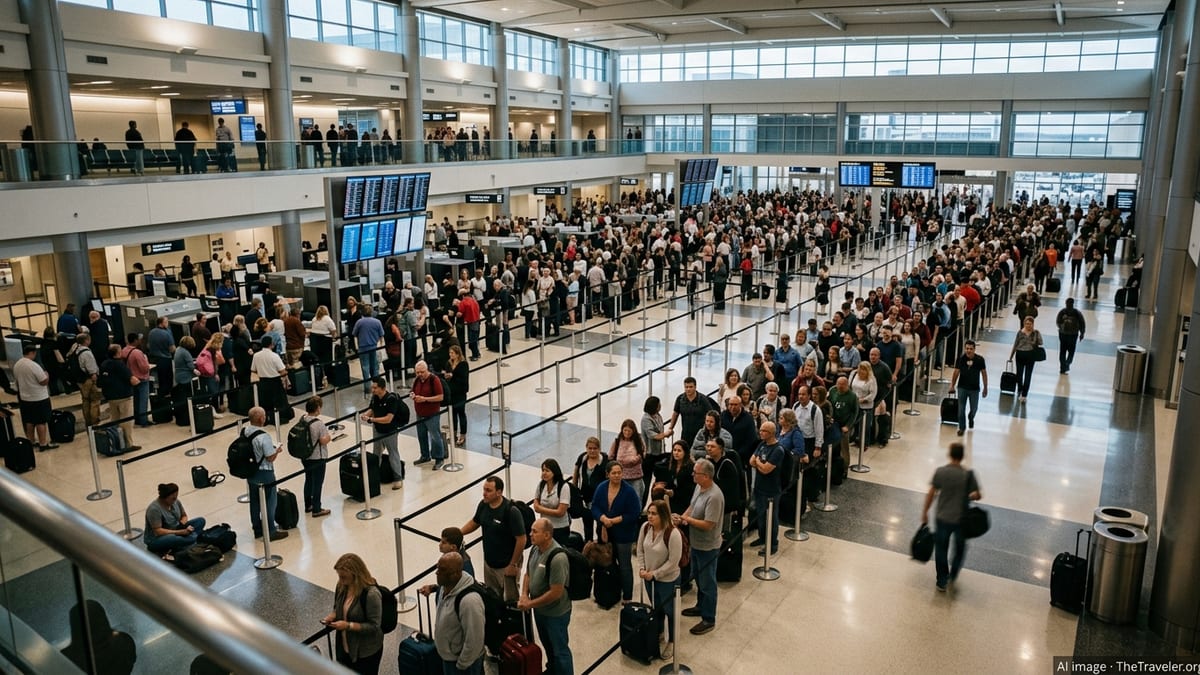
Houston’s Bush Intercontinental Becomes Epicenter of Delays
George Bush Intercontinental Airport in Houston has become a focal point of the disruption, with reports on March 25 and March 26 indicating security wait times in excess of four hours as spring travel demand collides with depleted TSA staffing. Publicly available briefings and local coverage describe security lines snaking across multiple levels of the terminal as only a fraction of security lanes operate during peak periods.
Houston aviation officials have acknowledged through online public statements that only around one-third to one-half of the usual TSA checkpoint capacity has been consistently available, despite reassignment of non-security airport staff to help manage flows. Social media posts and passenger accounts describe missed departures, tense crowds and travelers camping out near checkpoints overnight to avoid missing early-morning flights.
Industry analysts note that Bush Intercontinental’s role as a major connecting hub magnifies the impact when security bottlenecks arise. With a high proportion of banked departures and arrivals clustered in narrow time windows, even modest reductions in checkpoint capacity can spill over into widespread delays and misconnections across domestic and international networks.
Attempts to supplement TSA with personnel from other federal agencies have so far had limited visible effect in Houston, according to local and national coverage. Some reports suggest that specialized aviation security skills and certification requirements make it difficult for temporary reinforcements to significantly accelerate screening throughput in the short term.
National Pattern: Long Lines at Major International Gateways
Houston’s experience is part of a broader pattern of extended queues at key US international airports as the DHS funding lapse passes the 40-day mark. Published coverage and traveler reports point to sustained delays at New York’s John F. Kennedy International and Newark Liberty International, Atlanta’s Hartsfield–Jackson, New Orleans’ Louis Armstrong International and Austin–Bergstrom International, among others.
At these hubs, travelers describe peak-period waits commonly running well beyond the 45-minute benchmarks TSA typically uses as a service standard. In New York and New Jersey, local media have noted that transatlantic banks in the evening and early-morning departures toward Europe and Latin America are particularly vulnerable, with some passengers advised by airlines and airport websites to arrive at least three hours before departure for international flights.
In Atlanta, one of the world’s busiest passenger airports, regional outlets report intermittent surges in wait times that ripple across concourses, even as some checkpoints continue to operate relatively smoothly during off-peak hours. New Orleans and Austin, which have seen strong post-pandemic growth in international routes, are also experiencing pressure as staffing gaps collide with expanded schedules and seasonal peaks tied to festivals, conferences and the college spring break travel period.
The uneven pattern of disruption is creating a patchwork experience for travelers. While some secondary airports report only minor delays, many of the nation’s largest gateways are facing recurrent crunch periods each day when reduced TSA staffing cannot keep up with passenger surges.
Inside the DHS Funding Standoff and TSA Staffing Strain
The current wave of delays is rooted in a prolonged budget impasse over DHS funding that began with a lapse on February 14, 2026. Legislative summaries and national reporting describe a deadlock in Congress tied to disagreements over immigration enforcement policy and the future role and funding of agencies such as Immigration and Customs Enforcement and Customs and Border Protection.
To prevent an immediate broader government shutdown, lawmakers initially approved a short-term measure to keep DHS funded, but those stopgap arrangements have since expired for parts of the department. TSA screening functions are designated as essential, meaning officers are required to continue working without pay. As the shutdown has dragged on into late March, callout rates have climbed, according to testimony presented at a House Homeland Security Committee hearing this week.
Publicly available data and reporting indicate that some airports are seeing callout rates exceeding 40 percent among TSA staff. That has forced the consolidation of checkpoints, reduced operating hours at some lanes and the closure of secondary screening areas at several airports, concentrating passengers into fewer security lines.
Travel industry groups and labor organizations have warned repeatedly that the combination of missed paychecks, mandatory overtime and heightened passenger volumes would be unsustainable. Observers point to earlier shutdowns as precedent, but note that the current DHS-focused impasse is lasting longer than many analysts had expected, increasing the risk of attrition as officers seek more stable employment.
Record Wait Times, Talk of Potential Airport Closures
At a March 25 congressional hearing in Washington, the acting head of TSA outlined what was described in press coverage as record-high wait times nationwide and raised the possibility that entire airport checkpoints, and eventually some airports, might have to halt screening operations if staffing conditions continue to deteriorate.
According to summaries of the testimony, TSA leadership has been weighing a range of contingency options, from closing specific checkpoints during off-peak hours to temporarily suspending operations at smaller facilities to concentrate resources at major hubs. So far, large international airports remain open, but multiple checkpoints at different fields have already been shuttered for parts of the day to stretch limited staff.
Analysts note that even the hint of potential airport closures can have a chilling effect on travel planning, particularly for business and long-haul international itineraries that are more difficult to rebook at short notice. Airlines have so far emphasized that their schedules remain intact, but have begun issuing more explicit guidance urging passengers to arrive well ahead of departure and to allow additional time for connections between domestic and international flights.
Some aviation commentators suggest that if the shutdown persists without a clear timeline for back pay, TSA may be forced into more dramatic triage, prioritizing staffing for airports with the highest international and security significance, while shifting others to reduced operating models. Such a move would further concentrate traffic and could exacerbate long queues at the nation’s largest gateways.
Traveler Impact and What Flyers Can Expect in the Coming Days
The immediate impact for travelers is highly visible: extended lines at security, more stressed checkpoints and greater uncertainty about how long it will take to reach the gate. Passenger accounts circulating across social media, online forums and local news comment sections describe missed flights after two- to four-hour waits, especially at Houston, Atlanta, New Orleans and New York area airports during peak periods.
Airport and airline advisories reviewed by TheTraveler.org’s editorial team consistently recommend arriving earlier than usual, particularly for international departures. In several cases, carriers are advising passengers at the hardest-hit hubs to arrive at least three hours before scheduled departure for international flights and to consider four hours during the busiest morning and evening banks.
Despite the high-profile disruptions, the situation is not uniform across the country. Some medium-sized airports continue to report relatively normal screening times, and even at major hubs, off-peak windows can see lines moving quickly. Travel experts quoted in national outlets suggest that passengers who have flexibility may benefit from mid-day or late-evening departures, avoiding the heaviest morning and late-afternoon waves.
For now, the trajectory of airport wait times will largely depend on whether Congress can break the DHS funding deadlock. Until a resolution is reached and back pay is restored, observers widely expect callouts and resignations to remain elevated, keeping pressure on TSA staffing. With the busy summer travel season only weeks away, aviation stakeholders are watching negotiations closely, warning that the current patterns at George Bush Intercontinental and other major international airports may be a preview of broader systemic strain if the shutdown continues.