

More news on this day
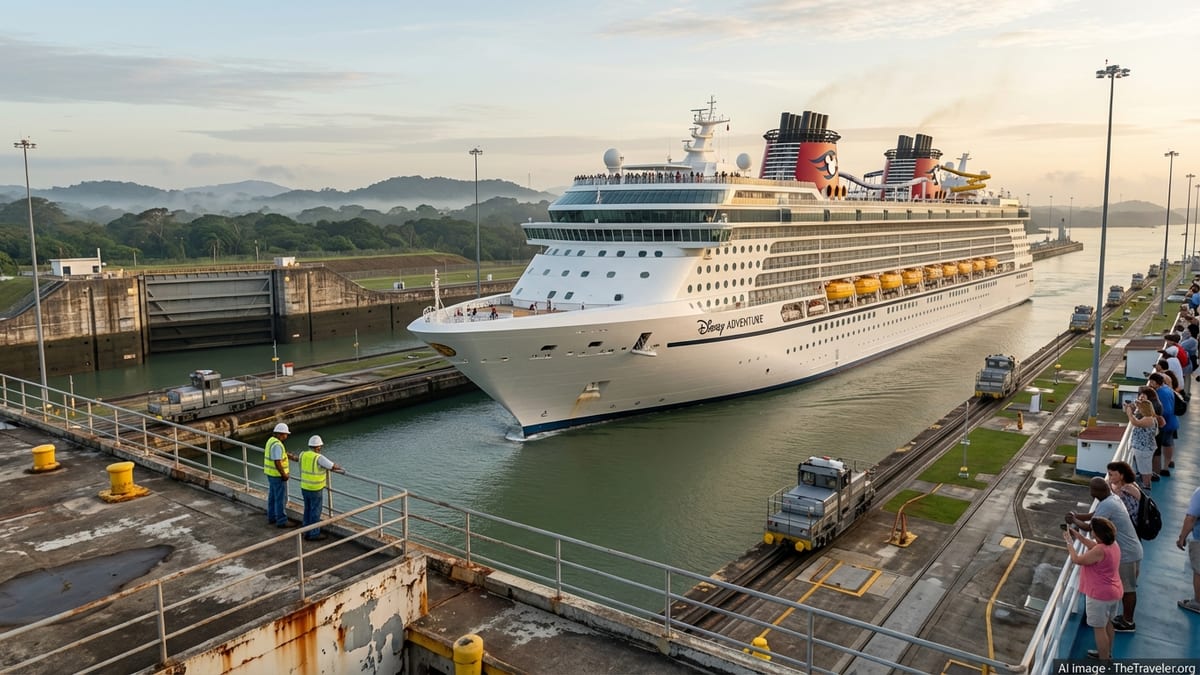
As dawn broke over the Panama Canal on February 2, 2026, a new silhouette loomed above the locks: Disney Adventure, a 208,000‑gross‑ton mega ship that has now become the largest cruise vessel ever to transit the interoceanic waterway.
The record‑setting passage, confirmed by the Panama Canal Authority, marks a watershed moment for both Disney Cruise Line and the canal itself, signaling a new era in large‑ship deployment and redefining what a Panama Canal cruise can be for global travelers.
More News
- Caribbean Travel to U.S. Upended by New Visa Freezes and Expanded Bans
- Mexico Restores E-Visas for Brazilians, Paving the Way for Borderless Tourism
- Philippine Airlines Joins Regional Carriers Powering Southeast Asia’s Tourism Boom
A Record Transit That Rewrites Canal History
Disney Adventure’s maiden Panama Canal crossing was more than a logistical feat; it was a signal that the era of the mega ship has fully arrived at one of maritime trade’s most strategic chokepoints. At 342 meters in length and 46.4 meters in beam, the vessel is not only the first cruise ship exceeding 200,000 gross tons to pass through the canal’s Neopanamax locks, but it also surpasses the previous passenger‑ship record set by Norwegian Bliss in 2018 by roughly 40,000 gross tons. Canal officials characterized the operation as a carefully choreographed effort involving multidisciplinary teams to manage the ship’s scale and draft within the constrained waterway.
The transit formed part of Disney Adventure’s long repositioning voyage from Europe toward Asia, where it will be based in Singapore. For the Panama Canal Authority, the crossing fits into a broader strategy to accommodate a new generation of larger, higher‑yield cruise ships despite ongoing operational challenges linked to water availability and climate. The agency expects more than 40 Neopanamax cruise ships to transit in 2026, underlining how vital leisure travel has become to the canal’s revenue mix at a time when cargo volumes remain volatile.
The record also carries symbolic weight for the global cruise industry. For years, engineers and planners debated how practical it would be for the very largest vessels to navigate the canal’s locks, even after the Neopanamax expansion opened in 2016. Disney Adventure’s successful passage effectively settles that argument in favor of ultra‑large ships, opening the door to new itinerary designs that blend resort‑style hardware with one of cruising’s most storied routes.
Inside Disney’s Largest Ship: From Casino Giant to Floating Storyworld
Disney Adventure is not a conventional newbuild. Originally designed as Global Dream for Asian casino operator Genting Hong Kong, the hull languished unfinished in a German shipyard when its owner went into insolvency in 2022. Disney acquired the partially completed ship at a steep discount and embarked on a multiyear transformation that industry analysts estimate at close to 1.8 billion dollars, turning a gaming‑centered vessel into what Disney markets as its most immersive “story‑driven” cruise experience to date.
The finished ship carries about 2,111 staterooms and can host approximately 6,000 guests, supported by more than 2,300 crew members. Designers reworked the interior to improve service ratios and align with Disney Cruise Line’s family‑focused model, replacing large areas originally earmarked for casinos with themed neighborhoods inspired by Disney, Pixar and Marvel franchises. Public descriptions highlight seven distinct themed zones, including a San Fransokyo‑inspired street from Big Hero 6, a central Imagination Garden conceived as the emotional heart of the ship, and dedicated areas built around Toy Story, Moana and other popular titles.
The vessel also pushes Disney’s technical ambitions. It is designed to run on lower‑emission methanol‑capable engines and is equipped with ABB Azipod propulsion, helping reduce fuel consumption and improve maneuverability in constrained waterways such as the canal. On deck, Disney Adventure features what the company describes as its longest roller coaster at sea, alongside large water complexes and expansive family activity spaces, intensifying the trend toward “resort at sea” hardware that competes directly with land‑based theme parks and integrated resorts.
Why This Canal Transit Matters for Global Cruise Tourism
For cruise tourism, Disney Adventure’s Panama Canal crossing illustrates how deployment patterns are evolving in response to both market demand and infrastructural improvements. The Neopanamax locks, which opened a decade ago to accommodate larger container and LNG ships, have gradually become a critical asset for cruise lines that want flexibility in moving their largest vessels between oceans without sending them around Cape Horn. By taking a ship of this size through the canal, Disney has effectively validated the route as viable for future mega ships during repositioning windows.
The transit comes at a time when the Panama Canal is carefully managing the number and size of vessels due to prolonged drought conditions affecting the Gatun Lake watershed. Against that backdrop, prioritizing high‑value passenger ships during peak season is increasingly attractive. Cruise transits generate less wear on infrastructure per ton of revenue than many bulk shipments and come with softer benefits, including international media exposure and increased tourism for Panama’s ports and excursion operators.
For travelers, the record reshapes perception of what a Panama Canal cruise entails. Historically associated with smaller, more expedition‑style ships that emphasized engineering and nature, canal itineraries are now intersecting with the largest and most entertainment‑dense vessels in the world. This broadens the cruise’s appeal beyond history buffs and retirees, drawing families and multigenerational groups who might previously have opted exclusively for Caribbean or Mediterranean routes but are now tempted by the idea of experiencing a famed canal transit without sacrificing big‑ship amenities.
Singapore as a New Powerhouse Homeport
Perhaps the most far‑reaching implication of Disney Adventure’s journey through Panama lies at its final destination. Once it completes its repositioning to Asia, the ship will operate year‑round from Singapore’s Marina Bay Cruise Centre, marking the first time Disney has permanently based a vessel outside the United States. The deployment underscores Singapore’s rapid emergence as a leading homeport in Asia, supported by strong air connectivity, well‑developed cruise infrastructure and active government backing.
Tourism officials in the city‑state view Disney Adventure as a strategic anchor asset. Singapore welcomed a sharp rise in visitor arrivals over the past two years, and cruise volumes have rebounded strongly, with a record 2 million cruise passengers reported recently. The presence of one of the world’s largest cruise ships, specifically tailored for shorter three‑ and four‑night itineraries at sea, is expected to attract both regional passengers from Southeast Asia, India and Greater China and long‑haul visitors combining a sailing with land stays in Singapore and beyond.
For Disney, Singapore offers a stable regulatory environment and a multicultural customer base that is already familiar with the brand through cinema, streaming and consumer products, but underserved in terms of dedicated Disney tourism infrastructure. Positioning Disney Adventure there allows the company to test new products, menus and entertainment offerings oriented toward Asian tastes, from expanded regional dining concepts to multiple language options in shows and wayfinding. It also creates a maritime counterpart to Disney’s long‑running parks presence in Tokyo, Hong Kong and Shanghai.
Redefining the Panama Canal Cruise Experience
Disney’s strategy with Adventure goes beyond simple ship deployment. The company has developed an operating concept in which the vessel is marketed as “both the journey and the destination,” with itineraries composed entirely of sea days. While Panama Canal repositioning sailings will retain classic elements such as viewing the lock mechanisms and learning about canal history, the onboard product is designed to feel less like a transit and more like a multi‑day festival at sea.
For travelers encountering the canal for the first time on such a mega ship, the experience will be markedly different from traditional crossings. Guests can watch the ship inch through the chambers from elevated promenade decks, dedicated viewing lounges or even from the vantage point of an onboard coaster. Simultaneously, they have access to Broadway‑style productions, character encounters, themed dining and interactive games that continue throughout the long hours required for a full passage from ocean to ocean.
This blend of engineering spectacle and curated entertainment may broaden the demographic profile of Panama Canal cruise passengers. Families with young children, who might once have worried about sea days filled with lectures and limited activities, now encounter a product built around immersion and play. At the same time, Disney faces the challenge of preserving space onboard for quiet observation of the canal’s operation, ensuring that the historic and environmental dimensions of the transit are not overshadowed by spectacle.
Environmental, Operational and Competitive Pressures
Disney Adventure’s record‑setting transit also draws attention to the environmental and operational pressures facing both the cruise industry and the canal. On the maritime side, Disney has emphasized the ship’s advanced propulsion and alternative‑fuel readiness as part of its broader emissions‑reduction strategy. Compared with older tonnage, the vessel is built to meet stricter efficiency standards, including optimized hull design and waste‑heat recovery systems. Still, environmental advocates note that sheer scale brings its own footprint, raising questions about the cumulative impact of ever larger ships, especially in ecologically sensitive regions.
For the Panama Canal, managing mega ship transits during periods of reduced water levels is a complex balancing act. Every passage consumes millions of liters of freshwater used to raise and lower vessels through the locks. In response to recent drought conditions, the canal has imposed draft restrictions and experimented with daily transit caps, creating a competitive environment in which cruise lines vie for limited slots. High‑profile crossings by large passenger ships such as Disney Adventure may strengthen the business case for prioritizing cruise traffic, but they also highlight the need for long‑term water management and potential infrastructure adaptations.
Competitively, Disney Adventure’s arrival through the canal raises the stakes for other cruise brands with global ambitions. Lines such as Royal Caribbean, MSC Cruises and Carnival Corporation have all introduced or ordered mega ships with capacities rivaling or exceeding 6,000 passengers. Many already deploy large vessels seasonally between markets, and observers expect more of them to consider Panama Canal routes for future repositionings. The record just set by Disney Adventure is therefore unlikely to stand unchallenged for long, even as it cements Disney’s status as an innovation leader in the family cruise segment.
What It Means for Travelers Planning Future Voyages
For travelers, the most immediate effect of Disney Adventure’s milestone is an expanded set of options when planning canal‑related or Asia‑focused itineraries in the coming years. While the record transit itself was part of a one‑off repositioning route, it demonstrates that ultra‑large vessels can be integrated into complex global deployment plans. Guests booking future seasons may see more varied one‑way and extended itineraries that string together multiple marquee experiences, from Caribbean islands and Central American ports to Asian gateway cities.
The ship’s eventual homeporting in Singapore adds another layer of choice. Regional guests will gain access to short, high‑intensity voyages that emphasize entertainment, dining and sea‑day relaxation rather than port‑intensive sightseeing. Long‑haul travelers, particularly from North America and Europe, can combine a Panama Canal transit on one ship with a separate journey on Disney Adventure in Asia, effectively creating multi‑year “bucket list” arcs centered on the brand’s cruise offerings.
At a broader level, the record signals that the cruise industry’s post‑pandemic recovery has shifted from cautious restarts to full‑scale expansion. Lines are betting heavily on new ships, new homeports and new markets. For destinations around the canal and across Southeast Asia, that brings opportunities in the form of visitor spending and infrastructure investment, alongside familiar debates about overtourism, port congestion and environmental stewardship.
FAQ
Q1: What record did Disney Adventure set in the Panama Canal?
Disney Adventure became the largest cruise ship by gross tonnage and passenger capacity to transit the Panama Canal, and the first cruise vessel over 200,000 gross tons to pass through the Neopanamax locks during its February 2, 2026 crossing.
Q2: How big is Disney Adventure compared with previous record holders?
The ship measures about 208,000 gross tons and 342 meters in length, making it roughly 24 percent larger by gross tonnage than Norwegian Bliss, the previous cruise ship record holder for a Panama Canal transit.
Q3: Why was Disney Adventure originally built, and how did Disney acquire it?
The vessel began life as Global Dream, a mega ship ordered by Genting Hong Kong for the Asian market. After Genting’s insolvency, Disney acquired the unfinished hull in 2022 at a significant discount and spent several years converting it into a dedicated Disney Cruise Line ship.
Q4: Where will Disney Adventure be based after its repositioning cruise?
Following its transit of the Panama Canal and subsequent sailing to Asia, Disney Adventure will be homeported year‑round in Singapore, operating primarily three‑ and four‑night cruises at sea from the Marina Bay Cruise Centre.
Q5: What makes the onboard experience on Disney Adventure different from traditional canal cruises?
Unlike classic Panama Canal voyages that focus heavily on lectures and sightseeing, Disney Adventure offers a theme‑park‑style experience with multiple immersive themed zones, large entertainment venues, character appearances and the longest coaster in the Disney fleet, turning the canal transit into just one highlight of a broader resort‑at‑sea vacation.
Q6: Will regular guests be able to book Panama Canal sailings on Disney Adventure?
Yes, but likely on a limited basis. The record transit took place during a one‑time repositioning voyage. Future crossings, if scheduled, are expected to be special itineraries rather than part of the ship’s standard short‑cruise program from Singapore.
Q7: How does Disney Adventure address environmental concerns associated with mega ships?
The ship is designed with more efficient hull forms, methanol‑capable engines and modern propulsion systems to reduce fuel consumption and emissions relative to older vessels of similar size, although environmental groups continue to scrutinize the overall impact of very large cruise ships.
Q8: What does this transit mean for the future of the Panama Canal as a cruise route?
Disney Adventure’s successful crossing demonstrates that the canal can accommodate the largest new‑generation cruise ships, strengthening its role as a strategic corridor for global cruise deployments and potentially attracting more high‑capacity vessels during repositioning seasons.
Q9: How is Singapore expected to benefit from hosting Disney Adventure?
Singapore’s tourism authorities anticipate that the ship will draw millions of passengers over its multi‑year deployment, boosting hotel stays, air arrivals and spending across attractions, while reinforcing the city‑state’s status as a leading cruise hub in Asia.
Q10: What should travelers consider when booking a cruise on a ship this large?
Prospective guests should factor in the ship’s scale, which provides extensive entertainment and dining options but can mean larger crowds at peak times. Early planning for dining, shows and shore experiences is advisable, as is considering cabin location for ease of movement on such an expansive vessel.