

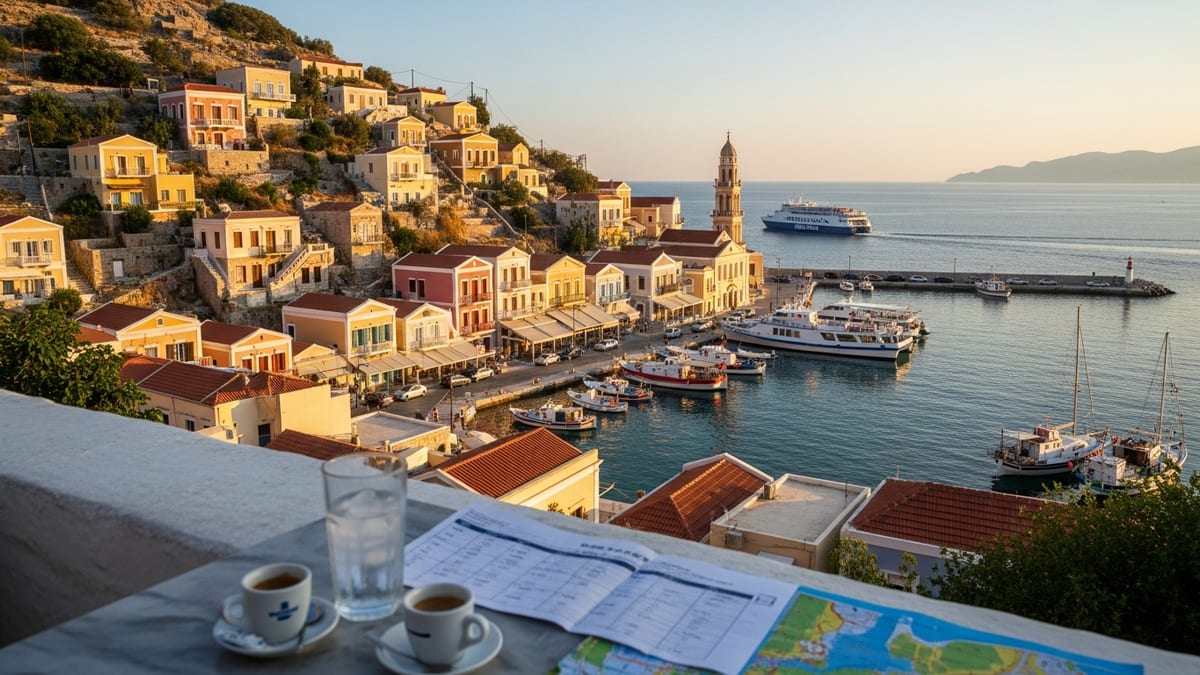
The Dodecanese are where Greece stretches one last time toward Turkey and the Levant, a scattered chain of sun-baked islands that mix Crusader castles with Ottoman mosques, volcanic craters with pine forests, and tiny fishing harbors with full-scale resort towns.
As international arrivals to the region continue to climb, the Dodecanese today sit at the heart of Greece’s island tourism story, offering travelers a slower, more varied alternative to the overburdened Cyclades. This guide brings together the latest travel realities with practical routing advice so you can choose the right islands, move between them confidently, and know exactly what to expect when you arrive.
The Dodecanese at a Glance
The Dodecanese consist of twelve “main” islands plus dozens of smaller islets scattered across the southeastern Aegean. The two hubs are Rhodes and Kos, which handle the bulk of international arrivals and act as jumping-off points for quieter neighbors such as Symi, Nisyros, Tilos, Leros, Patmos, Kalymnos, Karpathos, Kasos and Kastellorizo. Each island has a distinct identity: Rhodes and Kos lean resort-style and family-friendly, Patmos and Symi feel elegant and romantic, Kalymnos is an outdoor playground, while tiny Tilos and Nisyros appeal to travelers seeking low-key, sustainable tourism.
In the last several seasons, inbound arrivals to the Dodecanese have grown steadily, with the region repeatedly ranking as Greece’s second most-visited island destination after Crete in national tourism data. That upward trend matters on the ground: infrastructure is better than a decade ago, with improved ports, more air connections and a wider spread of midrange and upscale hotels, but it also means higher demand in peak months, busier roads around Rhodes Town and Kos Town, and a rising cost base. Travelers who plan ahead, travel slightly off-peak, or base themselves on smaller islands can still find the quieter, old-Aegean atmosphere that first put the Dodecanese on the map.
Geographically, the group is long and linear, running roughly north to south. At the top are Patmos, Leros and Kalymnos, sitting not far off the Turkish coast across from Bodrum and Didim. Midway down the chain are Kos and its neighboring volcanic islands, Nisyros and Tilos. Further south lie Rhodes, the historic powerhouse, and beyond it the windier, more rugged duo of Karpathos and Kasos on the way toward Crete. The outlier is Kastellorizo, a tiny dot of color almost within swimming distance of Turkey’s Lycian coast. For travelers, this geography translates into two main ferry “spines” that crisscross the islands and a series of shorter local hops that can be woven into creative multi-island itineraries.
Island Profiles: From Rhodes to Remote Outposts
Rhodes is the natural entry point for many visitors and the most developed island in the Dodecanese. Rhodes Town combines a remarkably intact medieval Old Town, built by the Knights of St John, with a modern waterfront lined with hotels, bars and shops. The east coast is dotted with beaches and large resorts around Faliraki, Kolymbia and Lindos, while the greener interior hides stone villages and pine-covered hills. For first-timers who want a simple base with easy excursions, Rhodes offers the best choice of organized tours, bus services and car rentals, along with a long season that typically stretches from April into early November.
Kos comes in a close second in terms of infrastructure, with a busy airport and a port that connects north to Kalymnos and south toward Nisyros and Tilos. Kos Town is a mix of harborfront cafes, archaeological remains and post-war Italian planning, while resorts fan out along the north and south coasts. The island has a reputation for nightlife and package tourism, but there are quieter corners in the center and west, especially around Kefalos. Kos also acts as a convenient link in multi-island routes: it is one of the easiest places to combine beach time with day trips to volcanic Nisyros or low-key Tilos.
Further north, Patmos has long drawn a more contemplative crowd. It is known for the Monastery of St John and the Cave of the Apocalypse, but beyond the religious heritage there are graceful mansions in Chora, attractive beaches, and a gentle, relatively upscale atmosphere. Nearby Leros retains a lived-in island feel, with bays like Alinda and Vromolithos, remnants of Italian architecture around Lakki, and a year-round community that softens the seasonality of tourism. Kalymnos, just to the south of Leros, has transformed into one of the Mediterranean’s premier rock climbing destinations, attracting an international outdoors community while still anchored in its history of sponge diving and fishing.
On the quieter southern end, Karpathos and Kasos reward travelers willing to go a bit further. Karpathos has dramatic mountain villages, a strong musical and folkloric tradition, and beaches ranging from family-friendly coves to wild surf spots exposed to the Meltemi winds. Kasos, even smaller and less visited, offers a slow rhythm of life and simple tavernas by the sea. Between the hubs sits Nisyros, defined by its active volcanic caldera, and Tilos, which has consciously pursued a low-impact tourism model, investing in renewable energy and attracting nature lovers and hikers. The smallest jewel is Kastellorizo, a tiny harbor town painted in pastels, which feels like a movie set and is usually visited as a side trip rather than a standalone destination.
How to Get There and Move Around
Most visitors arrive in the Dodecanese by air, flying directly into Rhodes or Kos on international seasonal services or via Athens year-round. In recent seasons, both islands have seen growth in international arrivals as airlines add capacity and extend schedules at the shoulders of the season. Summer schedules typically ramp up from late April, peak in July and August, and tail off through October. If you are coming from elsewhere in Greece, domestic flights link Rhodes and Kos to Athens and, less frequently, to Thessaloniki or other regional centers. Smaller islands like Karpathos, Leros, Kalymnos and Kastellorizo also have airports with domestic services, but frequencies are limited and routes can change from year to year, so it is wise to check timetables before shaping a detailed itinerary.
Ferries remain the backbone of Dodecanese travel. Large, conventional ferries run the main north-south spine through the islands, connecting Piraeus with Patmos, Leros, Kalymnos, Kos, Rhodes and on to Karpathos and Crete on certain routes. These sailings are less frequent than on some Cycladic routes but are generally reliable in high season, with extra sailings layered in during July and August. High-speed catamarans and smaller passenger ferries fill in the gaps, offering shorter hops between Rhodes and Symi, Rhodes and Kastellorizo, Kos and Nisyros, or Kos and Kalymnos, among others. Because of the distances involved, overnight ferries from Piraeus to Rhodes or Karpathos are common, and cabins are worth considering if you want to arrive rested.
Once on the islands, car and scooter rentals are the most flexible way to explore. Road quality on Rhodes and Kos is generally good, with main arteries circling the islands and branching into the interior. On smaller islands, roads are narrower and driving is more relaxed, but hairpin bends and strong winds are common, especially on Karpathos and in windy seasons. Local buses operate reliably on Rhodes and Kos, linking major resorts, villages and beaches, though frequency drops in the shoulder months and off-season. On islands like Patmos, Leros and Kalymnos, limited bus networks connect ports with main beaches and settlements, but services may be timed tightly around local commuting needs rather than sightseeing.
Because schedules can shift from year to year, travelers planning complex, multi-island routes should build in some flexibility. Routes that are straightforward in high summer may be impossible or require backtracking in May or October when certain inter-island links are reduced. Buying long-distance ferry tickets a few weeks in advance is increasingly advisable on popular summer dates, while local hops can often be booked closer to travel, either online, in island ticket offices, or through local agents. Always allow buffer time if a ferry connection is critical to an onward flight, as delays from weather or port congestion are not unusual in peak season.
Classic Routes and Suggested Itineraries
For first-time visitors, a classic northern Dodecanese loop works well: fly into Kos, spend several days there, then travel by ferry to Kalymnos for climbing or coastal walks, move on to Leros for quiet bays and local life, and finish on Patmos for a mix of history and beaches. This route strings together islands with short sea crossings, avoiding the need for overnight ferries, and offers a good balance between busier and calmer places. With ten to twelve days you can explore each island at a relaxed pace, adding a night in tiny Lipsi from Patmos if schedules allow.
Another popular corridor runs from Rhodes to Symi and onwards to smaller islands to the northwest. Starting in Rhodes, travelers typically spend time in the Old Town and at least one east-coast beach area before boarding a ferry to Symi. The harbor at Symi Town is one of the most photogenic in Greece, framed by neoclassical houses rising steeply above the water. From Symi, in high season there may be connections onward to Tilos or Nisyros, which allow you to taste the volcanic landscapes and low-key villages of the central Dodecanese before looping back via Kos. This route suits travelers who prefer pretty harbors and short crossings to longer overnights.
For those drawn to wild landscapes, a southern axis from Rhodes to Karpathos and Kasos is compelling. This requires either a long ferry ride or a flight to Karpathos followed by a local ferry to Kasos. The reward is a combination of windswept beaches, traditional hill villages like Olympos on Karpathos, and some of the least touristed corners of the Aegean. Two weeks allows enough time to split your stay between a beach base and a mountain village on Karpathos and to enjoy several slow days on Kasos. This route is better suited to independent travelers comfortable with sparse timetables and occasional schedule changes.
Travelers interested in combining the Dodecanese with other Greek regions can use Rhodes and Kos as stepping-stones. From Rhodes, there are seasonal ferries toward Crete or north toward the Cyclades on some years, while from Kos it can be possible to connect westward toward the North Dodecanese or onward to the eastern Cyclades, depending on the season’s routes. Because such cross-group links shift frequently, building your core itinerary around the north-south Dodecanese spine and treating any lateral hops as a bonus avoids last-minute disappointments.
What to Expect: Seasons, Crowds and Costs
Tourism across the Greek islands has risen in recent years, and the Dodecanese are no exception. Arrivals have set new records, with particularly strong numbers in peak months. In practical terms, this means that July and August bring busy beaches on Rhodes and Kos, higher occupancy even on smaller islands, and a general sense of bustle in ports and airport terminals. If you value space and slightly cooler temperatures, late May to late June and September to early October are excellent windows, combining warm seas with milder heat and fewer crowds. The shoulder months also bring more availability and often better rates on accommodations and car rentals.
Winter is a different story. While Rhodes and Kos maintain year-round populations and some level of service, many hotels and restaurants elsewhere close from November through March. Ferry schedules thin out, and domestic flights to smaller airports are sometimes reduced. For most leisure travelers, the Dodecanese are a spring-to-autumn destination. An exception is for hikers and those who prefer cooler weather, who may find early spring and late autumn appealing on islands like Tilos, Nisyros and Karpathos, though they need to accept limited tourist infrastructure and occasional weather-related disruptions.
In terms of budget, the Dodecanese sit in the midrange of Greek island costs. Rhodes and Kos offer a wide spectrum, from all-inclusive resort packages and large family hotels to simple pensions and city apartments. Patmos, Symi and boutique-heavy islands lean slightly higher in nightly rates, particularly for waterfront rooms and historical properties, while Tilos, Nisyros and parts of Leros and Kalymnos remain relatively affordable, especially outside the very peak weeks. Rising operating expenses and demand have pushed prices upward across the region in recent seasons, so it is prudent to book key stays early if you are traveling in high season or targeting specific smaller islands with limited beds.
Service standards are generally high by Greek island norms, and many businesses are well attuned to international visitors, given the long tourism tradition of Rhodes and Kos. English is widely spoken in ports, hotels and restaurants, and increasingly you will encounter staff familiar with other European languages as well. Payment by card is standard but keeping some cash for small tavernas, local buses and rural shops is wise. As volumes have grown, there is more attention to managing visitor flows in heritage areas, especially within Rhodes Old Town, where authorities have introduced measures such as traffic restrictions at peak times; travelers should expect a balance between free exploration and light-touch controls in the most sensitive sites.
On the Ground: Culture, Food and Everyday Practicalities
Culturally, the Dodecanese are layered in a way that sets them apart from many other island groups. Centuries of Byzantine, Crusader, Ottoman and Italian presence have left castles, minarets, mansions and rationalist harborfronts. In Rhodes Town, you can walk from the Street of the Knights to a former Ottoman quarter and then to Italian-era buildings along the waterfront in minutes. In Kos, Roman and Hellenistic remains sit near palm-lined boulevards that hint at early 20th-century planning. On smaller islands, the Italian interwar period is still visible in the urban fabric of Lakki on Leros or the port of Kos, while medieval fortifications crown hills on Patmos and elsewhere.
This layered history shapes daily life and festivals. Religious holidays follow the Greek Orthodox calendar, with Easter a major event, while summer brings local panigyria, or saints’ day celebrations, in villages across the islands. These gatherings mix liturgy with music, dancing and communal meals, and visitors are often welcome. Dress standards at monasteries and churches are conservative, particularly at major pilgrimage sites like the Monastery of St John on Patmos, where shoulders and knees should be covered and quiet behavior is expected. In beach towns and resorts, the atmosphere is relaxed, but modest cover-ups are still appreciated away from the shoreline.
Food in the Dodecanese reflects both island and regional Greek traditions. Fresh fish and seafood are common, but prices have risen and catches vary, so grilled local fish may appear more as a treat than a daily staple. Tavernas often highlight local specialties, from chickpea dishes and stuffed vegetables to island-specific pies, cheeses and sweets. On volcanic Nisyros and fertile parts of Kos and Rhodes, local produce plays a central role, and you will find village tavernas where much of the menu comes from family gardens. Vegetarian travelers are generally well catered for, with multiple meat-free options on most menus.
Daily rhythms are shaped by heat and light. In high summer, midday can be punishing, particularly on the more exposed islands, so locals and experienced visitors often retreat indoors between early afternoon and early evening, reemerging for swims, walks and dinners as temperatures drop. Shops in tourist centers may open throughout the day in season, while in smaller villages they sometimes close for a few hours at midday. Tap water is drinkable in some places but not in others; even where it is safe, many locals drink bottled water due to taste or supply issues, so it is sensible to ask your host what they recommend on each island.
Responsible Travel and Changing Realities
The success of Greece’s island tourism has brought environmental and social pressures, and the Dodecanese sit directly within that debate. Growth in arrivals has translated into fuller flights, busier ports and a noticeable rise in accommodation capacity, including short-term rentals. Some islands, such as Tilos, have attracted international attention for their efforts to invest in renewable energy and manage waste more effectively, demonstrating one path toward a more sustainable model. Others, particularly larger hubs like Rhodes and Kos, are still grappling with how to balance mass tourism with water scarcity, energy demands and protection of natural and cultural heritage.
For visitors, responsible travel choices can make a practical difference. Traveling slightly outside the absolute peak weeks reduces pressure on infrastructure and spreads income into the shoulders of the season. Choosing locally owned lodgings and dining in family-run tavernas helps keep tourism revenue in island communities. Simple steps such as avoiding single-use plastics where possible, refilling bottles from safe taps or larger containers, and being mindful of water use in showers and pools are increasingly important in a region where summer droughts and high demand can strain supplies.
On the cultural side, the Dodecanese’s position near the Turkish coast and along historical trade routes has long made them gateways as much as destinations. Recent years have seen changing patterns in regional politics and migration, and while most visitors experience only the holiday side of island life, it is worth recognizing that the local context is more complex. Showing respect for local concerns, following the guidance of authorities in sensitive areas, and engaging with islanders as more than simply service providers all contribute to a more balanced, mutually rewarding experience.
Climate change is another underlying factor. Hot spells are becoming more frequent and intense across the eastern Mediterranean, with some summers bringing sustained high temperatures. For travelers, that reinforces the value of good planning: securing accommodations with adequate shade and ventilation, recognizing the importance of hydration and sun protection, and being prepared to adjust plans if authorities issue heat or fire advisories. It also strengthens the case for visiting outside the hottest weeks of the year, when conditions are more comfortable both for visitors and for those who work in tourism.
The Takeaway
The Dodecanese combine some of the most accessible island entry points in Greece with a string of less-developed, personality-rich islands that still feel distinctly local. From medieval Rhodes and easygoing Kos to contemplative Patmos, craggy Kalymnos and the tiny harbors of Symi, Tilos and Kastellorizo, the group offers a spectrum of experiences within a single region. Growing arrivals mean better connections, more choice of places to stay and eat, and longer seasons, but they also mean that careful timing and advance planning are increasingly important, particularly in July and August.
If you are dreaming of a Greek island journey that goes beyond the postcard clichés, the Dodecanese reward travelers who are willing to look beyond the main resort strips and stretch their itinerary over multiple islands. Build your route around the north-south ferry spine, give yourself room to adapt to schedules and weather, and match your choice of islands to your own pace and interests, whether that is heritage, beaches, hiking, climbing or simply long, unhurried evenings by the sea. Travel with awareness of the region’s evolving realities and a willingness to engage with local life, and the Dodecanese are likely to become not just a one-off destination but a place you return to as the Aegean continues to change.
FAQ
Q1. When is the best time of year to visit the Dodecanese?
For most travelers, the ideal periods are late May to late June and September to early October, when the sea is warm, the weather is settled but not at its hottest, and crowds and prices are lower than in peak summer. July and August bring the most reliable beach weather but also the biggest crowds and highest costs, while November to March is very quiet with limited tourist services on many islands.
Q2. Which Dodecanese island should I choose for a first visit?
If you want simplicity and a wide range of services, Rhodes or Kos are the easiest introductions, thanks to their international flights, organized tours and multiple beaches. For a quieter yet still accessible experience, consider Patmos, Leros or Symi, which offer characterful towns and good swimming without the same level of resort development. Adventure-oriented travelers might prioritize Kalymnos for climbing or Karpathos for hiking and wild beaches.
Q3. Do I need to book ferries and accommodation in advance?
In July and August, booking ahead is recommended for both ferries on popular routes and accommodations, especially on smaller islands with limited beds or during local festivals. In shoulder months, you have more flexibility and may find last-minute options, though it is still sensible to secure key inter-island ferry legs and first-night lodging before arrival. Outside the main season, always check that services are running before you commit to fixed dates.
Q4. How many islands can I realistically visit in one trip?
With a week, it is usually best to focus on one major island and perhaps one smaller neighbor as a side trip or second base. In ten to fourteen days, you can comfortably cover three or four islands along one logical ferry line, such as Kos, Kalymnos, Leros and Patmos, or Rhodes, Symi, Tilos and Nisyros. Trying to see too many islands in a short time can leave you spending more hours in ports and on ferries than actually enjoying the places you came to visit.
Q5. Is it easy to get around without renting a car?
On Rhodes and Kos, local buses, taxis and organized excursions make it possible to see many of the main sights without driving, especially if you are based near a town. On smaller islands, public transport is often limited to a few daily buses between the port and major beaches or villages, and taxis can be scarce. Renting a car, scooter or e-bike for at least part of your stay greatly increases your flexibility, though you should be comfortable with narrow roads, occasional steep sections and, in summer, strong winds.
Q6. Are the Dodecanese suitable for families with children?
Yes, particularly Rhodes and Kos, which have family-oriented resorts, shallow sandy beaches and a wide choice of activities, from water parks to boat trips. Many smaller islands are also very child-friendly in atmosphere, with calm bays and relaxed tavernas, though they may lack formal attractions and organized entertainment. When traveling with young children, consider access to medical facilities, transfer times from the airport or main port, and the proximity of your accommodation to the beach or town center.
Q7. What should I pack for a summer trip to the Dodecanese?
Essential items include light, breathable clothing, a hat, high-factor sunscreen, sunglasses and sturdy sandals or shoes for walking on uneven ground and hot stones. A light layer for cooler evenings in shoulder seasons, a swimsuit, a cover-up for visiting churches and monasteries, and any specific medications you may need are also important. Reusable water bottles, a small daypack and basic travel adapters round out a practical packing list, as shopping options on smaller islands can be limited compared to Rhodes or Kos.
Q8. How safe are the Dodecanese islands for travelers?
The Dodecanese are generally very safe, with low levels of violent crime and a welcoming attitude toward visitors. The most common issues are minor thefts in busy tourist areas and the usual risks associated with driving unfamiliar roads, swimming in the sea and spending long hours in the sun. Taking normal precautions with valuables, following local advice on swimming conditions and fire safety, and carrying travel insurance that covers medical needs and trip disruptions provide a solid safety net.
Q9. Can I combine a trip to the Dodecanese with a visit to Turkey?
Many travelers do combine the two, as several Dodecanese islands lie close to the Turkish coast, and in season there are frequent boat connections between ports such as Kos and Bodrum or Rhodes and Marmaris. These involve crossing an international border, so you must have the correct travel documents and check current visa policies for your nationality. It is wise to build in some flexibility in case of schedule changes or weather-related cancellations on the cross-border routes.
Q10. Do I need to speak Greek to travel comfortably in the Dodecanese?
No, you can get by comfortably with English, which is widely spoken in hotels, restaurants, ferry offices and other tourism-facing businesses. Learning a few basic Greek words and phrases is appreciated and can enrich your experience, especially in smaller villages and local markets. Signage at major archaeological sites and transport hubs is typically bilingual, while menus in resort areas often appear in several languages during the main season.