

More news on this day
Severe travel disruption is continuing in Qatar, with at least 453 flights canceled to and from Doha in recent days as the Iran conflict keeps much of Gulf airspace restricted, forcing Qatar Airways and several foreign carriers to operate only a skeleton schedule and leaving thousands of passengers stranded across the network.
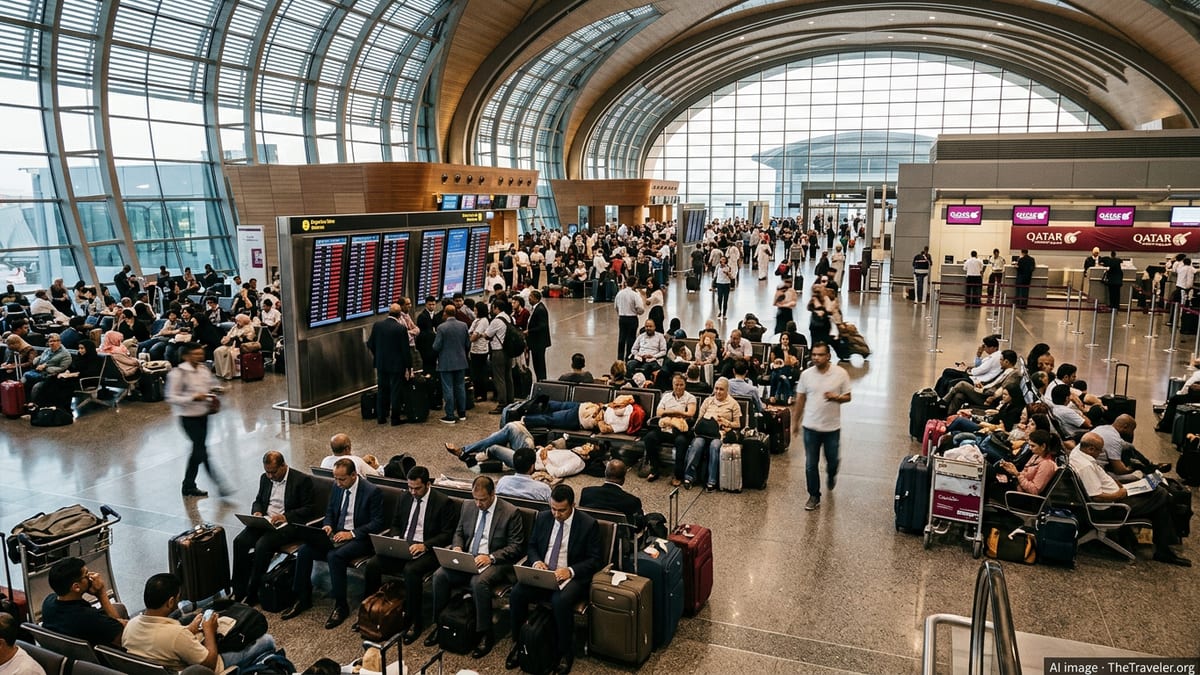
Airspace Closures Keep Doha a Regional Flashpoint
The crisis stems from a sharp escalation in the Iran war that began in late February, prompting Iran to launch missile and drone attacks across the Gulf and triggering sweeping airspace closures in Qatar and neighboring states. Authorities in Doha initially shut Qatari airspace to normal commercial traffic, allowing only emergency and military operations while air defenses responded to incoming threats.
Although regulators have since authorized tightly controlled corridors for limited operations, large parts of the region’s skies remain effectively off limits or heavily restricted. Airlines are being forced into lengthy detours around conflict zones, complex slot allocations and conservative safety margins, all of which have driven mass cancellations at Hamad International Airport and other hubs.
Aviation analysts say the disruption in Doha is particularly acute because Qatar’s flag carrier relies almost entirely on connecting traffic through its single hub. With many destinations in the Middle East temporarily suspended and long-haul routings constrained, carriers have little choice but to cancel departures and ground aircraft.
The 453 flight cancellations attributed to Doha in the latest tallies span both inbound and outbound services over the past days, highlighting how quickly the conflict has translated into operational paralysis for airlines that depend on Gulf airspace as a vital bridge between continents.
Qatar Airways Scales Back to Limited Relief Schedule
Qatar Airways, normally one of the world’s largest long-haul operators, is running only a sharply reduced schedule as it navigates the airspace restrictions. The airline has been authorized to operate a narrow band of relief and essential flights between March 9 and March 12, prioritizing key trunk routes such as London Heathrow, Cairo, Delhi, Manila, Frankfurt and Madrid.
Most regular commercial services, however, remain suspended, and the carrier has warned passengers not to travel to the airport unless they have received direct confirmation that their flight is operating. Those already in Doha are being rebooked onto the limited departures where possible, while others are being offered refunds or travel credits.
Industry briefings indicate that Qatar Airways is sequencing flights to reconnect stranded travelers in stages, focusing first on major population centers and hubs where onward connectivity is still available. Even so, the airline has acknowledged that capacity is far below normal, with only a fraction of its typical daily departures able to take off under current constraints.
The carrier is also grappling with crew rostering challenges, as duty time limits intersect with circuitous routings that avoid conflict zones. Aircraft that do operate are often flying longer, fuel-intensive paths, further tightening the number of services that can be maintained on any given day.
Regional Carriers From Pegasus to Royal Jordanian Hit Hard
The disruption in Doha has rippled through the wider Middle East and near-Europe, affecting carriers that rely on Qatar for both point-to-point and connecting traffic. Pegasus Airlines, Egypt Air and Royal Jordanian are among those reporting substantial schedule cuts or temporary suspensions on Doha routes as they adjust to Qatari airspace restrictions and broader regional safety advisories.
Travel advisories from governments and aviation regulators have urged airlines to exercise extreme caution in airspace near Iran and several neighboring states. Some carriers have opted to suspend services entirely rather than risk last-minute diversions or rely on limited corridors that may be subject to sudden closure.
For Royal Jordanian and Egypt Air, the loss of Doha frequencies compounds a broader contraction across the Levant and Gulf, where multiple destinations are currently subject to outright bans or reduced operations. Low-cost operators such as Pegasus also face a difficult balance between maintaining network presence and absorbing the high operational costs of detours and schedule instability.
Global airlines outside the region are not immune. European and Asian carriers that once used Doha as a key stopover for Gulf and South Asia traffic have canceled or rerouted services, further contributing to the total of 453 cancellations tied to the Qatari hub and undermining the reliability of long-haul itineraries built around Gulf connections.
Passengers in Doha Endure Long Waits, Uncertain Plans
Inside Hamad International Airport, passengers describe a tense and uncertain atmosphere as they wait for news of rebookings. Many travelers who arrived in Doha before the closures now find themselves stranded in the transit area, dependent on a patchwork of relief flights whose timing and destinations can shift with little notice.
Airport authorities and airlines have expanded assistance desks and deployed extra staff to manage rebooking queues, hotel placements and meal vouchers, but reports from the terminal suggest that information remains fragmented. With airlines often receiving operational clearances only hours before departure, confirmed flight lists can change repeatedly throughout the day.
Some passengers have turned to alternative routes, attempting to exit Qatar via future flights to cities such as Muscat, Riyadh or Istanbul, where schedules are less constrained. Yet even these options are limited, and seats on operating services are in high demand, pushing some travelers to delay return plans by several days.
Travel agents and corporate travel managers are recommending that passengers bound for Doha or connecting through Qatar postpone nonessential journeys, as the probability of disruption and extended layovers remains high while Iran-related hostilities continue to affect regional airspace.
Uncertain Outlook as Iran Crisis Continues
Aviation experts say the outlook for Doha’s recovery depends almost entirely on the trajectory of the Iran conflict and the confidence of regional authorities in reopening airspace. Even if missile and drone attacks subside, regulators are expected to move cautiously, maintaining conservative buffers and restricted corridors before authorizing a return to normal flight volumes.
For now, Qatar’s civil aviation authorities are issuing day-by-day updates, with each communication closely watched by airlines and passengers alike. While the gradual introduction of limited operating corridors has allowed a small number of Qatar Airways and partner flights to resume, the current tally of 453 cancellations underlines how fragile the situation remains.
Economists warn that prolonged disruption at Doha, along with closures at other Gulf hubs, could have a cascading impact on trade, tourism and global connectivity. The Gulf region functions as a crucial crossroads between Asia, Europe and Africa, and the grounding of hundreds of flights per day is already reverberating through hotel bookings, cargo flows and business travel plans.
Until there is a clear de-escalation in the Iran crisis and sustained reassurance on airspace safety, travelers can expect Qatar’s hub to operate well below capacity, with short-notice changes, cancellations and long queues in Doha likely to persist for days at least, and potentially longer.