

More news on this day
Doha’s Hamad International Airport is grappling with one of the most severe disruptions in its history, with more than 500 flights cancelled in recent days as regional airspace closures ripple across the Gulf and leave tens of thousands of passengers stranded worldwide.
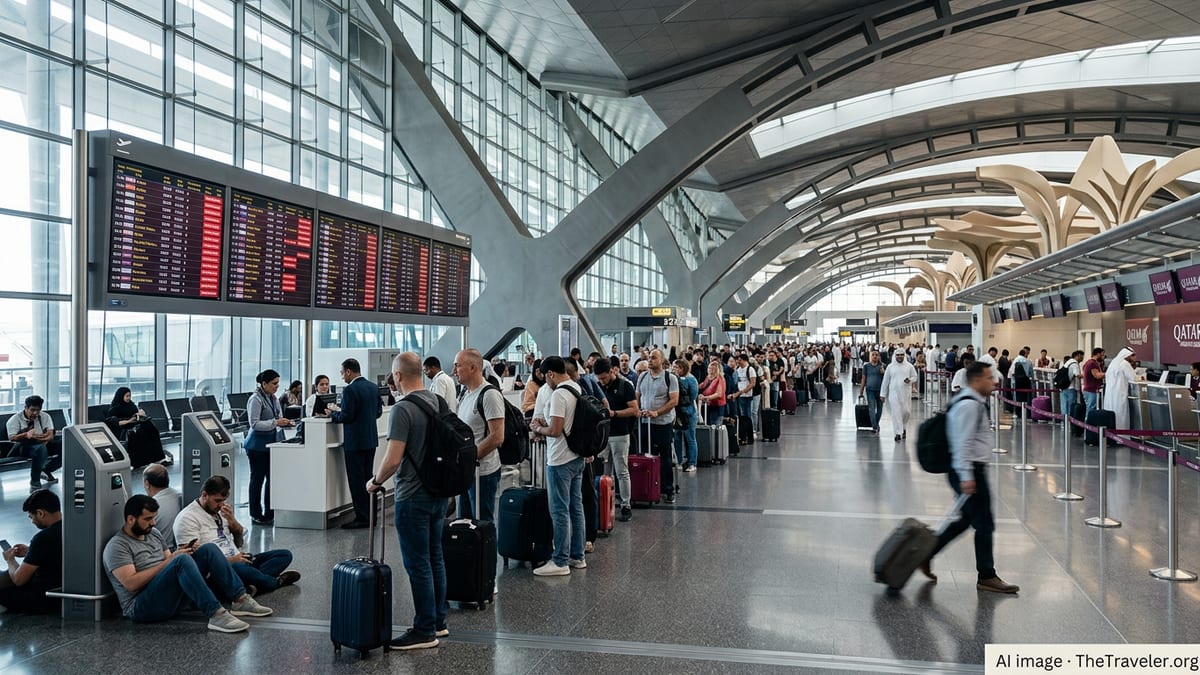
Airspace Closures Paralyse a Key Global Hub
The current disruption follows the closure of Qatari airspace after Iranian strikes and rising regional tensions, which forced authorities to halt almost all commercial movements into and out of Doha at the start of March. Hamad International Airport, normally one of the Middle East’s busiest connecting hubs, has been operating at a fraction of its capacity as airlines scramble to reroute or ground services.
Local aviation authorities have since authorised only a narrow contingency corridor, allowing a limited number of relief and repatriation flights to operate under strict controls. That partial reopening has offered some hope to stranded travellers, but it has not been enough to prevent a wave of cancellations that has now surpassed 500 flights when accounting for all affected carriers over the past week.
With the wider Gulf region also hit by airspace restrictions, the temporary shutdown in Doha is compounding an already fragile situation for long haul connectivity between Europe, Asia, Africa and Australasia. Airlines have been forced into longer routings around conflict zones, while others have suspended Middle East operations altogether.
Qatar Airways Scales Back to a Bare-Bones Operation
Qatar’s flag carrier, Qatar Airways, has borne the brunt of the turbulence. The airline suspended its full scheduled network earlier in the week, telling customers that all regular flights to and from Doha would remain halted until regulators signalled that it was safe to restore normal operations. The move immediately triggered hundreds of cancellations across its global schedule.
In a series of updates this weekend, the airline said it had secured temporary authorisation from the Qatar Civil Aviation Authority to run a tightly controlled relief corridor. On Sunday, March 8, it operated repatriation flights from Doha to several major European cities, prioritising families, elderly passengers and those with urgent medical or humanitarian needs. Only passengers with confirmed seats were asked to proceed to the airport, in a bid to prevent large crowds forming in the terminals.
For Monday, March 9, Qatar Airways has announced a limited set of inbound services into Hamad International Airport from Amsterdam, Berlin, Frankfurt, London, Zurich and Muscat. These flights are restricted to customers whose final destination is Doha and do not represent a broader reopening of the airline’s global network. Travellers holding onward connections have been urged to seek rebooking options or refunds, and to monitor direct communication from the airline rather than heading to the airport in person.
The carrier has also extended flexible policies for tickets covering the period from late February through mid-March, offering rebooking or travel vouchers as it works through a mounting backlog of disrupted itineraries.
Regional and International Carriers Caught in the Fallout
The shutdown of Qatar’s airspace and the knock-on operational limits at Hamad International Airport have hit far more than the country’s home airline. FlyDubai, Gulf Air, IndiGo, Virgin Australia and a range of other operators that rely on Doha as either a destination or a critical connection point have all reported cancellations and diversions.
Low cost and regional carriers have been particularly exposed on routes linking Doha with Gulf neighbours and South Asia, where frequencies are high and alternative routings are limited. Indian carrier IndiGo has already been grappling with its own scheduling pressures and has now had to cancel or reroute additional services avoiding Qatari and nearby airspace, putting further strain on its network.
Long haul airlines, including Virgin-branded services into the wider Gulf region and Asia Pacific connections run via Doha, have had to pause operations or rapidly shift passengers onto alternate hubs. Some travellers have been rebooked through Riyadh, Istanbul or European gateways, while others have been left facing multi day delays as seat availability tightens across the region.
Gulf-based operators that normally compete with Qatar Airways for transfer traffic are also feeling the effects of the broader conflict driven closures. With airports in the United Arab Emirates and Bahrain affected by missile threats and precautionary shutdowns at various points this week, the usual safety valves for displaced Doha traffic have not been able to absorb the surge in demand.
Passengers Stranded Worldwide as Backlogs Grow
The human impact of the disruption is increasingly visible, both in Doha and in far flung departure cities. Stranded Qatar Airways customers have reported sleeping in terminals from Melbourne to London as they await word of relief flights or alternative routings. Online forums are filled with accounts of repeated last minute cancellations, involuntary rebookings that still rely on closed airspace and long waits to speak with airline call centres.
In Doha, authorities have urged people not to travel to Hamad International Airport unless they have received explicit confirmation of a flight. The airport, which had earlier warned of overcrowding as passengers arrived hoping for standby seats, is now focused on managing controlled access for those on officially listed services. Hotel capacity in the city has come under pressure as airlines house transit passengers who can no longer continue their journeys.
For many travellers, the disruption has upended long planned trips, from family reunions and religious pilgrimages to business travel and major sporting events. Travel insurers are fielding rising claims, while tour operators are scrambling to rework itineraries that had relied on Doha as a seamless one stop connection between continents.
Industry analysts say it could take weeks for airlines to clear the backlog even after airspace fully reopens, as aircraft and crew are out of position and key routes remain heavily oversubscribed. Until then, passengers are being advised to build in significant flexibility, stay closely in touch with their carriers and consider alternative routings that avoid the most affected corridors.
Uncertain Timeline for Full Recovery
Despite the limited relief flights now operating, there is still no firm timeline for a complete restoration of normal services at Hamad International Airport. Officials in Doha have framed the partial reopening of air navigation routes as a cautious, safety led step that could be expanded only when regional security conditions allow.
Qatar Airways has signalled that it stands ready to scale up operations quickly once given the green light, with aircraft and crews on standby across its network. However, the airline has also warned that a phased restart is likely, with priority given to high demand trunk routes and essential travel before more peripheral connections return.
The broader Gulf aviation sector is watching closely, as Doha’s role as a transfer hub means its disruption has outsized effects on traffic flows between Europe, Africa, Asia and Oceania. Prolonged instability could encourage some passengers to favour routings through other regions in the medium term, though the scale and efficiency of Gulf hubs have historically allowed them to rebound quickly from crises.
For now, the message from airlines and authorities is one of caution and patience. With more than 500 flights already cancelled and counting, and only a narrow corridor into Doha currently available, travellers with near term bookings through Qatar are being urged to treat all itineraries as provisional until they receive direct confirmation that their flight is operating.