

More news on this day
Qatar Airways’ calibrated return to the skies from Doha is rapidly reshaping Gulf aviation, with a tightly controlled schedule that is already pulling global transit flows back toward Hamad International Airport and away from rival hubs still struggling to stabilise operations.
Get the latest news straight to your inbox!
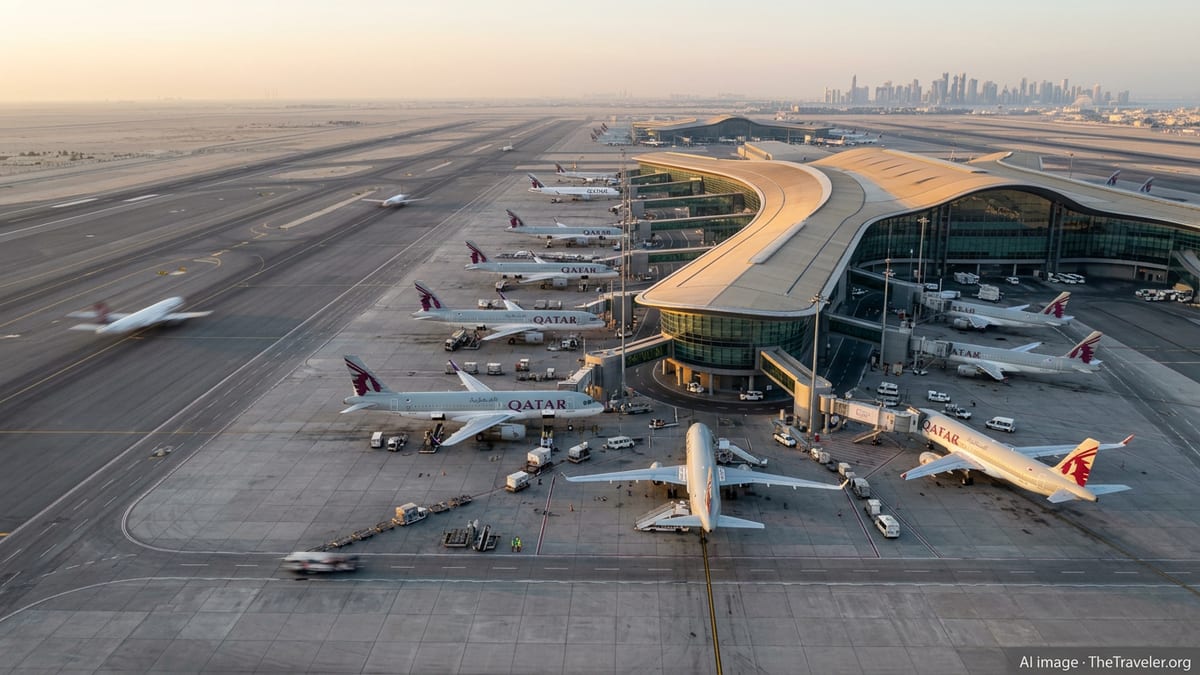
Strategic Restart Turns Limited Flights Into Maximum Influence
While the Gulf’s major hubs inch back from near standstill after late-February airspace closures, Qatar Airways is using a relatively small number of flights to achieve outsized impact. Schedule data and official updates show the carrier layering a compact network of long haul and regional services out of Doha that prioritises strategic corridors over sheer volume, effectively turning every available slot into a high-yield connection opportunity.
The airline’s plan for March 12, centred on 29 selectively restored flights, typifies this approach. Rather than chase breadth, Qatar Airways has focused on high-demand trunk routes linking Doha with major European capitals, North and South American gateways, and key nodes in Africa and Asia. This allows the carrier to reconnect critical flows between continents even as overall regional capacity remains heavily constrained.
Industry analysts note that Doha’s traditional strength has been its role as a pure connecting hub, with Qatar Airways accounting for the vast majority of movements at Hamad International Airport. In the current disruption, that model is being sharpened further: with less origin-and-destination traffic to protect than Dubai or Abu Dhabi, Qatar Airways can tune its schedule almost entirely around where displaced global passengers most need to go.
The result is that, despite running far fewer flights than in a normal March, Doha is again wielding disproportionate influence over long haul itineraries between Europe, Asia, Africa and the Americas. For many travellers, if there is a viable one-stop option this week, it is increasingly likely to pass through Qatar Airways’ home hub.
New Focus Cities Draw Traffic Away From Traditional Gulf Rivals
Central to Doha’s resurgence is the addition and expansion of flights to a handful of regional and near-regional cities that are acting as pressure valves for the disrupted Gulf network. Cairo, which joined Qatar Airways’ limited roster as a freshly restored destination, has emerged as a key staging point, funnelling passengers from North Africa and parts of Europe toward the carrier’s long haul departures.
Similar dynamics are playing out in Muscat and Jeddah, where Qatar Airways services are effectively backfilling connections normally handled via Dubai or Abu Dhabi. Airports in these cities are seeing a surge in transit and positioning traffic linked directly to Qatar Airways’ constrained schedule, as travellers accept more complex routings in exchange for certainty of movement.
This recalibration is subtly rebalancing regional competition. Emirates and Etihad have restarted a broader range of flights from Dubai and Abu Dhabi, but their operations remain capped by airspace restrictions and safety margins. Doha, by contrast, is concentrating its thinner schedule into a spine of high-value destinations that underpins its status as a long haul connector even at reduced capacity.
Airports and tourism authorities in these emerging focus cities are seizing the moment. Local officials in Cairo and Muscat report elevated hotel demand and rising transfer traffic, underlining how Qatar Airways’ selective rebuild is exporting Doha’s hub effect across a wider geography while still keeping the Qatari capital at the centre of the network.
Passenger Scramble Highlights Doha’s Pricing Power
For passengers caught in the upheaval, the return of scheduled Qatar Airways flights through Doha has been both a relief and a new source of pressure. Seats on the newly filed services have sold out quickly on several routes, according to booking platforms and travel agents, as stranded travellers race to secure one-stop connections that avoid protracted layovers or multi-stop detours.
The scarcity is translating into strong pricing power. With Gulf hubs still operating well below normal capacity, fares between Europe and Asia, and on Australia and New Zealand routes, have jumped sharply. As one of the few carriers now offering cohesive long haul itineraries via a single Middle Eastern hub, Qatar Airways is in a position to command premiums on many of its limited flights.
Agents say corporate travellers and long haul leisure passengers are showing a clear willingness to pay more for routings that keep transfers to a minimum and rely on a single airline from origin to destination. In this environment, a Qatar Airways ticket via Doha is often viewed as a safer bet than more fragmented itineraries stitched together through multiple hubs, some of which remain vulnerable to last-minute cancellations.
That demand profile feeds directly into Doha’s renewed dominance. Even as rival hubs add flights back into their schedules, Qatar Airways’ combination of network coherence and brand recognition is pulling high-yield traffic back into its orbit, reinforcing Hamad International’s position as the Gulf’s most resilient long haul junction.
Airspace Constraints Reshape Regional Hierarchy
The broader context for Doha’s re-emergence is a volatile airspace picture across West Asia. Recent missile and drone activity prompted sweeping closures that temporarily shut or curtailed operations at multiple Gulf hubs. While Dubai and Abu Dhabi began phased resumptions earlier this month, lingering restrictions and cautious route planning are keeping a lid on frequencies and forcing complex detours.
Qatar’s approach has been to hold back until it can operate within clearly defined safety parameters, then return with a schedule that is small but structurally significant. That contrasts with rivals who have prioritised scale and rapid resumption, only to trim or retime flights in response to evolving risk assessments and capacity bottlenecks.
Data from aviation consultancies suggests that, before the latest disruption, Doha had already eclipsed many competitors on the metric that matters most to connecting passengers: the proportion of hub traffic that is truly connecting rather than local. Today, as airlines re-thread their networks through a narrower set of safe corridors, that structural advantage is magnified.
Airlines elsewhere in the region, particularly those based in secondary hubs and low cost carriers reliant on open skies over the Gulf, are now recalibrating schedules around the reality that Doha and Qatar Airways are again acting as a primary bridge between continents. Each limited flight that departs Hamad International this week carries more connecting passengers than ever, underscoring how capacity cuts have not dulled the hub’s strategic edge.
What Doha’s Lead Means for Travellers in the Weeks Ahead
Looking beyond this week’s compressed schedule, Qatar Airways’ latest filings point to a gradual but deliberate ramp-up in capacity from Doha, contingent on stable airspace conditions. Aviation analysts expect more destinations to be added in waves, with frequencies increased first on already restored routes where demand has proved strongest.
For travellers, that is likely to translate into a premium tier of Doha-centric options returning ahead of a full restoration of pre-disruption choice across the region. Bookings that can be shifted a few days forward, especially for long haul trips between Europe, Asia and Australasia, may find additional Qatar Airways itineraries appearing as the airline unlocks further slots.
Rival hubs will remain important, particularly for origin-and-destination traffic into the United Arab Emirates and Saudi Arabia. Yet the current round of disruption has highlighted how quickly the balance can tilt toward Doha when network resilience and connecting efficiency matter more than raw flight counts. As long as Qatar Airways continues to rebuild with a focus on connectivity rather than capacity alone, its limited schedule will keep putting the Qatari hub firmly in the shade of its regional competitors.
In practical terms, passengers planning travel through the Gulf in the coming weeks may find it prudent to check Doha options first, especially on complex multi-leg journeys. While seats remain scarce and fares elevated, the return of even a thin Qatar Airways schedule has restored a measure of predictability to long haul planning that other hubs are still scrambling to match.