

More news on this day
Numerous flights at Doha’s Hamad International Airport have been cancelled or severely disrupted in recent days, leaving hundreds of passengers stranded as Qatar’s tightly controlled airspace remains at the center of the wider Middle East conflict.
Get the latest news straight to your inbox!
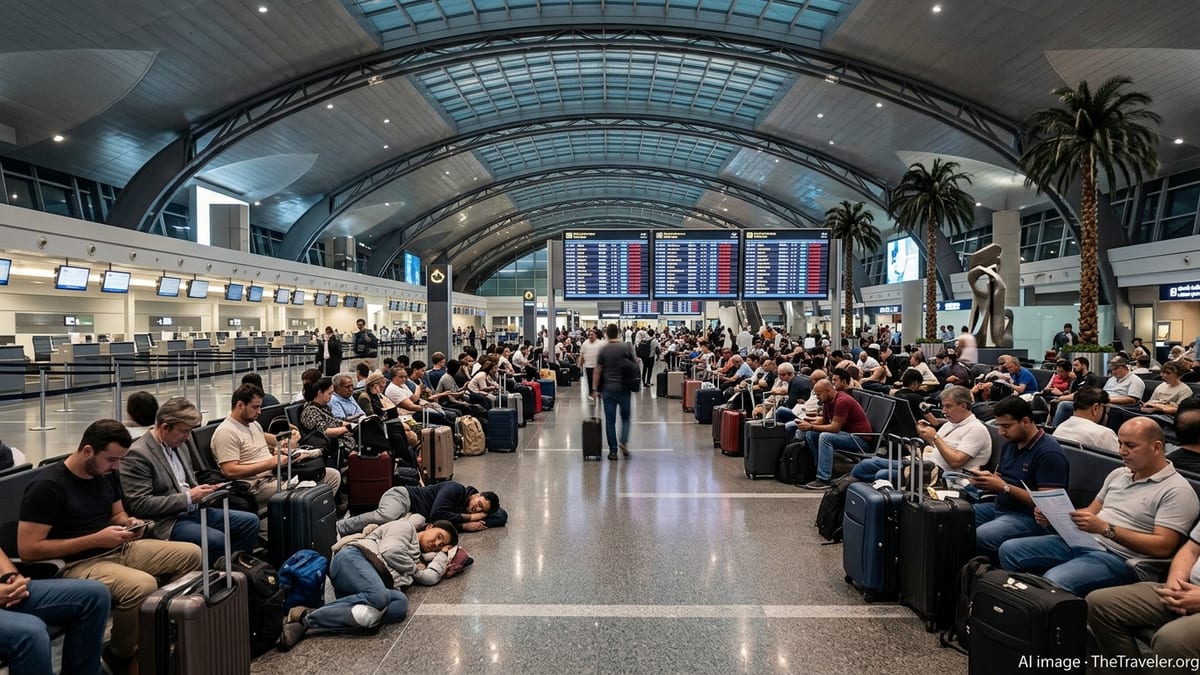
How the disruption at Hamad International unfolded
The latest wave of cancellations at Hamad International Airport follows the closure and gradual, tightly managed reopening of Qatar’s airspace after missile strikes and rising tensions linked to the 2026 Iran war. Publicly available information shows that standard commercial schedules through Doha were largely halted from late February, with only limited movements permitted under emergency arrangements.
Reports indicate that in the days that followed, thousands of flights across the region were cancelled or rerouted, with Doha among the hardest-hit hubs. Hamad International, normally one of the Middle East’s busiest transit airports, saw regular passenger services suspended or drastically reduced while aviation authorities evaluated security and traffic management conditions.
By early March, the Qatar Civil Aviation Authority had announced only a partial reopening of air navigation for a narrow set of operations. According to published coverage, this included specially organized repatriation flights and cargo services, while most routine commercial itineraries remained off the board. As a result, travelers who were already in transit or due to connect through Doha faced extended delays, uncertain rebooking options and, in many cases, days spent in terminals or temporary accommodation.
Industry bulletins from the second week of March describe Hamad International operating a limited number of repatriation flights aimed at clearing the backlog of stranded passengers. Even so, widespread cancellations and schedule changes continue to ripple through airline networks that rely on Doha as a central connecting point between Europe, Asia, Africa and the Americas.
Current situation for passengers in Doha
For travelers on the ground in Doha, the experience has been marked by long waits, shifting information and constrained options. Social media posts and passenger forums describe crowded departure halls, improvised sleeping areas and extended queues for customer service desks as travelers seek clarity on when they might be able to leave.
Publicly available airline updates suggest that priority on the limited flights now operating from Hamad International is being given to passengers whose earlier journeys were cancelled mid-trip and who have been stranded in Doha for several days. Some repatriation flights have been pre-allocated to travelers already ticketed through affected routes, limiting the availability of new bookings in the short term.
Travelers report that communication has varied by carrier and location, with some able to secure alternative itineraries via other Gulf or regional hubs, while others remain on waiting lists as airlines work through backlogs. Because aircraft and crew are not yet deployed at normal levels, spare capacity is extremely tight, and even confirmed flights are subject to last-minute timing changes.
Accommodation and welfare arrangements also differ depending on ticket type, airline policies and local regulations. Some stranded passengers indicate that they have been provided with hotel stays and meal support, while others have had to organize lodging at their own expense. Receipts and documentation are therefore important for any later reimbursement or insurance claims.
Why so many flights are being cancelled
The immediate cause of the cancellations at Hamad International is the combination of airspace restrictions, security considerations and network disruption stemming from the wider regional conflict. When large sections of regional airspace are closed or heavily controlled, airlines must rapidly reconfigure flight paths, crew rosters and aircraft positioning, often making scheduled services through a hub like Doha temporarily unworkable.
According to published coverage of the 2026 Iran war, multiple countries in the Gulf and wider Middle East enacted full or partial airspace closures after missile and drone strikes, including those targeting aviation-related infrastructure. Even where physical damage has been limited, elevated risk assessments and the need to create safe corridors for evacuation and cargo flights have pushed regular passenger operations down the priority list.
On top of the security dimension, operational complexity contributes to prolonged disruption. Airlines need time to reposition planes that were diverted or grounded, return crews to legal duty-time patterns, and rebuild intricate global schedules designed around wave-like banks of arrivals and departures. With Doha functioning as a major transfer hub rather than just an origin-destination airport, a bottleneck in any part of its network can cascade into widespread cancellations.
The result is a rolling pattern of schedule changes. Even as some repatriation and relief flights operate from Hamad International, many onward connections remain suspended or heavily reduced, prompting airlines to cancel segments days or weeks in advance while they try to rebuild a predictable timetable.
What affected travelers should do now
For passengers whose flights to, from or through Doha have been cancelled, the first priority is to confirm the status of their booking directly with their airline or, if applicable, their travel agent. Publicly available guidance from carriers operating through Hamad International indicates that most are offering a mix of free rebooking, travel vouchers or refunds, subject to fare rules and the specifics of each disruption.
Given the scale of the cancellations, travelers are being advised in many publicly accessible advisories to use digital channels such as airline apps, websites and social media for updates wherever possible, as call centers and airport desks are experiencing heavy demand. Keeping contact details and notification settings up to date can help ensure that any automatic rebooking offers or schedule changes reach passengers promptly.
Where alternative routings are available, many airlines are allowing changes to different departure dates, nearby airports or partner carriers without the usual change fees, although fare differences may still apply. In some cases, travelers have reported that securing space on flights via other regional hubs has been the fastest route home, even if it involves additional connections or an overland segment to reach an open airport.
Travel insurance policies and credit card protections may provide supplementary coverage for accommodation, meals and incidental expenses incurred during extended delays. However, benefit limits and exclusions vary widely, so travelers are encouraged by consumer advocates to review policy wording carefully and keep detailed records of out-of-pocket costs.
Outlook for flights through Doha in the coming days
Looking ahead, the trajectory of flight operations at Hamad International will depend largely on how regional security conditions evolve and how quickly aviation authorities expand the scope of permitted traffic. Industry reporting suggests that air navigation over Qatar has moved from a full closure to a restricted, emergency-focused regime, with gradual steps toward broader reopening under discussion but not yet complete.
As more safe corridors are established and airlines finalize operational plans, the number of repatriation and relief flights from Doha is expected to increase, helping to clear at least some of the backlog of stranded passengers. However, experts cited in open-source analyses caution that a full return to pre-crisis schedules could take weeks or even longer, especially on lower-frequency or highly interconnected routes.
Travelers with bookings through the remainder of March are likely to face a fluid situation in which timetables are revised repeatedly. Some airlines have already extended blanket cancellation windows for specific dates or destinations, signaling that they do not expect normal operations to resume immediately. Prospective passengers are therefore being encouraged, in publicly available advisories, to monitor their flights closely and to consider flexible arrangements where possible.
For now, Hamad International Airport remains a critical but constrained node in the global air travel system, simultaneously serving as a staging point for evacuation efforts and a chokepoint for routine passenger traffic. Until regional skies fully reopen and airlines can restore their normal wave patterns through Doha, travelers can expect continued cancellations, limited seat availability and a premium on timely, verified information.