

More news on this day
Travelers across Europe, the Middle East, Asia, and North America are facing severe disruption as more than 120 flights linked to Doha have been canceled or heavily curtailed, with Qatar Airways, Gulf Air, Malaysia Airlines, and other carriers trimming schedules and rerouting services amid ongoing regional instability.
Get the latest news straight to your inbox!
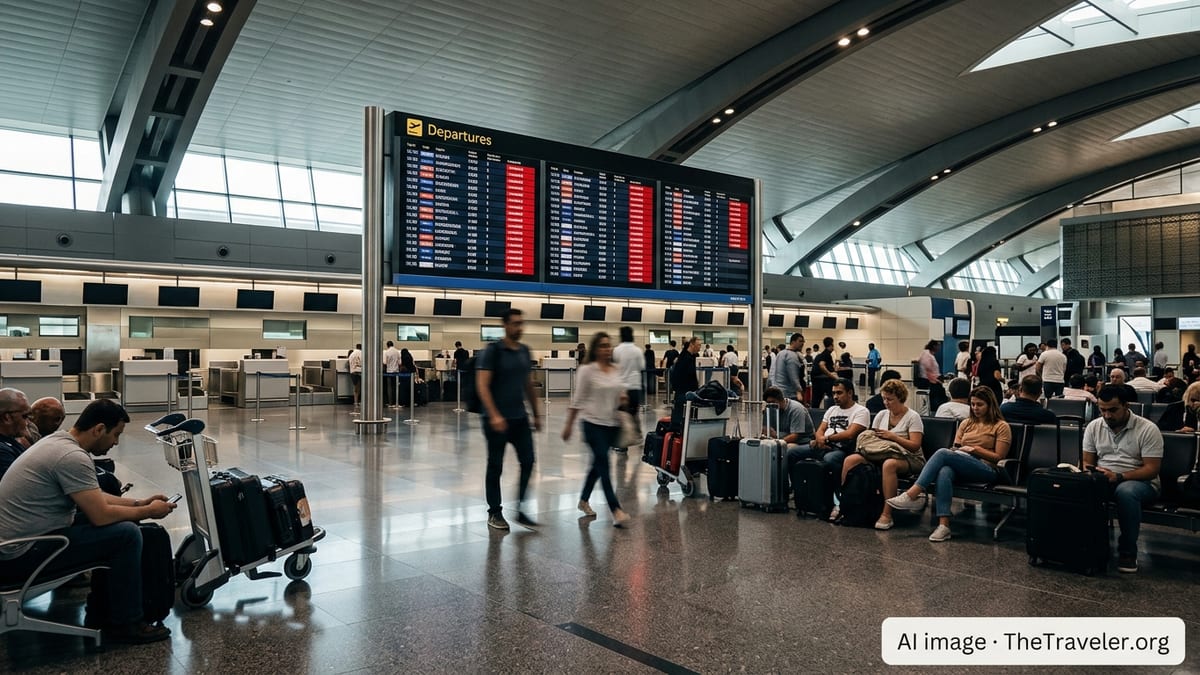
Major Cancellations Hit Doha’s Role as a Global Hub
Publicly available flight data and travel advisories show that Hamad International Airport in Doha remains one of the hardest-hit hubs in the Gulf, with widespread cancellations and a sharply reduced schedule compared with normal operations. Industry assessments and security briefings indicate that commercial services have been operating on an emergency, corridor-based model for much of March, rather than as a fully open global hub.
Analysts tracking airline timetables report that more than 120 individual flights involving Doha have been withdrawn or consolidated in recent days, affecting both inbound and outbound services. The figure spans Qatar Airways’ own network and services by partner and regional airlines such as Gulf Air and Malaysia Airlines, which typically rely on Doha for connections between Europe, the Middle East, and Asia.
The loss of capacity has significantly eroded Doha’s usual status as a high-frequency connector between continents. In ordinary conditions, Qatar’s airspace and its flagship airport handle a sizeable share of east–west traffic, but current restrictions mean that far fewer aircraft are taking off and landing, and many routes remain absent from booking systems.
Key Long-Haul Routes to Europe, Asia, and North America Disrupted
Routes linking Doha to major European gateways such as London, Paris, Amsterdam, Frankfurt, and Rome have been among the most affected. Travel forums, airline bulletins, and risk advisories highlight repeated cancellations and “rolling” schedule changes on these corridors, with some passengers reporting that flights were withdrawn only a few days before departure, then rebooked and later canceled again.
Limited “safe-corridor” or repatriation-style flights have continued on select days from Doha to cities like London Heathrow and Paris Charles de Gaulle, but at a fraction of normal frequency. Travelers who once had multiple daily options are now seeing single departures on specific dates, often fully booked and subject to last-minute timing adjustments.
Asian routes have also been heavily curtailed. Services between Doha and key destinations such as Singapore and Bangkok, typically operated by Qatar Airways and interline partners including Malaysia Airlines, have seen a patchwork of cancellations, retimings, and reroutes. Some long-haul itineraries that would ordinarily connect via Doha are instead being shifted over alternative hubs in Turkey, India, or East Asia, extending total travel times by many hours.
North American links have not been spared. Passengers booked on itineraries between Doha and cities such as New York report disrupted connections, reroutes via Europe, or offers to travel with partner airlines on different routings entirely. The reduced connectivity is especially problematic for travelers heading to or from secondary cities that depended on smooth transfers at Doha.
Passengers Face Uncertainty, Last-Minute Changes, and Complex Rerouting
For passengers, the cumulative effect of these cancellations has been days of uncertainty and rapidly shifting plans. Accounts shared on public forums and social platforms describe travelers receiving cancellation notices only a short time before departure, followed by long waits to reach call centers and secure alternative arrangements.
In many cases, travelers report being rebooked onto different dates or placed on partner airlines through other hubs, sometimes with substantially longer layovers or overnight stops. Some passengers who originated in Asia or Europe en route to destinations beyond Doha have turned to self-booked alternatives with fully refundable tickets on non-Gulf carriers, using them as a back-up in case their revised Doha itineraries fall through.
The disruption has also affected those already in Qatar and seeking to leave. With only a limited selection of outbound flights operating on any given day, demand for seats on available services has surged. Anecdotal reports point to higher one-way fares on certain alternative routes, alongside a scramble for scarce award and redemption seats when they appear in inventory.
Travel risk consultants advise that even confirmed tickets may be subject to further short-notice changes while airspace restrictions and adjusted airline schedules remain in place. Travelers are being encouraged, through widely circulated advisories, to monitor bookings frequently, enable airline app notifications, and maintain flexible onward plans.
Gulf and Asian Carriers Cut, Consolidate, and Reroute Networks
While Qatar Airways sits at the center of the disruption, other carriers with exposure to Doha and regional airspace are adjusting in parallel. Publicly available schedules and aviation briefings show that Gulf Air, Malaysia Airlines, and a range of European and Asian airlines have either suspended their own services to Doha or sharply reduced joint operations built around the Qatari hub.
Some operators appear to be consolidating several lightly loaded flights into a smaller number of departures, while others have opted to suspend particular routes entirely for a defined period. In several published advisories, airlines are steering passengers toward alternative routings via Istanbul, New Delhi, Kuala Lumpur, or other hubs that sit outside the most affected air corridors.
The shifting patterns have ripple effects that extend far beyond Qatar. Carriers that normally codeshare on Doha flights are recalibrating their networks in real time, moving capacity to secondary routes and focusing on cities where demand can still be served reliably. Industry reports suggest that these changes are adding pressure to already busy hubs elsewhere, with knock-on delays and equipment shortages.
For Malaysia Airlines and other Asian partners, the loss of predictable feed through Doha complicates long-haul planning to Europe and North America. Some have started leaning more heavily on their own regional partners to bridge gaps, effectively rebuilding itineraries that once relied on the Gulf as a central connection point.
Global Air Traffic Feels the Strain of a Disrupted Gulf Corridor
Aviation and economic analyses of the broader regional conflict indicate that airspace closures and capacity cuts across the Gulf are weighing heavily on global air traffic. Published assessments of the 2026 Iran conflict note that multiple Middle Eastern airports, including Doha, have either closed or reduced operations, helping to drive thousands of daily cancellations across the wider network.
With Qatar’s skies constrained, airlines operating long-haul links between Europe and Asia are being forced onto longer routes that bypass the most sensitive areas. These detours increase flight times and fuel consumption, pushing up operating costs and, potentially, ticket prices over time. The combination of diversions and canceled legs is also complicating aircraft and crew rotations, a key factor in maintaining stable schedules.
Travel risk briefings describe the current period as one of “ongoing operational instability” for the Gulf, with rolling adjustments rather than a single, time-limited closure. That pattern makes it difficult for airlines, travel agencies, and passengers to plan with confidence, since schedules published weeks in advance may not reflect the realities on the day of travel.
For now, the situation in Doha remains fluid. While some additional destinations and limited services have gradually been reintroduced in March, the scale of cancellations involving Qatar Airways, Gulf Air, Malaysia Airlines, and other partners continues to disrupt journeys between major cities such as London, Paris, Singapore, New York, Bangkok, and Amsterdam, with no firm timeline yet for a full restoration of pre-crisis connectivity.