

More news on this day
Travelers moving through Doha’s Hamad International Airport are facing another day of severe disruption, as reports indicate at least 29 flight cancellations and 10 significant delays affecting Qatar Airways, Gulf Air, and Malaysia Airlines services linking Doha with London, New York, and Kuala Lumpur.
Get the latest news straight to your inbox!
Fresh Turbulence at a Critical Gulf Hub
Hamad International Airport, one of the Middle East’s most important long-haul hubs, is again under pressure as disruption ripples across its departure boards. Publicly available flight-tracking data and passenger reports on March 16 point to dozens of grounded or heavily delayed services, with Qatar Airways bearing the brunt, and Gulf Air and Malaysia Airlines also affected on itineraries that normally funnel through Doha.
The latest figures indicate 29 cancellations and 10 delays tied to services connecting Doha with London, New York, and Kuala Lumpur, either directly or via codeshares and through‑tickets. The impact is being felt not only by origin and destination passengers, but also by those who rely on Doha as a connecting waypoint between Europe, Asia, and North America.
These problems come on top of a weeks‑long period of instability in Gulf airspace following regional tensions and intermittent restrictions on commercial traffic. According to published coverage, airspace closures and limited operating corridors have already triggered thousands of cancellations across the region in recent weeks, and the new wave of disruption at Doha suggests that recovery remains fragile.
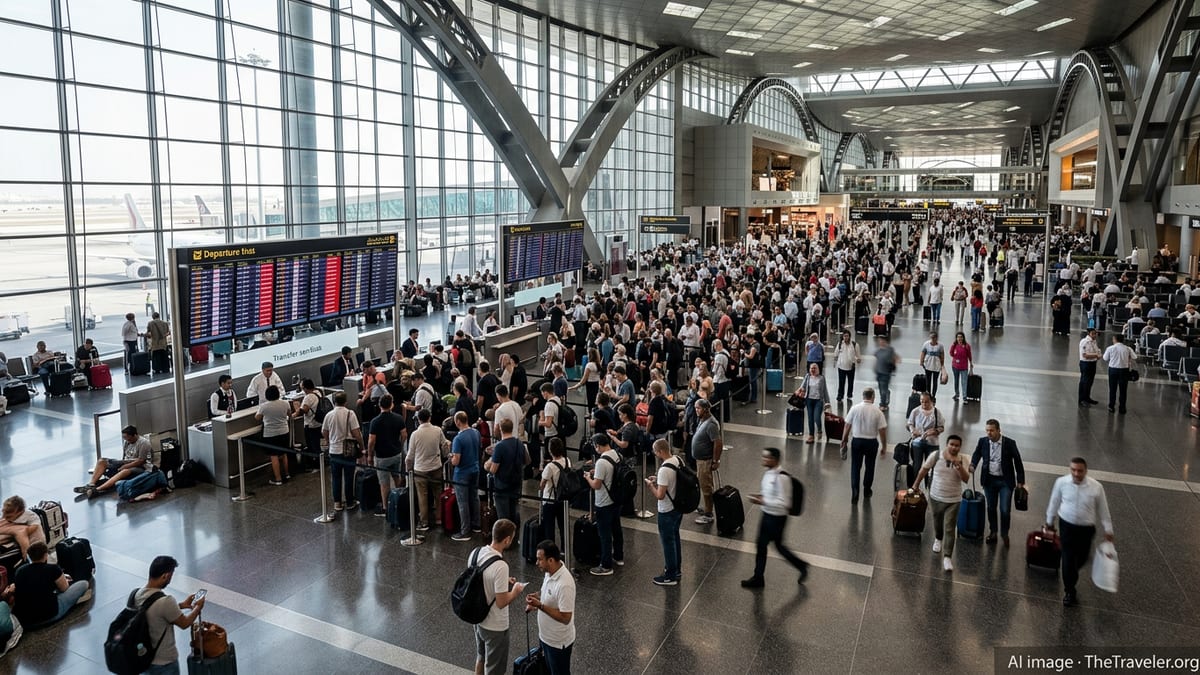
While basic airport operations continue, traveler accounts from Doha describe crowded terminals, long queues at transfer desks, and difficulty securing timely rebookings as airlines work within constrained schedules and reduced route options.
London, New York, and Kuala Lumpur Connections Disrupted
The latest operational snarl is particularly visible on some of Hamad International’s busiest long‑haul corridors. London services, especially Heathrow‑linked flights, have seen repeated cancellations and schedule changes since the start of March, with today’s tally adding more grounded services and missed onward connections for Europe‑bound travelers who normally rely on Doha’s dense bank of departures.
On the North Atlantic side, flights connecting Doha and New York have faced rolling disruption as airlines juggle aircraft availability, crew positioning, and evolving routings around sensitive airspace. According to publicly available information, some passengers ticketed on Qatar Airways itineraries have been shifted onto partner carriers via alternative hubs such as London or East Asia, adding extra legs and extended travel times.
In Southeast Asia, Kuala Lumpur routes have also been caught up in the turbulence. Malaysia Airlines and partner‑marketed flights that typically depend on smooth transits through Doha have seen cancellations and retimings, leaving some travelers in Malaysia scrambling to adjust plans at short notice. Recent passenger accounts highlight rerouting from Kuala Lumpur via Beijing or other Asian hubs in order to bypass constrained Gulf corridors.
The net effect is that three major global gateways London, New York, and Kuala Lumpur are experiencing knock‑on disruption from a single bottleneck in Doha, underlining how central Hamad International has become to intercontinental connectivity.
War‑Related Airspace Restrictions Still Casting a Long Shadow
The current bout of travel chaos cannot be separated from the broader regional context. According to widely reported analyses of the 2026 Iran conflict, airspace closures across Qatar and neighboring states have forced carriers to suspend or curtail many routes in recent weeks, with standard commercial schedules only partially restored under special operating permissions.
In Qatar’s case, the civil aviation regulator has gradually allowed limited emergency and repatriation services to move through designated corridors, but full commercial operations remain constrained. This patchwork reopening means that airlines are juggling a mix of one‑off rescue flights, ad hoc schedule changes, and heavily modified routings that can change on short notice as the security and diplomatic landscape shifts.
Qatar Airways, as the home carrier at Hamad International, has repeatedly adjusted its timetable across Europe, North America, and Asia in response to these conditions. Gulf Air and Malaysia Airlines, both of which depend on predictable overflight permissions and smooth access to regional hubs, have also had to rework operations, which in turn is contributing to the 29 cancellations and 10 delays reported today.
Industry observers note that even when airspace technically reopens, restoring normal patterns is not immediate. Aircraft and crews can be stuck out of position, maintenance windows are disrupted, and previously allocated takeoff and landing slots at busy airports such as London Heathrow and New York JFK may be lost, forcing airlines into less efficient alternatives.
Stranded Passengers Face Rebooking Challenges and Longer Journeys
For passengers, the operational complexity behind the scenes is translating into missed connections, unexpected hotel nights, and journeys that take days instead of hours. Recent traveler accounts shared publicly describe being told that there are no available seats to London for more than a week, as airlines work through a sizable backlog created by repeated waves of cancellations.
Some flyers connecting between Asia and Europe via Doha have reported being rerouted onto partner or non‑partner airlines altogether, sometimes via hubs as far afield as Beijing or Istanbul, to keep itineraries moving. Others have opted to cancel and seek refunds, then rebook independently on carriers whose networks avoid troubled airspace, accepting additional cost in exchange for more certainty.
According to publicly accessible airline guidance, flexible rebooking and refund policies introduced in response to the regional security situation remain in force, though passengers report that implementation can vary by channel and ticket type. Those who booked through online travel agencies or credit‑card portals often face an additional layer of coordination before any new itinerary is confirmed.
Meanwhile, Hamad International’s terminals themselves are experiencing the human impact of the disruption. Social media posts and forum discussions describe passengers camping in seating areas overnight, children sleeping on luggage, and long waits at customer service counters, as staff attempt to handle queues spanning multiple carriers and destinations.
What Travelers Can Expect in the Coming Days
With airspace conditions still fluid and airlines fine‑tuning their schedules day by day, further disruption at Hamad International appears likely in the short term. Operational data and industry commentary suggest that airlines will prioritize limited capacity for essential repatriation and key trunk routes, which may mean reduced frequency or temporary suspension on less critical city pairs.
For those scheduled to travel through Doha, travel experts advise closely monitoring booking tools and airline apps for last‑minute changes, as well as preparing contingency plans that might include rerouting via alternative hubs or adjusting travel dates. Given the current backlog, same‑day solutions are becoming harder to secure, particularly for popular destinations such as London and New York.
Analysts note that once regional security conditions stabilize and airspace is more reliably open, carriers like Qatar Airways, Gulf Air, and Malaysia Airlines are expected to ramp up operations, adding back frequencies and restoring suspended routes. However, with today’s 29 cancellations and 10 delays underscoring the fragility of the current setup, a full return to pre‑crisis normality is likely to be measured in weeks rather than days.
Until then, Hamad International Airport remains a vivid example of how geopolitical tensions can translate into very personal travel headaches for passengers around the world, turning a single missed flight in Doha into a chain reaction that stretches from London and New York to Kuala Lumpur and beyond.