

More news on this day
Global air travel has been thrown into turmoil after Qatar abruptly closed its airspace on February 28, 2026, forcing Qatar Airways to suspend all flights to and from Doha and severing one of the world’s busiest transit lifelines.
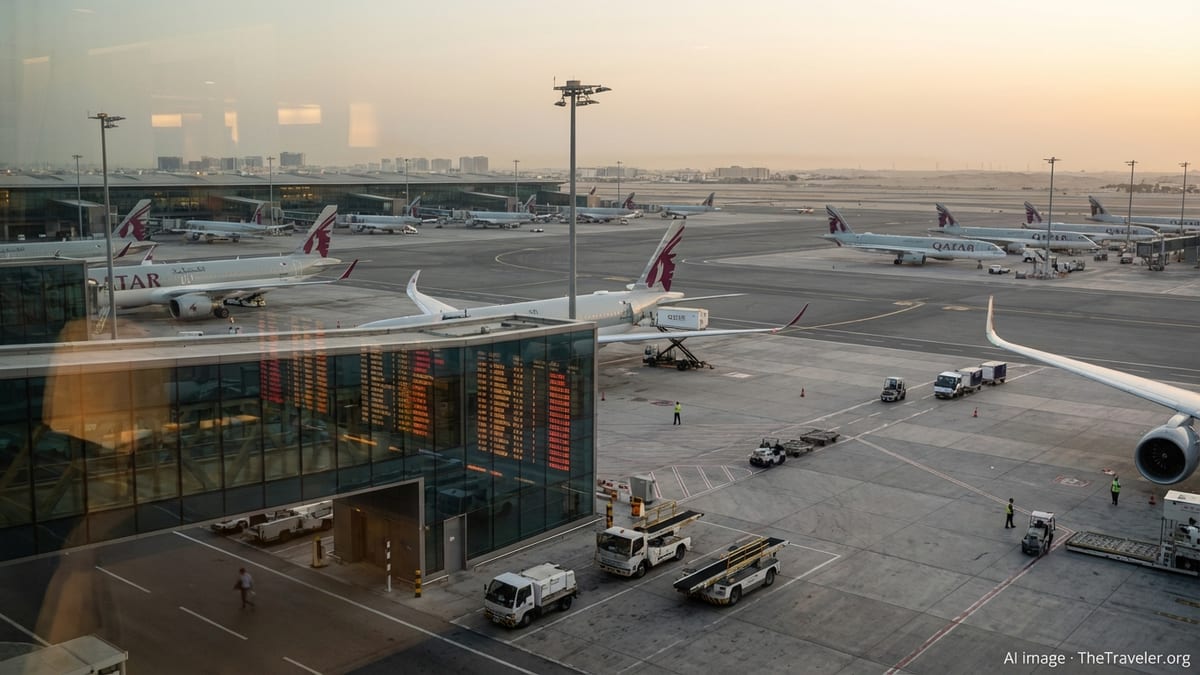
Qatari Skies Fall Silent as Conflict Spills Into the Air
Qatar’s civil aviation authorities ordered an immediate shutdown of national airspace on Saturday, halting commercial traffic in and out of Doha within minutes and effectively grounding Qatar Airways’ hub-and-spoke network. The move followed coordinated United States and Israeli strikes on Iran and subsequent regional missile activity, including intercepts reported over Doha itself.
Qatar’s Ministry of Defense confirmed that missile attacks targeting the Gulf state had been intercepted over the capital, while aviation regulators described the airspace closure as a precautionary safety measure. The Qatar Civil Aviation Authority announced a temporary suspension of air navigation, with no firm timeline for reopening. The decision instantly turned Hamad International Airport, a critical crossroads between Europe, Africa and Asia, from a 24-hour transfer machine into a holding zone for stranded travelers.
Qatar Airways, one of the world’s largest long-haul carriers, said it had temporarily suspended all flights to and from Doha in line with the airspace order. The airline stressed that operations would resume as soon as the airspace reopens and that the safety of passengers and crew remains its highest priority. Additional ground teams have been deployed at Hamad International Airport and at key outstations to manage the disruption and assist affected customers.
Shockwaves Along Global Flight Corridors
The sudden loss of Qatari airspace has reverberated across some of the world’s busiest long-haul corridors, especially between Europe, the Middle East, South Asia and Australia. Major carriers have been forced to divert or turn back aircraft already en route, with some passengers experiencing so-called flights to nowhere as jets returned to their departure airports after overflying hours of ocean and land.
Business and leisure travelers on itineraries carefully built around Doha’s wave of connecting departures are among the hardest hit. Qatar Airways typically operates hundreds of daily flights through its hub, funnelling passengers between secondary cities in Europe and Asia, the Indian subcontinent, Africa and Australasia. With the hub offline, entire chains of onward connections have collapsed, leaving airline call centers, apps and airport desks struggling to rebook customers onto alternative routings that avoid closed or high-risk airspace.
Regional neighbors have taken parallel steps, with the United Arab Emirates, Kuwait, Bahrain and other states restricting or closing their own airspace in response to the widening conflict. Aviation regulators in Europe have issued conflict zone bulletins urging airlines to avoid large swathes of Middle Eastern skies at all altitudes, creating sudden bottlenecks in the remaining open corridors. The resulting congestion is expected to drive longer flight times, higher fuel burn and rolling delays on routes far from the front lines.
Transit Passengers Face Uncertain Timelines and Limited Options
International transit passengers who had counted on seamless same-day connections in Doha now face overnight stays, missed events and in many cases an unplanned search for accommodation. At Hamad International Airport, travelers reported growing queues at service desks as staff arranged hotel vouchers where possible and tried to prioritize families, the elderly and those without visas to enter Qatar. With missiles intercepted over the capital and heightened security in place, authorities are balancing the need to clear the terminal with the imperative to keep people safe.
For passengers yet to begin their journeys, airlines and travel agents are advising against traveling to the airport without confirmed rebookings. Qatar Airways and rival carriers are waiving some change and refund fees, but inventory on alternative routings is tightening as demand surges. Travelers connecting between Europe and South or Southeast Asia, who often choose Doha as a convenient midpoint, may find themselves rerouted via more southerly tracks over Saudi Arabia, the Red Sea or Central Asia once airspace permits, or shifted to entirely different hubs in Istanbul, Riyadh or European capitals.
The uncertainty extends to timing. Authorities and airlines are framing the suspension as temporary, yet have not indicated whether the closure is likely to last hours, days or longer. Safety assessments will hinge on the trajectory of the regional conflict and on intelligence about the risk to civilian aircraft at cruising altitudes. Until that picture stabilizes, many carriers are expected to keep a conservative buffer around the Gulf, even if formal airspace bans are lifted.
Operational Strain and Strategic Risks for Qatar’s Aviation Hub
Beyond the immediate passenger impact, the shutdown represents a significant operational and strategic challenge for Qatar Airways and Hamad International Airport. The airline’s business model is built around dense global connectivity through a single hub, a structure that is highly efficient in stable times but acutely exposed to geopolitical shocks that affect local airspace. Temporarily losing access to its own skies effectively neutralizes the carrier’s ability to reposition aircraft, crews and cargo where they are needed.
Industry analysts note that the disruption comes at a time when global aviation is still recalibrating routes around other conflict zones, including airspace restrictions over parts of Eastern Europe and the Red Sea. Each new closure compresses traffic into fewer corridors, complicating flight planning and raising costs. For Qatar, sustained disruption could chip away at its competitive edge as a preferred transit point for travelers between continents, particularly if rivals are able to maintain more stable operations through alternative hubs.
In the short term, the airline is focused on crisis response: parking aircraft safely, maintaining crew duty limits, preserving critical cargo flows where possible, and communicating clearly with passengers and partners. In the longer term, the episode is likely to fuel wider industry debates about overreliance on a handful of mega-hubs in politically sensitive regions and may accelerate efforts to diversify routings and strengthen resilience against sudden shocks.
What Travelers Should Expect in the Coming Days
For now, passengers with existing bookings through Doha are being urged to monitor airline channels closely before making any moves. With telephone lines congested, digital tools have become the primary avenue for rebooking, refunds and notifications of schedule changes. Those whose trips are not time critical are being encouraged to consider postponement, freeing up scarce seats for travelers with urgent needs.
Travel insurers and consumer advocates say passengers should keep meticulous records of additional costs incurred, such as extra hotel nights, meals and local transport, which may be claimable under policy or passenger rights regimes depending on jurisdiction. However, they note that armed conflict and airspace closures often fall under force majeure categories, limiting the scope of compensation that airlines are legally required to provide.
As the situation evolves, the reopening of Qatari skies will not instantly restore normality. Once restrictions are lifted, Qatar Airways and other carriers will need time to reposition aircraft and crew, clear backlogs and absorb a wave of disrupted passengers into already busy schedules. Travelers transiting through Doha in the days and weeks ahead should brace for continued delays, last-minute gate changes and altered routings, even after the first planes lift off again from the Qatari capital.