

More news on this day
Flights to and from Doha remain largely suspended as Qatari airspace stays closed following recent regional attacks, disrupting operations at Hamad International Airport and clouding the outlook for Qatar’s tourism sector.
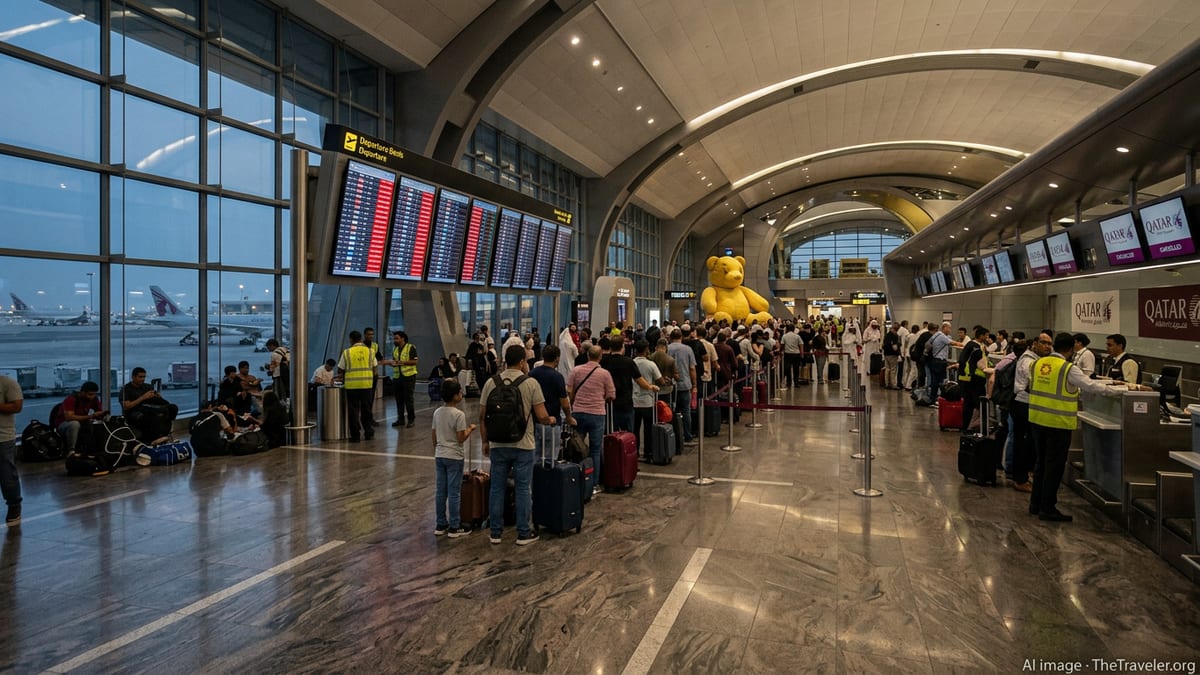
Airspace Closure Keeps Most Flights Grounded
Qatar’s General Civil Aviation Authority has kept the country’s airspace closed since February 28, 2026, in response to escalating regional security tensions and missile and drone attacks targeting the Gulf. The move has effectively halted normal commercial traffic in and out of Doha, transforming one of the world’s busiest transit hubs into a largely quiet airport handling only a trickle of special flights.
Hamad International Airport, consistently ranked among the Middle East’s top airports, has confirmed that the airspace closure remains in force as of March 9. Airport management has urged passengers not to travel to the terminal unless they have been specifically instructed to do so by their airline, warning that most scheduled services remain suspended and that space within the terminal is being reserved for those on confirmed relief flights.
The restrictions follow a week of heightened military activity across the region, including Iranian strikes and air-defense interceptions over Qatar. While the airport itself has avoided major damage, officials say airspace safety considerations leave them with no option but to limit activity until authorities deem the skies secure enough to reopen.
For now, the closure means that tens of thousands of seats once available daily through Doha have disappeared from the global aviation network, with knock-on effects for travelers well beyond the Gulf.
Limited Corridors and Relief Flights Offer a Narrow Lifeline
Despite the broad shutdown, Qatari authorities have carved out a narrow operating corridor to allow limited, tightly controlled flights. Hamad International Airport and Qatar Airways say these services are designed mainly for passenger repatriation and essential cargo, not for restoring normal connectivity.
Qatar Airways, which initially extended a blanket suspension of regular scheduled flights, has begun operating a small number of relief flights to and from Doha via the temporary corridor. According to statements published since March 7, the airline has focused on connecting Doha with key European and regional cities, including Amsterdam, Berlin, Frankfurt, London, Zurich and Muscat, with additional services announced to destinations such as Seoul, Moscow, Delhi, Madrid, Beijing, Perth and Nairobi over the coming days.
These flights are explicitly limited to passengers whose final destination is Doha and do not represent a full restart of the carrier’s global hub operations. Authorities stress that each flight must be individually authorized and may be subject to last-minute adjustments, given the fluid security environment and the strict constraints of the safe operating corridor.
Airport officials and the airline are also coordinating dedicated evacuation waves for stranded passengers and maintaining cargo movements for essential supplies. However, in capacity terms, the emergency operations represent only a fraction of Hamad International Airport’s usual throughput.
Stranded Passengers and Travel Chaos in Doha
The sudden shutdown has left thousands of travelers stranded in and around Doha, many of them transit passengers who had been connecting through Qatar’s hub when airspace restrictions took effect. Local media and aviation analysts estimate that up to several thousand passengers have been affected, with some now waiting days for a seat on outbound relief flights.
Qatar’s authorities say they have moved quickly to provide hotel accommodation, food, and visa extensions for those unable to leave the country, working with airlines and embassies to prioritize vulnerable travelers and families. According to guidance issued by Hamad International Airport, passengers whose flights were canceled should avoid going to the airport and instead liaise with their airline or travel agent remotely to rebook onto available services.
The uncertainty has rippled into travel planning worldwide. Tour operators, corporate travel managers and individual tourists who had booked Doha stopovers or Qatar as a final destination are scrambling to reroute itineraries at short notice. Some passengers are turning to alternative Gulf gateways such as Dubai or Abu Dhabi, where limited services have resumed, though seat availability is tight and prices have surged on remaining routes.
Airlines that relied on Doha as a major connection point, including codeshare and alliance partners of Qatar Airways, are meanwhile adjusting schedules, deploying larger aircraft on alternative routes and, in some cases, temporarily suspending services until airspace conditions stabilize.
Tourism Ambitions on Hold as Arrivals Plunge
The timing of the disruption is a blow to Qatar’s tourism strategy. Since hosting the FIFA World Cup in 2022, Qatar has invested heavily in positioning Doha as a year-round destination for stopover visitors, business travelers and major events, supported by Hamad International Airport’s role as a global super-hub.
With regular flights suspended, international arrivals have dropped sharply, affecting hotels, tour operators, restaurants and the city’s growing cultural and events calendar. Industry figures say previously strong booking pipelines for spring conferences, exhibitions and high-end leisure travel are now under review, with some events postponed and others shifted to alternative locations in the region.
Retail and hospitality operations linked directly to Hamad International Airport, including its luxury shopping precincts and airside hotels, are also feeling the impact. While some outlets remain open to serve relief passengers and airport staff, revenue volumes are far below normal, and staffing schedules have been scaled back pending clearer guidance on when full operations can resume.
Travel analysts note that Qatar’s tourism sector has shown resilience in past regional crises, but warn that the longer the airspace remains closed, the harder it will be to quickly rebuild traveler confidence and restore long-haul connecting traffic that underpins many of Doha’s recent tourism gains.
What Travelers Need to Know Right Now
For travelers with upcoming trips involving Doha or connections on Qatar Airways, the most important message from authorities is not to proceed to the airport unless holding a confirmed booking on an operating flight. Both the airline and Hamad International Airport are directing passengers to use official digital channels or travel agents to check the latest status of their journeys and to explore rerouting options where possible.
Those currently in Qatar should monitor airline notifications closely, as seats on relief flights are limited and typically prioritized for travelers whose journeys have already been disrupted. Travelers may be asked to accept alternative routing, dates or destinations as airlines work to clear backlogs within the narrow operating windows permitted by the temporary air corridor.
New bookings to or through Doha are heavily constrained, and many carriers have removed Doha from their schedules until further notice. Travel insurers may treat the closure differently depending on policy wording, so passengers are advised to review coverage for disruption caused by security incidents and government-ordered airspace closures.
Looking ahead, Qatari aviation authorities say normal flight operations will resume as soon as they can confirm that the airspace can be safely reopened. Until such a decision is announced, however, travelers should assume that only a limited number of carefully controlled flights will operate, and plan their journeys with considerable flexibility built in.