

More news on this day
Travelers across the Middle East, Africa and Asia are facing renewed disruption after around 91 flights linked to Doha’s Hamad International Airport were reportedly cancelled, affecting services operated by Qatar Airways, Gulf Air, Malaysia Airlines, Saudia, EgyptAir and other carriers and putting fresh pressure on major gateways including Cairo, Bahrain, Nairobi and Kuala Lumpur.
Get the latest news straight to your inbox!
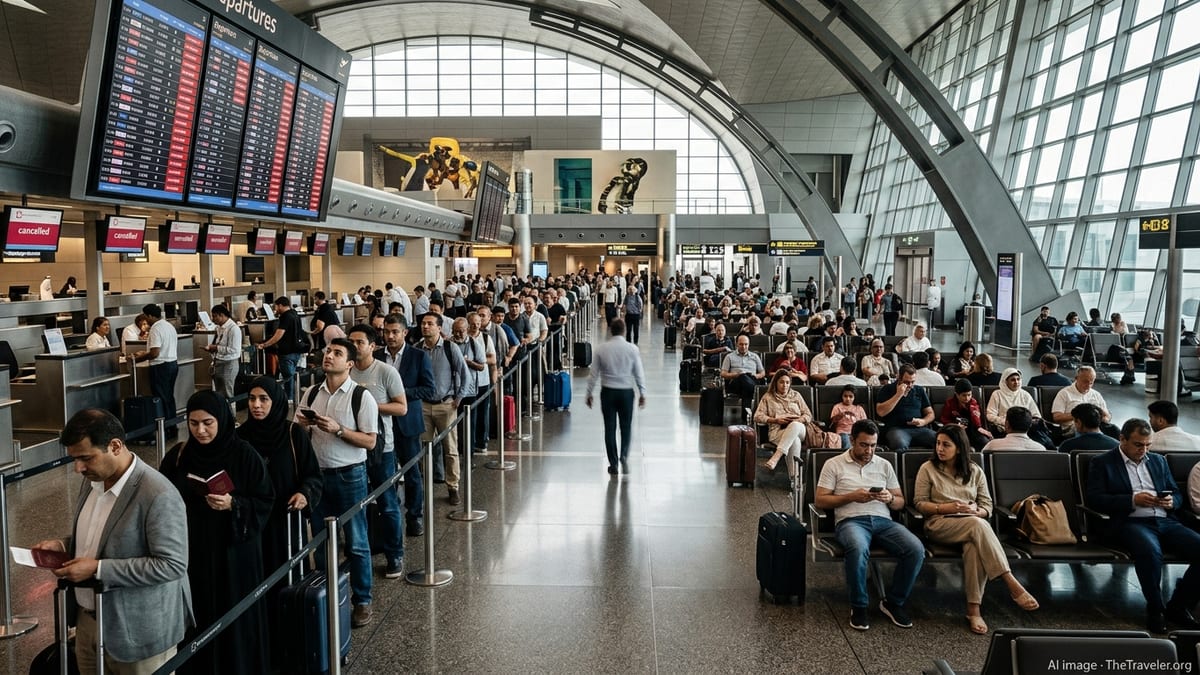
Rolling Disruptions at Hamad International Airport
Publicly available aviation data and regional media coverage indicate that cancellations around Doha escalated in the wake of airspace restrictions connected to the ongoing 2026 Iran conflict, with Hamad International Airport at the epicenter. The reported cancellation of 91 flights in a short window added to an already fragile operating environment, forcing airlines to trim schedules, consolidate services and divert aircraft away from Qatar’s main hub.
Specialist security and aviation briefings describe “rolling” airspace closures and reopenings across the Gulf, with Hamad International among the airports experiencing repeated schedule adjustments and short-notice disruptions. These stop-start permissions for limited operating corridors have allowed some repatriation and point-to-point flights, but the broader network around Doha has remained constrained, making regular planning difficult for both carriers and passengers.
According to flight-tracking snapshots and airline bulletins, cancellations have cut across long-haul and regional routes, including services to and from Europe, East Africa and Southeast Asia. Some flights that remained on departure boards were later removed or rescheduled as airlines reassessed routings and crew availability in light of changing airspace risk assessments.
The resulting uncertainty has been particularly acute for transit passengers, who traditionally rely on Doha as a through-connection hub. With many itineraries broken mid-journey, travelers have had to endure extended layovers, short-notice hotel arrangements or rerouting via alternative hubs.
Major Carriers Forced to Trim Networks
Qatar Airways, whose global network normally funnels large volumes of connecting traffic through Hamad International Airport, has continued to operate only a limited schedule under emergency permissions from national aviation authorities. Recent statements carried in local newspapers refer to narrow operating corridors and a focus on flights for travelers whose final destination is Doha, rather than full-scale hub-and-spoke connections.
Gulf Air, Saudia and EgyptAir have also been drawn into the disruption, as regional airspace closures and risk advisories forced adjustments to timetables involving Doha and neighboring hubs. Public timetables and booking engines for these airlines show a pattern of cancellations and aircraft type changes on affected routes, including those touching Bahrain and key Saudi gateways, as carriers attempt to maintain some connectivity while avoiding high-risk air corridors.
Malaysia Airlines and other Asian carriers with services into Doha and nearby Gulf hubs have likewise been impacted. Routes connecting Southeast Asia to the Middle East and onward to Europe have been subject to cancellation or diversion, fragmenting what would normally be seamless multi-leg trips. Passengers originating in Kuala Lumpur, Bangkok and other regional airports have reported being rebooked onto alternative routings through different hubs as airlines work around the constrained access to Qatari airspace.
Industry analyses of the wider conflict-related aviation disruption point to thousands of cancellations across the Middle East since late February, with the 91-flight figure associated with Doha forming just one snapshot of a much larger pattern of operational volatility.
Knock-on Effects in Cairo, Bahrain, Nairobi and Kuala Lumpur
The impact of cancellations centered on Hamad International Airport has been felt most strongly in other major transit and origin-destination airports that depend on flows to and from Doha. In Cairo, schedule data and local reporting show disrupted services involving both Qatar Airways and EgyptAir, affecting passengers moving between North Africa, the Gulf and beyond. Cairo’s role as a major regional connector has amplified the consequences of even modest schedule cuts.
In Bahrain, Gulf Air’s home base has had to absorb a mixture of rebooked passengers and tactical schedule changes. Aviation risk briefings highlight Bahrain as one of several Gulf states managing intermittent airspace restrictions, with delays and cancellations at Bahrain International Airport feeding into the same web of regional disruption that has slowed traffic through Doha.
Nairobi has emerged as another pressure point. Travelers using Kenya’s main airport as a gateway to and from Doha have faced multiple cancellations and rebookings, reflected in passenger reports and booking system changes. Routes linking Nairobi with Doha are important for traffic between East Africa, Europe and Asia, and any reduction in capacity quickly reverberates through tour operators, business travel and migrant worker flows.
In Kuala Lumpur, Malaysia Airlines and codeshare partners have been adjusting schedules as regional closures and risk advisories continue. Kuala Lumpur International Airport, a significant Southeast Asian hub, has recorded cancellations and altered routings on services that would typically connect through Doha, interrupting travel patterns between Southeast Asia, the Middle East and Europe.
Stranded Passengers and Complex Rebooking Efforts
The wave of 91 cancellations linked to Hamad International Airport has contributed to a growing number of stranded travelers across several continents. Social media posts and passenger forums describe cases of families and solo travelers stuck in Doha, as well as in outstations such as Nairobi and Kuala Lumpur, waiting for rebooking options as airlines work through backlogs.
Publicly accessible advisories from Qatar Airways and other affected carriers emphasize flexible rebooking policies, including options to change dates or reroute through alternative hubs where feasible. However, limited seat availability and the concentration of demand on a reduced number of operating flights have complicated these efforts, leaving some travelers facing days-long delays or multi-stop replacement itineraries.
Travel industry observers note that airline call centers and airport ticket desks have come under sustained pressure as passengers seek clarity on which of their upcoming flights remain viable. In some cases, route suspensions have led to the creation of ad hoc “special flights” or one-off services to help clear stranded passengers, particularly on high-demand corridors linking Doha with major cities in Europe, South Asia and Africa.
The cascading disruptions have also affected cargo movements, with freighter and belly-hold capacity reduced by cancellations and reroutings. This has had secondary effects on time-sensitive shipments and supply chains that ordinarily depend on frequent services through Doha and the other impacted hubs.
Outlook: Limited Recovery Amid Ongoing Volatility
As of mid-March 2026, publicly available schedules suggest a gradual but uneven effort to rebuild limited operations at Hamad International Airport. Some carriers, including Qatar Airways, appear to be introducing a small number of additional routes and frequencies under strict operating constraints, while maintaining wider suspensions on many long-haul and regional services.
Aviation risk assessments continue to classify the broader Gulf airspace environment as high risk, and analysts expect cancellations and short-notice changes to remain a feature of travel in and out of Doha for some time. The 91-flight cancellation episode underscores how quickly conditions can shift, even when airports are attempting to reopen in a controlled and phased manner.
For travelers, the evolving situation means that flexibility remains essential. Travel specialists recommend closely monitoring airline apps and official communication channels, preparing for potential overnight stays during connections, and considering alternative routings through less affected hubs where possible. With key airports from Cairo and Bahrain to Nairobi and Kuala Lumpur still feeling the knock-on effects of disruptions centered on Doha, the regional air travel network is likely to remain fragile in the weeks ahead.