

More news on this day
Travel disruption in Qatar intensified on March 13 as at least 287 flights to and from Doha were cancelled in a fresh wave of schedule cuts by Qatar Airways and multiple partner and regional carriers, prolonging an aviation crisis that has upended journeys across the Gulf and beyond.
Get the latest news straight to your inbox!
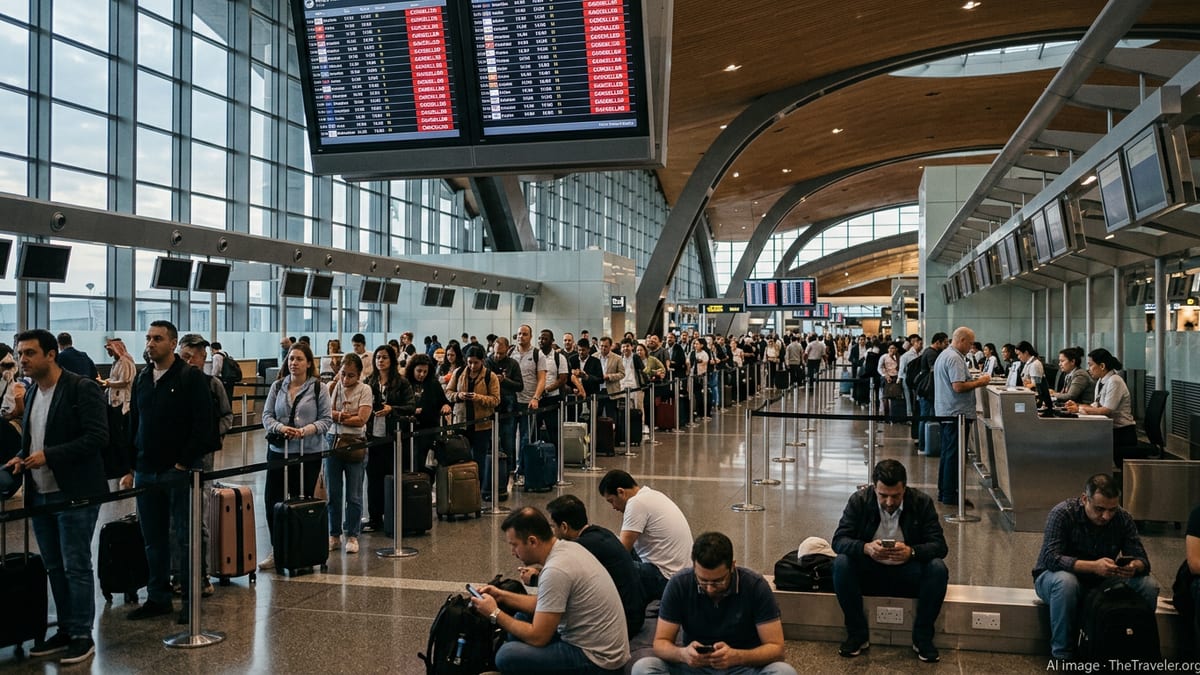
New Cancellations Hit Doha Hub as Crisis Drags On
The latest cancellations, verified through airport operations data and airline schedule updates on Wednesday and Thursday, affect departures and arrivals operated or codeshared by Qatar Airways, Gulf Air, IndiGo, Malaysia Airlines and several other partners that funnel traffic through Hamad International Airport in Doha. The affected flights include regional shuttles across the Gulf, high-demand links to South Asia, and long-haul connections to Europe and Southeast Asia.
Qatar’s aviation sector has been under mounting pressure since late February, when the regional security crisis linked to the Iran conflict triggered sweeping airspace restrictions and route suspensions across multiple Gulf states. While Qatar’s Civil Aviation Authority has allowed only a partial resumption of traffic on tightly controlled contingency routes, overall capacity remains sharply limited, leaving airlines to trim schedules day by day.
Operational notices seen by travel agents indicate that the latest round of adjustments brings cumulative cancellations involving Doha to at least 287 flights over the current scheduling window, as carriers consolidate services, reroute via alternative hubs, or suspend routes outright. Industry sources say the numbers are likely to climb further if constraints on overflying neighbouring airspace persist through the end of March.
Qatar Airways continues to describe its mainline schedule as "temporarily suspended" on several trunk routes, with only a skeleton network operating under special clearances. Partner airlines including Gulf Air and Malaysia Airlines have, in parallel, removed or downgraded multiple Doha rotations from their systems, reducing options for passengers who rely on interline connections through the Qatari hub.
Passengers Stranded and Re-Routed in a Patchwork Network
For travellers in Doha and at outstations across Europe, Asia and Africa, the figures translate into mounting uncertainty. Passengers report last-minute cancellation notices, rolling delays, and prolonged queues at airport counters and call centres as they attempt to secure alternatives via other Gulf and European hubs.
At Hamad International, travellers arriving to find onward sectors cancelled describe being placed in hotels or transferred to limited-capacity services via third countries. Those yet to start their journeys are often advised not to proceed to the airport until they have written confirmation of new itineraries. Many report having to accept longer routings via cities such as Istanbul, Muscat or European gateways, adding many hours and additional connections to their trips.
Airline staff and travel agents say that rebooking priorities are being guided by an evolving matrix of guidelines that varies by carrier and ticket type. Qatar Airways has issued internal instructions expanding the use of partner airlines for disrupted passengers and extending the travel window for refunds and date changes, but implementation on the ground has been uneven as call centres struggle with volume.
Travellers booked on IndiGo and Gulf Air codeshares via Doha face a particularly complex situation, as Indian and regional airspace restrictions intersect with constraints in the Gulf. In some cases, passengers have been reprotected on non-stop services bypassing Doha entirely; in others, they have been advised to wait until 24 to 48 hours before departure for potential rerouting, a policy that has drawn criticism from those stranded far from home.
Carriers Balance Safety, Airspace Limits and Commercial Pressures
Airline executives and independent analysts say the wave of cancellations reflects an attempt to balance safety concerns and regulatory constraints with the commercial imperative to maintain a minimum level of connectivity. With key air corridors over parts of Iran and neighbouring states either closed or heavily restricted, many flights that would ordinarily use Doha as a crossroads have become operationally or economically unviable.
International carriers have already curtailed many Middle East services, and Gulf-based airlines including Qatar Airways have been forced to redraw routings around restricted airspace. The diversions add flying time, fuel burn and crew duty complications, shrinking the margin for operating already thinly scheduled services and prompting proactive cancellations on routes where consistent operations cannot be guaranteed.
For regional carriers such as Gulf Air and for partners like Malaysia Airlines and IndiGo, the disruption of Doha’s hub function also undermines carefully timed connection banks that underpin profitability. Several have quietly removed selected Doha rotations from their advance schedules, signalling that even if airspace restrictions ease, a full restoration of capacity may lag behind demand for some time.
Behind the scenes, airline operations control centres are engaged in daily coordination with Qatar’s aviation authorities and neighbouring air navigation service providers. Industry officials describe a highly fluid picture in which contingency routes can change at short notice, leaving carriers unwilling to sell seats on flights that might have to be scrubbed or significantly rerouted only hours before departure.
Guidance for Affected Travellers and What Happens Next
With no firm timeline for a full reopening of Gulf airspace, airlines and regulators are urging passengers to take a proactive approach if they are due to travel via Doha in the coming weeks. The broad message from carriers is that customers holding tickets for travel through at least the end of March should assume potential disruption and monitor their bookings frequently.
Qatar Airways and its partners are generally offering fee-free date changes or refunds for passengers on cancelled or significantly altered flights, although policies differ by fare class and ticketing channel. Travel agents recommend that customers who booked through intermediaries contact their original point of sale, as many online agencies require changes to be processed via their own systems rather than directly with the airline.
Travel insurers are also seeing an uptick in claims linked to flight cancellations and enforced itinerary changes. Policy terms vary, but experts say passengers should retain all documentation of cancellations, rerouting offers and additional accommodation or subsistence expenses, as these may be needed to support claims once they return home.
Looking ahead, airline planners caution that the Doha disruption is likely to remain a feature of global schedules so long as the broader regional security crisis continues. While limited additional capacity may be introduced if Qatar’s civil aviation authorities secure more stable contingency corridors, any meaningful restoration of normal hub operations will depend on a sustained easing of tensions that allows airlines to return to their preferred routings across the Gulf and beyond.