

More news on this day
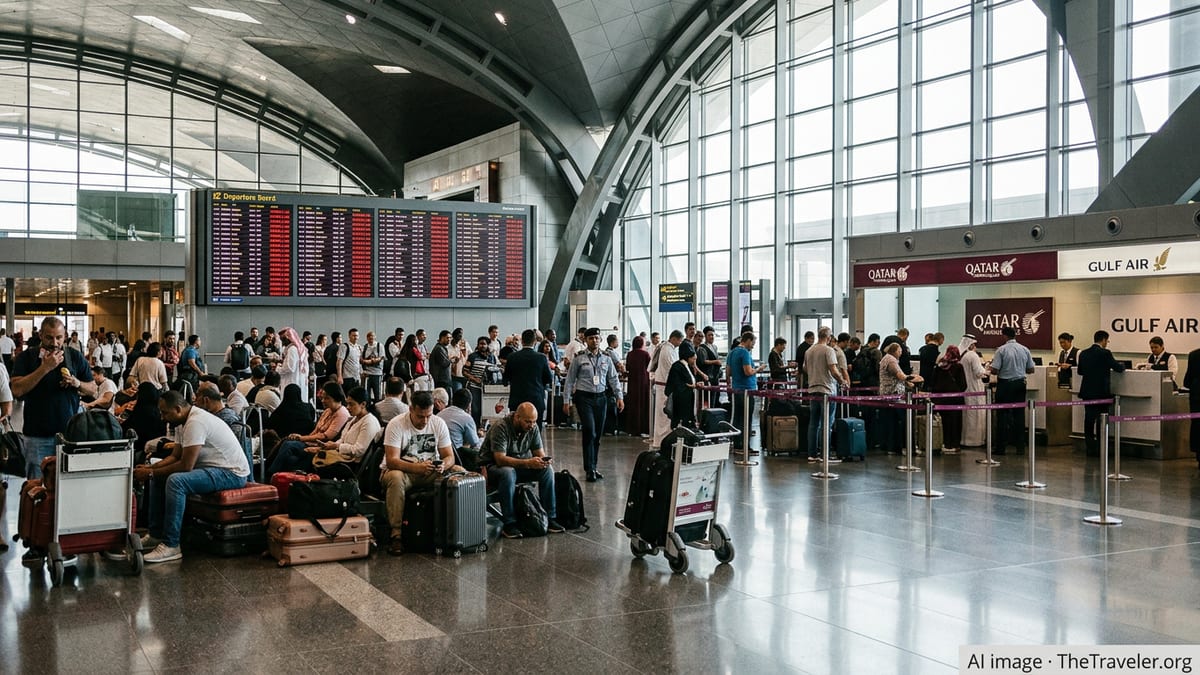
Travel disruption in and out of Doha continues to escalate in mid-March 2026, as restricted airspace over Qatar keeps Hamad International Airport operating at sharply reduced capacity and forces hundreds of flight cancellations by Qatar Airways, Gulf Air, Saudia, Malaysia Airlines and other major carriers.
Get the latest news straight to your inbox!
Conflict-Linked Airspace Closures Leave Doha Hub Half-Paralysed
Closures and tight restrictions on Qatari airspace, introduced after the outbreak of the Iran war on 28 February 2026, remain the root cause of the disruption gripping Doha’s Hamad International Airport. Publicly available information shows that Iranian missile and drone strikes targeted sites across Qatar in the opening days of the conflict, leading to a full suspension of regular air traffic while air defenses were activated and damage assessments carried out.
Qatari authorities moved to partially reopen air navigation on 7 March, but only through limited contingency corridors and with strict emergency restrictions in place. This partial reopening has primarily supported evacuation and repatriation movements, rather than a normal commercial schedule. As a result, Hamad International remains far from its usual role as a high-frequency global transfer hub, with its runways and airspace handling a fraction of typical volumes.
Travel industry commentary and passenger accounts indicate that Qatar’s constrained skies have had a knock-on effect across the wider Gulf. Airlines that rely on the Doha hub have been forced to pull aircraft, adjust routings around closed or restricted zones, and endure longer flight times due to diversions. Even where individual airports remain physically undamaged, regional network connectivity has been severely weakened.
Qatar Airways Leads Cancellations as Limited Repatriation Flights Begin
Qatar Airways, which usually operates one of the world’s densest long-haul schedules from Doha, has become the most visible symbol of the ongoing disruption. Publicly available statements and traveler reports show that the carrier initially suspended almost all regular passenger services to and from Doha after the airspace closure on 28 February, cancelling hundreds of flights over the first two weeks of March.
In recent days, the airline has begun operating a narrow band of repatriation flights under temporary authorisation from the Qatar Civil Aviation Authority. These limited services, including departures to major European gateways such as London, Paris, Madrid, Rome and Frankfurt, are designed to move stranded passengers out of Qatar and connect them with onward journeys. However, they do not yet represent a resumption of normal operations, and seat availability remains constrained.
Travel forums and consumer advisories describe a landscape of rolling cancellations, last-minute schedule changes and congested customer service channels. Many passengers with tickets for travel between late February and at least the second half of March have been offered refunds, complimentary date changes or rerouting via alternative hubs on other airlines. Even with these measures, a significant number of travelers remain stuck in transit or separated from checked baggage.
Regional Carriers From Gulf Air to Saudia Struggle to Maintain Links
The problems are not confined to Qatar’s flag carrier. Gulf-based and regional airlines that feed traffic into Doha or use Qatari airspace as part of their routings have also been drawn into the turmoil. Published coverage and airline notices indicate that Gulf Air, Saudia and other Middle Eastern carriers have cancelled or suspended services touching Doha, while also rerouting or cutting flights that would normally overfly Qatari territory.
Gulf Air, which relies on connectivity across the northern Gulf, has adjusted its network to route more passengers via alternative airports such as Dammam in Saudi Arabia. Saudia and other Saudi operators have also made schedule changes in response to shifting security assessments and evolving restrictions across the region’s skies. These adjustments have reduced direct options into Doha and complicated multi-leg itineraries that previously depended on seamless Gulf connections.
Beyond the Middle East, airlines in Asia and Europe that partner with Qatar Airways or operate their own services into Doha have taken similar steps. Malaysia Airlines and other Asian carriers have cut or suspended flights to Hamad International for at least part of March, while some codeshare services have been removed entirely from booking systems. Travelers who would usually transfer in Doha on journeys between Asia, Europe, Africa and the Americas are instead being rebooked through hubs such as Istanbul, Beijing and various European capitals.
Stranded Passengers Face Long Queues, Reroutes and Uncertain Timelines
For individual travelers, the cumulative effect of these cancellations has been a prolonged period of uncertainty. Accounts shared through public online platforms describe passengers arriving at airports to find check-in counters shuttered, flights cancelled with short notice and limited on-the-ground information about alternative arrangements. Some report being rebooked through different continents or on entirely different carriers, often after days of repeated calls or visits to ticket offices.
Travel advisers warn that the backlog created by nearly three weeks of disruption will likely persist even after Qatari airspace is fully reopened. Aircraft and crews must be repositioned, long-haul rotations rebuilt and connecting banks of flights carefully re-sequenced. In the meantime, passengers with departures planned for late March and even early April are being told to expect further changes, with many encouraged to hold refundable backup tickets via alternative hubs.
Reports from regional travel agencies suggest a spike in demand for routes that bypass the Gulf entirely, with travelers opting for connections through East Asia or Europe instead of Doha, Dubai or Abu Dhabi. At the same time, some countries are organising or supporting dedicated repatriation efforts for citizens caught in the Middle East when the conflict erupted, adding further ad hoc traffic to an already fragile system.
Outlook: Gradual Recovery Expected, But Full Normality Still Distant
Aviation analysts following the situation in Qatar suggest that recovery at Hamad International Airport will likely be phased and uneven. Even if broader security conditions improve and airspace restrictions are eased over the coming weeks, airlines are expected to restore capacity cautiously, monitoring demand, political risk and operational resilience before rebuilding the dense schedules that characterised Doha’s pre-conflict role.
For Qatar Airways, the priority in the near term appears to be clearing the backlog of affected passengers through targeted repatriation and rebooking, while preserving the integrity of key long-haul connections. Other regional carriers, including Gulf Air and Saudia, are similarly expected to focus on stabilising limited core routes before reintroducing more marginal services to or through Qatar.
Travel industry guidance consistently urges passengers with upcoming itineraries involving Doha to monitor flight status closely, maintain flexible plans and consider alternative routings where possible. While the partial reopening of air navigation and the appearance of new schedules in mid-March provide some hope that the worst phase of cancellations is passing, the experience of the last weeks underlines how quickly a strategic aviation hub like Hamad International can shift from global connector to bottleneck when conflict reaches the Gulf’s skies.