

More news on this day
Once dominated by coal and quarries, South Lanarkshire’s Douglas Valley is emerging as one of Scotland’s most closely watched outdoor frontiers, as new trails, restored landscapes and regeneration funding converge into an ambitious adventure tourism vision.
Get the latest news straight to your inbox!
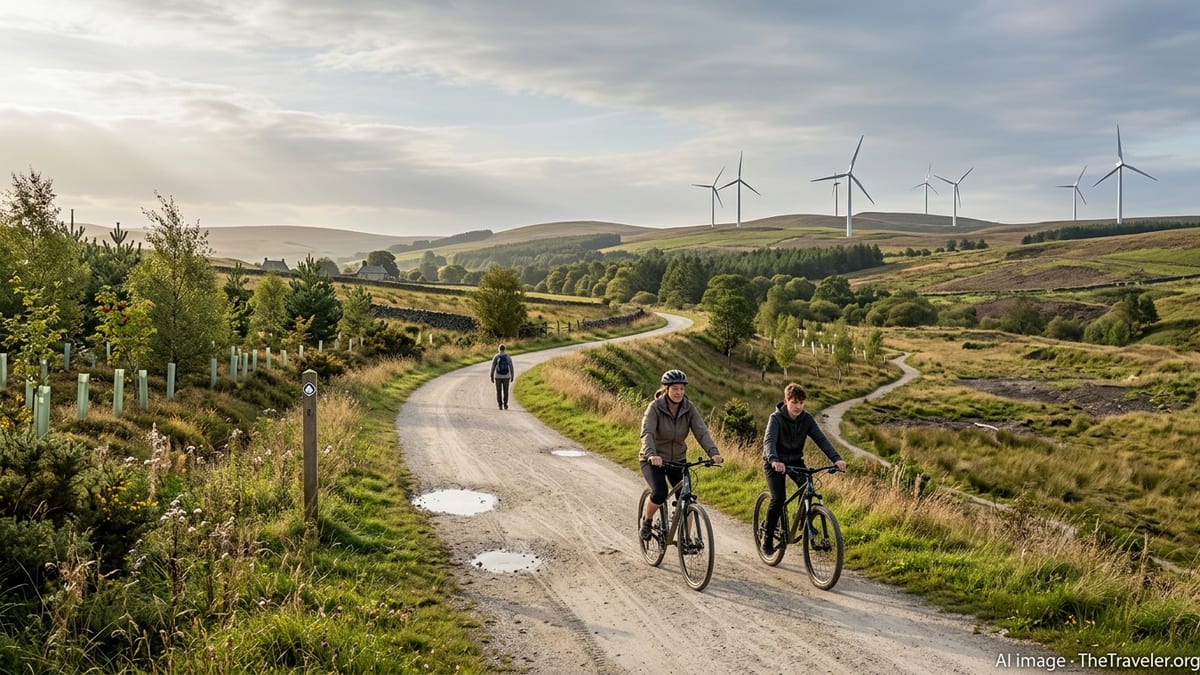
From industrial heartland to outdoor test bed
Publicly available planning documents and local authority coverage describe Douglas Valley as the focus of a long-term effort to reposition a former mining landscape as a centre for outdoor recreation and eco-tourism. The area, stretching between the villages of Coalburn, Douglas and Lesmahagow, sits within the Hagshaw energy cluster, one of Scotland’s most densely developed onshore wind zones.
A development framework for the cluster sets out a strategy that combines renewable energy operations with community investment in recreation, access and landscape restoration. Reports indicate that partners have highlighted adventure tourism as a core pillar in this vision, ranging from new multi-use trails to potential activity hubs on restored opencast sites.
Community groups such as the Douglasdale Recreation, Environment, Access and Leisure Group have positioned the valley as a living laboratory for how former extractive landscapes can be reimagined for leisure, biodiversity and low-carbon travel. Their published material emphasises improved paths, woodland creation and heritage interpretation as the foundations for future visitor growth.
Regional planning guidance references Douglas Valley as a Special Landscape Area, noting the combination of rolling upland, historic estates and post-industrial land as both a constraint and an opportunity. The evolving adventure proposition is being presented as a way to draw visitors while reinforcing conservation and climate goals.
New trail network anchors an emerging adventure spine
One of the clearest signs of change on the ground is the rapid expansion of off-road paths. In late 2025, Walking Scotland and South Lanarkshire Council highlighted the unveiling of almost 10 kilometres of new active travel routes linking Coalburn, the National Cycle Network Route 74 and the village of Douglas, largely repurposing former mineral railway lines.
Local news and charity updates describe these whin-dust surfaced tracks as suitable for walking, wheeling and cycling, with gentle gradients intended to attract families and less experienced riders. The routes connect into leisure centres, schools and village services, creating what promoters call a practical alternative to car journeys as well as a recreational asset.
Further segments are under construction or planned between Coalburn and neighbouring settlements, gradually stitching together what project backers describe as a continuous spine for active travel. The paths pass close to existing nature trails and community woodlands, offering scope for looped walks, gravel riding and guided heritage or wildlife outings.
Project summaries also flag the role of refurbished mining infrastructure and access roads, which offer broad, hard-packed surfaces suitable for bikes and adaptive equipment. Observers suggest that this is laying the groundwork for more specialised activities, including graded mountain bike routes and skills areas on more rugged ground.
Windfarm wealth fuels a “great awakening” in the valley
The pace of change has been strongly influenced by funding linked to the Hagshaw energy cluster. Official summaries of the cluster vision explain that windfarm community benefit funds, combined with national transport and path grants, are being channelled into woodland planting, pathbuilding and feasibility studies for adventure tourism.
Grant announcements from the Renewable Energy Fund, community trusts and national path schemes show repeated references to Douglas Valley projects, from equipment to maintain new routes to studies exploring outdoor recreation business opportunities. In several cases, public communications highlight the ambition to use a restored opencast site as an anchor for an adventure destination.
Nature agencies and consultants involved in the cluster’s land-use strategy present this approach as a way to align climate and economic objectives. Renewable generation provides long-term revenue streams, while recreation and tourism are positioned as tools to diversify local livelihoods beyond energy and agriculture.
The concept has gained recognition beyond the valley. A land-use vision covering Douglas Valley and adjacent uplands has been cited in environmental awards for its emphasis on community benefit, habitat restoration and low-carbon travel. Commentators note that this external validation strengthens the case for continued investment in trails, visitor facilities and outdoor programming.
Adventure blueprint leans on Scotland’s trail success stories
Although Douglas Valley is at an earlier stage than established destinations, the emerging strategy draws clear lessons from other Scottish adventure hubs. Public documents and sector analysis often reference the 7stanes mountain bike network in the Borders and Dumfries and Galloway, as well as centres such as Glentress and Kirroughtree, where graded trail systems have helped drive significant visitor numbers and rural jobs.
Analysts point out that these sites built their reputations on consistent trail quality, clear grading, year-round rideability and support services such as bike hire, coaching and cafes. The Douglas Valley plan echoes many of these elements, particularly the idea of combining family-friendly green and blue routes with more technical options for experienced riders.
There is also growing interest in blending adventure sports with heritage and ecological storytelling. Visitor information for Douglas village already promotes attractions such as Douglas Heritage Museum and St Bride’s Church, while woodland projects nearby are framed around climate action and post-mining recovery. Observers suggest that future adventure offerings are likely to weave these narratives into waymarked routes and guided experiences.
Industry commentators note that any large-scale bike park or multi-activity hub in the valley would enter a competitive market that now includes forest adventure parks and high-profile trail centres across Scotland. Supporters argue, however, that Douglas Valley’s combination of central location, existing energy infrastructure and extensive brownfield land gives it a distinctive niche.
Communities position themselves at the heart of the frontier
Community organisations have been closely associated with the valley’s transformation. Information from Coalburn Community Action Group, Douglas and Glespin representatives and local charities shows that many of the new routes and woodland projects emerged from long-running campaigns for safer paths, access to nature and post-mining restoration.
Programme descriptions for recent launch events highlight grassroots involvement in everything from path design workshops to volunteer maintenance. Free bike loans, skills sessions and school visits have been used to encourage local residents to adopt the new infrastructure for everyday journeys as well as leisure.
Consultation exercises held across the valley in recent years invited residents to comment on draft proposals for an outdoor recreation and adventure tourism masterplan. Feedback summarised by organisers points to strong interest in activities that offer jobs and training for young people, protect sensitive habitats and retain spending in nearby villages.
Stakeholders involved in regional economic planning now frame Douglas Valley as a test of whether community-led models can shape the next generation of Scottish adventure destinations. If the vision is realised, the former coal corridor between Coalburn and Douglas could evolve into a flagship example of how rural landscapes can move from extraction to exploration, with local people steering the route of travel.