

More news on this day
Hundreds of travelers were left stranded at Queen Alia International Airport in Amman on Saturday as at least 55 flights were delayed and 54 canceled, snarling Royal Jordanian’s hub operations and disrupting services by Emirates, Ryanair, British Airways and other carriers across key regional and international routes.
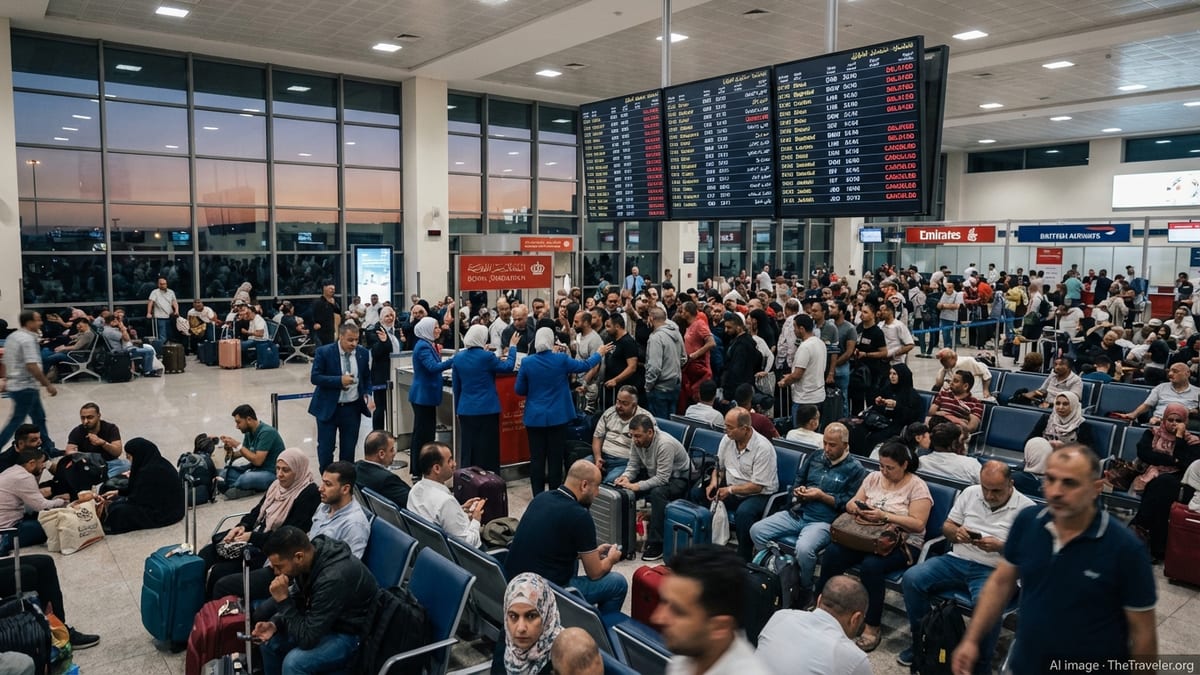
Regional Conflict Pushes Amman Hub to Breaking Point
The disruption in Amman unfolded as large parts of Middle Eastern airspace were abruptly shut following joint U.S. and Israeli strikes on Iran and retaliatory missile attacks across the Gulf, prompting aviation authorities to impose sweeping safety restrictions. With neighboring countries including Iraq and segments of Gulf airspace effectively off limits, airlines serving Jordan were forced into last‑minute cancellations, extensive rerouting and rolling delays.
Queen Alia International, usually a relatively smooth connection point between Europe, the Levant and the Gulf, quickly became a choke point. Royal Jordanian, which relies heavily on east‑west transit traffic, saw multiple departures and arrivals scrubbed or pushed back for hours as it waited for updated routing clearances. International carriers feeding traffic into Amman, including Emirates and British Airways, also pulled flights or extended ground holds rather than risk flying into a rapidly evolving conflict zone.
Airport staff struggled to manage the ripple effects as inbound aircraft diverted or returned to their points of origin, leaving aircraft and crews out of position. By late afternoon, long queues had formed at airline service desks, with passengers attempting to rebook limited seats on remaining flights or seeking hotel vouchers in an already stretched local market.
Passengers Face Long Waits on Routes to the Gulf and Beyond
The heaviest impact at Queen Alia was felt on routes linking Amman to the Gulf’s major hubs and other key cities along the conflict’s periphery. Services to Dubai and Doha were among the first to be canceled or indefinitely delayed as the United Arab Emirates and Qatar moved to restrict air traffic in response to missile and drone activity and broader regional security warnings.
Travelers bound for Baghdad, Istanbul and Jeddah also faced significant uncertainty. Some flights were initially posted as delayed while dispatchers explored circuitous routings to skirt closed airspace corridors, only to be canceled hours later when it became clear that safe, commercially viable paths were not available. Passengers connecting onward from these cities, including those with long‑haul itineraries to Asia, Europe and North America, saw carefully timed journeys collapse into open‑ended layovers.
British Airways passengers connecting through Amman onto regional flights were caught out after the airline suspended certain services into the wider region, while low‑cost carriers such as Ryanair faced challenges repositioning aircraft and crews when point‑to‑point services into Jordan were canceled. Emirates customers en route to and from Dubai, which ordinarily functions as a massive onward connection hub, were especially hard hit, with some travelers reporting that they were rebooked several days out or advised to seek refunds.
Inside the Terminal: Crowded Halls, Limited Answers
Inside Queen Alia’s departure halls, the situation quickly turned into a test of patience. Long lines snaked from Royal Jordanian and foreign airline counters as travelers sought clarity that staff often did not have. Electronic boards cycled repeatedly between “delayed” and “canceled” beside flights to Dubai, Baghdad, London, Doha, Istanbul and Jeddah, reflecting how rapidly airspace notices and security guidance were shifting.
Families with young children attempted to carve out space on the floor near departure gates, while solo travelers clustered near power outlets to keep phones charged in order to monitor airline apps and social media updates. Cafes and airport lounges filled well beyond normal capacity, with some passengers spending the better part of the day in the terminal as they waited for news that often failed to materialize.
Ground staff distributed water and snacks in some crowded gate areas, but passengers reported inconsistent communication between handling agents, security personnel and airline teams. Many travelers said they learned of cancellations only when boarding times slipped repeatedly or when airport screens suddenly updated, triggering a rush back to reservation counters already dealing with earlier waves of stranded customers.
Airlines Scramble With Waivers and Rebooking Options
As the scale of the disruption became apparent, Royal Jordanian and other affected airlines began issuing broad travel waivers that allowed passengers to change dates or reroute itineraries without additional fees. For some, that meant shifting to later flights once airspace corridors reopen; for others, particularly those with time‑sensitive travel plans, it meant abandoning trips altogether and seeking refunds.
Operations teams for full‑service carriers attempted to consolidate demand onto a smaller number of flights, prioritizing routes that could still be operated on safe, alternative tracks. However, with many neighboring countries restricting overflights and the risk environment evolving from hour to hour, planners had limited flexibility. Aircraft utilization plummeted as jets remained on the ground awaiting slots or diplomatic clearances that did not come.
Low‑cost carriers such as Ryanair, which operate on tight aircraft rotations, were disproportionately constrained once initial cancellations rippled through subsequent legs of multi‑sector schedules. British Airways and Emirates, for their part, focused on maintaining core long‑haul networks while trimming or suspending select services into the most affected airports, including Amman, until they could be confident of stable routing and security conditions.
What Travelers Through Amman Should Expect Next
For passengers scheduled to travel through Queen Alia International Airport over the coming days, uncertainty is likely to remain the norm. Airline and airport officials have indicated that they are monitoring regional security developments and airspace notices in real time, but the reopening of key corridors over Iraq, the Gulf and western Iran will depend on military and political decisions outside the control of civil aviation authorities.
Travelers with imminent departures are being urged to check their flight status frequently, maintain up‑to‑date contact details with airlines and consider flexible rebooking where possible. Those who must travel are advised to allow extra time at the airport, be prepared for additional security screening and anticipate the possibility of last‑minute schedule changes, even after check‑in and boarding passes have been issued.
In the meantime, Queen Alia International, like many airports across the region, is bracing for a prolonged period of operational strain. With more than 100 flights already delayed or canceled in a single day and aircraft, crew and passengers scattered across multiple continents, a swift return to normal schedules appears unlikely. For hundreds of travelers caught in Amman on Saturday, the experience has been a stark reminder of how quickly geopolitical tensions can ground even the most carefully planned journeys.