

More news on this day
Regional affiliates PSA Airlines, Piedmont, Endeavor Air, Republic and low cost carrier Frontier suspended 44 flights and contributed to more than 700 delays at Charlotte Douglas International Airport this week, snarling travel across a web of key domestic routes linking North Carolina with Wilmington, Cincinnati, Savannah, Nashville, New York and other major cities.
Get the latest news straight to your inbox!
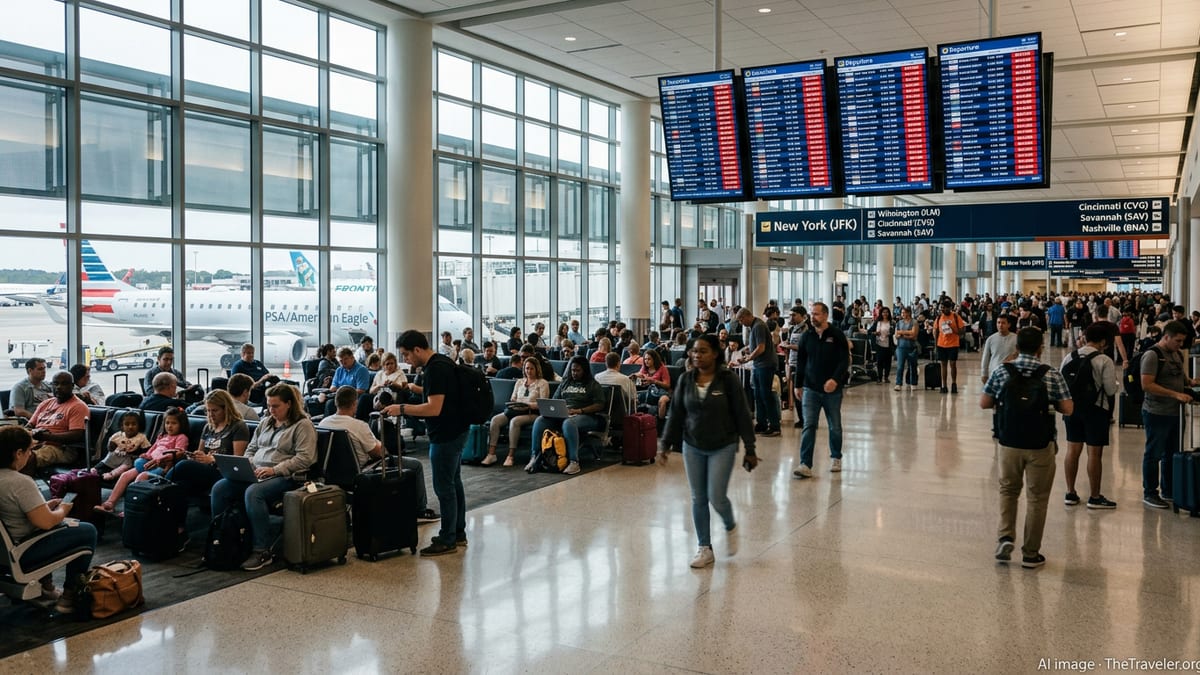
Staffing Strains and System Pressures Converge at Charlotte
The latest wave of disruption at Charlotte comes as the airport, one of the busiest in the United States by aircraft movements, operates under heightened strain from a partial federal government shutdown and a tight labor market for air traffic controllers. Industry analysts say the regional carriers that feed Charlotte’s extensive domestic network are particularly exposed when staffing or weather issues ripple through the system, because they operate dense schedules with limited slack.
PSA Airlines and Piedmont, both American Eagle affiliates that anchor Charlotte’s regional connectivity, joined Endeavor Air, Republic and Frontier in temporarily suspending dozens of departures while crews, aircraft and gate slots were reshuffled. The suspensions, while short of a full ground stop, were enough to trigger rolling delays across the day as inbound aircraft arrived out of sequence and flight crews bumped against federally mandated duty-time limits.
Airport officials have warned for months that even relatively modest operational shocks can quickly compound at a hub structured around tightly timed banks of regional arrivals and departures. When several regional operators simultaneously trim or freeze their schedules, passengers often experience the results as extended delays, missed connections and crowded gate areas rather than headline-grabbing mass cancellations.
People flying through Charlotte in recent weeks have already been reporting longer time in queues and at gates, as federal staffing constraints intersect with strong seasonal demand and operational caution by airlines wary of being caught short during storms or air traffic control slowdowns.
Key Routes to Wilmington, Cincinnati, Savannah and Nashville Hit
The 44 suspended flights and cascading delays were felt most acutely on short-haul and medium-haul routes that rely on regional jets and high-frequency service. Travelers connecting between Charlotte and coastal destinations such as Wilmington and Savannah faced extended waits as airlines consolidated frequencies and reassigned aircraft to protect remaining departures.
Midwestern and Southern business corridors into Cincinnati and Nashville were also disrupted, with some passengers reporting late-night arrivals after multiple rolling delay notifications. For many travelers on these routes, Charlotte is a critical connecting point, meaning a single scrubbed regional leg can unravel an entire day’s itinerary, especially when alternative departures are fully booked.
New York area flights, which typically operate at high load factors and under heavy air traffic control oversight, experienced their own share of knock-on disruption. Delayed departures from Charlotte risked missing slot times into constrained Northeast airspace, leading to further holding, reroutes or last-minute schedule changes that left passengers scrambling at departure gates.
Travelers on affected routes described busy rebooking desks, crowded customer service queues and gate agents juggling rolling updates as operations teams attempted to re-stitch the day’s flight plan together in real time. In many cases, passengers were moved to later departures or rerouted through alternative hubs, while others saw their trips pushed to the following day.
Regional Carriers Shoulder Disproportionate Impact
Regional airlines such as PSA, Piedmont, Endeavor and Republic operate much of the short-haul network branded under the major carriers’ flags, but they do so with smaller fleets and thinner buffers when trouble hits. Aviation experts note that losing even a handful of aircraft to maintenance, weather diversions or crew-positioning issues can have an outsized effect compared with the larger fleets of mainline operators.
At Charlotte, where regional affiliates account for a significant share of daily departures, any broad-based schedule adjustment by these partners tends to multiply quickly across the timetable. A single delayed inbound regional jet arriving from a city like Wilmington or Cincinnati can knock its next departure to Savannah or Nashville off schedule, and so on throughout the day.
Frontier’s participation in the current bout of disruption added another layer of complexity. The ultra-low-cost carrier operates a lean point-to-point network with limited spare capacity, so when its Charlotte flights are suspended or heavily delayed, there are often fewer immediate backup options for stranded travelers compared with legacy hub-and-spoke operators. That can leave passengers waiting for the next available day’s service or forced to purchase last-minute tickets on competing airlines.
Industry observers say the situation underscores how deeply interconnected the U.S. domestic network has become. When multiple regional partners and a budget carrier all cut or slow their operations at a major hub, the combined effect can look and feel to travelers like the kind of disruption once associated only with severe storms or full ground stops.
Knock-on Effects Across the U.S. Air Travel Network
Although the immediate focus is on Charlotte, the reverberations of the suspensions and delays have reached far beyond North Carolina. As airlines worked to reposition aircraft and crews, delays cropped up at downline airports across the Southeast, Midwest and Northeast, from coastal gateways to interior business hubs.
Travelers departing from secondary airports reported last-minute gate changes and equipment swaps as carriers tried to backfill gaps created by the Charlotte imbalance. In some cases, aircraft originally scheduled to operate flights into the hub were reassigned to protect peak-time departures out of Charlotte, spreading the inconvenience across a wider geographic footprint.
Airline operations centers increasingly rely on sophisticated forecasting software to anticipate where delays will snowball next, but these systems cannot fully eliminate the human side of the disruption. Passengers still face the same uncertainties at the departure board, and crews still time out if they remain on duty too long while waiting for aircraft to be cleared for departure or arrival.
For business travelers and families alike, the practical impact is measured in missed meetings, lost vacation time and unexpected hotel nights. Travel advisers say the fresh turmoil at Charlotte has prompted some frequent flyers to build longer connection buffers into their itineraries or to favor early morning departures that are less exposed to the accumulated delays of a busy day.
What Travelers Passing Through Charlotte Should Expect Next
With Charlotte remaining a critical hub for both legacy carriers and regional partners, aviation analysts expect continued vulnerability to episodic disruption as long as federal staffing constraints and strong travel demand persist. While the specific flight suspensions affecting PSA, Piedmont, Endeavor, Frontier and Republic are expected to be temporary, operational ripples can linger for days in the form of repositioned aircraft, out-of-place crews and shifted departure banks.
Passengers booked through Charlotte in the coming days are being urged by airlines and airport officials to arrive early, monitor their flight status closely through airline apps or text alerts, and be prepared for schedule adjustments. Travel experts also recommend packing essential medications and an overnight change of clothes in carry-on bags in case of unplanned layovers.
Some carriers are offering flexible rebooking options or waiving change fees for customers whose journeys involve Charlotte during particularly stressed periods, though policies vary by airline and fare class. Travelers who can shift to non-peak days or times, or who have the option to connect through alternative hubs, may be able to reduce their exposure to the most acute disruption.
For now, Charlotte Douglas remains open and operating, but the latest round of suspensions and delays serves as a reminder that the U.S. aviation system is still finely balanced. When multiple regional carriers and a budget airline adjust their operations at a major hub on the same day, even routine travel between cities like Wilmington, Cincinnati, Savannah, Nashville and New York can suddenly become anything but predictable.