

More news on this day
Hundreds of travelers have been left stranded across Saudi Arabia and Portugal after a fresh wave of flight disruptions led to scores of delays and cancellations at King Fahd and King Khalid international airports and Madeira International Airport, compounding weeks of turbulence for Middle East and European air traffic.
Get the latest news straight to your inbox!
Airports in Saudi Arabia and Madeira Grapple With Fresh Disruptions
Publicly available flight-tracking data and regional media reports indicate that operations at King Fahd International Airport in Dammam and King Khalid International Airport in Riyadh have been affected by a new round of delays and selective cancellations, as airlines continue to navigate constrained airspace and rerouted traffic across the Gulf region.
At the same time, Madeira International Airport in Funchal has faced repeated weather-related operational challenges in recent days, with local coverage pointing to cancellations and schedule disruptions tied to strong winds and adverse sea conditions around the Portuguese Atlantic archipelago. On key days this week, the number of affected flights at Madeira alone has climbed into the dozens as landings were temporarily halted during periods of unstable wind conditions.
Taken together, the latest figures from open flight-status boards and airport reporting suggest that at least 48 flights have been delayed and five canceled across the three hubs over a 24-hour window, leaving passengers facing missed connections, extended layovers, and overnight stays. While the precise tally has fluctuated throughout the day, the pattern reflects a broader trend of elevated operational stress across Middle Eastern and European gateways since late February.
Services have been especially vulnerable on routes that intersect with already congested or restricted corridors over the wider Middle East, where airlines have been juggling altered routings and crew schedules. This has added knock-on delays even in airports whose runways and terminal infrastructure remain fully open.
Knock-on Effects for Gulf Air, Biman Bangladesh, FlyDubai and European Carriers
Airline operations data show that the disruptions have rippled across a diverse mix of carriers serving Saudi Arabia and Madeira, including Gulf-based airlines, South Asian flag carriers, and European low-cost and leisure operators. Flights operated or marketed by Gulf Air, Biman Bangladesh Airlines and FlyDubai have faced schedule changes on selected services touching King Fahd and King Khalid airports, particularly on rotations connecting to other Middle Eastern and South Asian hubs.
In Portugal, Madeira’s role as a seasonal holiday gateway has meant that European operators such as Eurowings and several other continental and UK-based airlines have been drawn into the disruption as adverse weather triggered cancellations and diversions. Reports from regional outlets indicate that, during peak impact windows, multiple arrivals and departures to and from German and northern European cities were scrubbed or heavily delayed, stranding short-break visitors and package tourists on both ends of the route.
The result has been a patchwork of operational adjustments: some aircraft have been held on the ground awaiting improved conditions or revised routings, while others have been rerouted to alternative airports on the mainland. For carriers operating tight rotations across several time zones, even modest delays at one of these hubs can cascade into missed departure slots and crew timing constraints later in the day.
Although hubs in Saudi Arabia and Madeira remain officially open, the combination of schedule changes and constrained capacity has significantly reduced day-of-travel flexibility for passengers. Travelers seeking to rebook onto later services have in many cases found remaining seats limited, pushing some onto next-day departures.
Weather and Airspace Tensions Combine to Stress Flight Networks
The latest disruptions reflect an overlay of two distinct but interacting forces. In Madeira, shifting crosswinds and low-visibility conditions have periodically brought arrivals to a halt, a familiar challenge at an airport known for its demanding approach and rapidly changing Atlantic weather. Regional meteorological bulletins this week have highlighted rough seas and strong winds around the islands, and airport operations have been adjusted accordingly for safety reasons.
Across the Gulf and wider Middle East, the backdrop remains a more complex pattern of airspace restrictions and rerouted traffic that has persisted since late February. International aviation advisories and industry updates describe a web of temporary closures and detours affecting multiple corridors, compelling airlines to redesign flight paths and, in some cases, reduce frequencies to certain destinations.
Analysts note that these conditions increase block times and fuel requirements, often forcing carriers to reoptimize aircraft and crew allocations. As planes are pulled from some routes and redeployed to others, airports like Riyadh and Dammam experience rolling pockets of congestion around specific banks of arrivals and departures, amplifying the effect of even short-lived operational hiccups.
Europe has simultaneously been contending with its own surge in schedule volatility, with recent tallies showing more than a thousand flights delayed or canceled across the continent on certain days. Madeira’s latest difficulties fit into this wider pattern of aviation fragility, where weather, airspace constraints and tight summer-style schedules can combine to create outsized disruption.
Passengers Face Long Queues, Rebookings and Overnight Stays
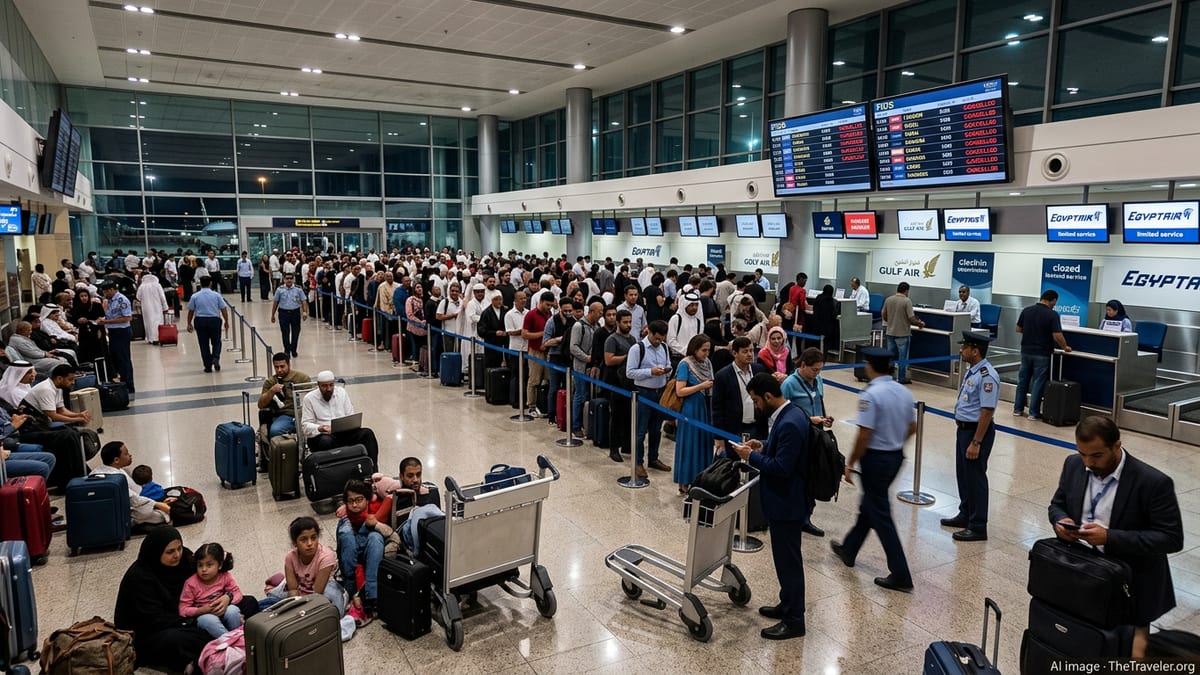
For travelers on the ground, the immediate impact has been familiar but no less disruptive: long waits at departure gates and check-in counters, uncertainty over onward connections, and a scramble for rebooked itineraries. Visuals from airports in Saudi Arabia and Madeira over the past two days have shown crowded departure halls and dense lines at airline service desks as passengers seek alternative ways to reach their destinations.
Publicly available customer guidance from a range of airlines serving the affected airports reiterates that travelers on delayed or canceled flights are being offered rebooking options free of additional change fees, subject to seat availability. In some cases, carriers have encouraged passengers to consider alternative departure airports or later travel dates, particularly where regional airspace constraints leave little room to add extra sections on busy routes.
Accommodation patterns have also come under strain. In resort-focused Madeira, where bed capacity can be heavily booked in peak periods, extended stays triggered by flight cancellations have left some visitors searching beyond their original hotels. In Saudi Arabia, passengers on interrupted itineraries have reported seeking short-notice hotel rooms around Dammam and Riyadh, as well as arranging overland transport to other regional hubs where flights remain more stable.
Travel insurers and consumer groups have continued to remind passengers to document delays, retain receipts for unexpected expenses and review policy terms related to weather and airspace disruptions. While some travelers may be entitled to compensation under applicable consumer-protection regimes, others will be dependent on the goodwill and published flexibility policies of the airlines involved.
What Travelers Should Do Next
Across all three affected airports, publicly available advisories from aviation authorities, airport operators and airlines emphasize a similar message: passengers should verify the real-time status of their flights before proceeding to the airport and allow extra time for check-in and security where services remain operational.
Industry guidance suggests that travelers with flexible plans consider voluntarily rebooking to later dates or less congested routes, particularly if they are scheduled to transit through multiple Middle Eastern hubs on the same itinerary. For those who must travel, monitoring airline apps and flight-status tools closely in the 24 hours before departure remains essential, as schedules may continue to shift with little advance notice.
Analysts also point out that this latest wave of delays and cancellations is occurring ahead of the northern summer peak, serving as a reminder that flight networks remain sensitive to shocks in both weather and geopolitics. With Madeira’s coastal conditions still unsettled and Middle Eastern airspace restrictions in flux, observers expect further localized disruption in the coming days, even if most scheduled services ultimately operate.
For now, travelers departing from or connecting through King Fahd, King Khalid or Madeira International face a more unpredictable experience than usual. Careful planning, flexible expectations and a close eye on evolving conditions may help reduce the risk of becoming among the next group of passengers unexpectedly stranded at the gate.