

Renting a car and driving across Italy can be one of the most rewarding ways to explore the country, but it is also where many visitors get their costliest travel surprises. Between unfamiliar road rules, strict speed enforcement, alcohol limits, and the infamous ZTL restricted zones that ring historic centers, a carefree Tuscan road trip can easily turn into a stack of fines that arrive months after you are home. Understanding how driving in Italy actually works allows you to enjoy the freedom of the road while avoiding the most common and expensive mistakes.
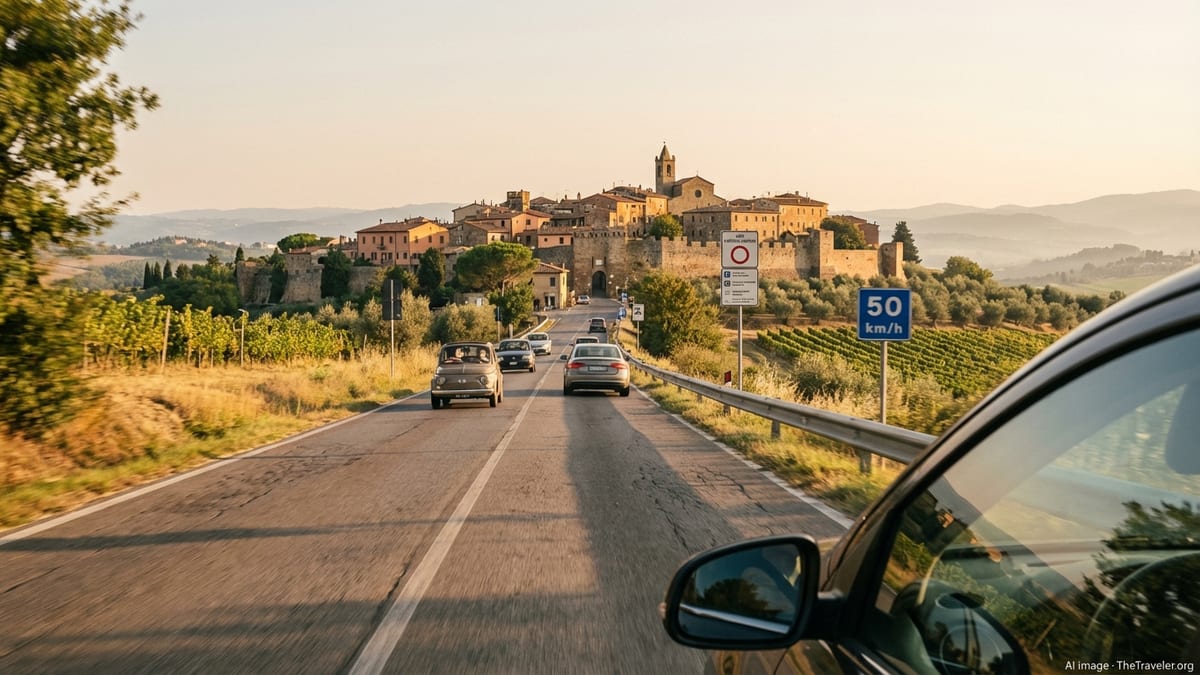
Understanding the Basics: Licenses, Documents and Road Culture
Before touching a steering wheel in Italy, foreign visitors need to make sure their paperwork is in order. Drivers from the European Union can use their national license. Travelers from the United States, Canada, the United Kingdom and many other countries can usually drive with their home license, but are strongly advised, and in some regions effectively expected, to carry an International Driving Permit as a translation. Car rental companies typically require a valid credit card, a license held for at least one year, and often a minimum age of 21 or 23, with additional daily fees for drivers under around 25.
Every vehicle on Italian roads must carry specific mandatory equipment, and rental agencies are expected to provide it. This includes a reflective safety vest and warning triangle for breakdowns, and on most roads outside built-up areas dipped headlights are required even during the day. In mountain or northern regions, winter tires or snow chains may be mandatory between mid November and mid April, something that is usually handled by the rental company but is worth double-checking if you are planning alpine passes or rural detours.
Italian road culture can feel intense to visitors but largely follows clear patterns. Drivers expect others to be decisive and predictable. Lane discipline is taken seriously on high speed roads: the left lane is for overtaking and not for cruising. Tailgating does happen and flashing headlights from behind often means “I am overtaking” rather than “After you.” The safest response is to complete your own maneuver calmly and return to the right when safe, rather than be pressured into abrupt changes.
Urban driving has its own rhythm. Scooters slip between lanes, pedestrians cross assertively, and parking can appear chaotic, but there is more structure than it first seems. Marked spaces, colored lines, and signage tell you where you can and cannot stop. Learning these cues and accepting that you will drive more slowly in towns than at home will make city segments far less stressful.
Speed Limits, Autostrade and How Enforcement Really Works
Italy’s main highways, the autostrade, are fast, efficient and almost all tolled. The standard speed limit is around 130 kilometers per hour on most autostrada sections in dry conditions, with automatic reductions to about 110 in rain or poor weather. Main extra urban roads generally have limits near 110, secondary roads around 90, and within towns the default is 50 unless signs specify a lower limit. New drivers who have held a license for less than three years face lower top speeds on faster roads, and limits can also drop near junctions, tunnels or construction.
Enforcement is both visible and subtle. Fixed cameras called Autovelox control speed at a single point, and you will usually see signs warning of “controllo elettronico della velocità” before you reach them. On many autostrade, a system known as Tutor or Safety Tutor calculates your average speed between two camera gates. This means that briefly slowing for a camera and then accelerating again is not enough; it is your overall speed along the monitored section that counts. Fines often arrive weeks or months later, forwarded by the rental company to your home address along with an administrative fee.
Unlike some countries where police tend to issue on the spot tickets, in Italy automated enforcement is the backbone of speed control. That encourages consistent compliance rather than short bursts of braking. It also means that tourists often do not realize they have been caught until long after the trip, which is one reason stories of “unexpected Italian fines” are so common. Staying close to posted limits, especially in tunnels and near urban approaches, is the most reliable way to protect both your budget and your license.
Toll booths themselves are straightforward once you know the categories. Lanes signed for cash or cards accept standard payments, while Telepass lanes are reserved for vehicles with an electronic tag and should be avoided by tourists unless your rental is specifically equipped. Take a ticket when you enter, keep it somewhere safe, and pay when you exit. Losing the ticket can lead to the maximum fare for that section, another avoidable expense.
Alcohol, Safety Rules and What Has Recently Changed
Italy’s legal blood alcohol limit is lower than in some countries and has become a focus of tightening regulations in recent years. The standard maximum for most drivers is 0.5 grams per liter of blood, but there are stricter expectations for certain groups such as young or newly licensed drivers and professional drivers, who are effectively expected to remain at or near zero. Penalties escalate with the measured alcohol level, ranging from administrative fines and license point deductions to criminal charges and possible imprisonment at higher readings or in the event of an accident.
Recent regulatory updates have emphasized both enforcement and public awareness. Authorities have introduced more roadside checks and have required nightlife venues to display information that shows how typical drinks translate into approximate blood alcohol levels for men and women of different body weights. This shift aims to move responsibility upstream by encouraging people to understand that even a couple of glasses of wine can place some drivers near the legal limit, particularly on an empty stomach.
From a visitor’s point of view, the safest policy is to avoid drinking if you are driving at all, especially at night or on weekend evenings when checks are more frequent. Refusing a breath test is treated extremely seriously and can result in penalties equivalent to very high alcohol levels, including long license suspensions and heavy fines. For tourists, this can also create complicated interactions with rental companies and insurance that may not cover incidents involving alcohol.
Seat belts are mandatory for all occupants, front and rear, and using a mobile phone without a proper hands free system is prohibited while driving. Children must travel in appropriate child seats or boosters that match their size and weight. Italian police do conduct roadside checks for these basic safety measures, and non compliance can lead to on the spot fines. Ensuring that your rental is equipped with the correct child restraints and that everyone buckles up before departure is both a legal and practical priority.
The Reality of ZTL Zones: Italy’s Most Expensive Tourist Mistake
Zona a Traffico Limitato, usually shortened to ZTL, is arguably the single most misunderstood aspect of driving in Italy for visitors. These limited traffic zones sit around the historic centers of cities and towns, where narrow medieval streets, dense pedestrian areas and high pollution levels make unrestricted car access impractical. Several hundred Italian municipalities have introduced some form of ZTL, and in many major destinations such as Rome, Florence, Milan and Bologna they form a tight ring around the old town.
A typical ZTL is marked by a round white sign with a red border, often accompanied by the words “zona traffico limitato” and a list of permitted vehicles or operating hours. Cameras mounted at the entrances record the license plate of every car that passes. If your plate is not on the local authority’s list of authorized vehicles, the system automatically generates a fine. Rental cars and tourist vehicles are almost never authorized unless a hotel or guesthouse has pre registered your plate with the municipality.
The problem for foreign drivers is that these zones often look like ordinary streets, navigation apps may route you directly through them, and there is no immediate feedback when you violate the rule. Many visitors only discover they have entered a ZTL when a fine arrives months later. Because each illegal entry counts separately, you can easily receive multiple penalties in a single day by passing in and out of a zone, or re entering through different gates. With administrative fees from rental companies added on top, one confused drive through a historic center can become the most expensive part of your holiday.
Some cities operate ZTLs only at certain hours of the day, while others enforce them almost continuously. A few, such as parts of Milan’s central area, use congestion charges that can be paid to enter legally if you organize this in advance. The challenge is that the rules vary by city and are generally published only in Italian. For most tourists, the simplest approach is to assume that any sign showing the ZTL symbol near a historic center means “do not enter under any circumstances” unless you have explicit written confirmation from your hotel that your license plate has been authorized.
Parking, Navigation and Smarter Ways to Use a Rental Car
Once you accept that many historic cores are essentially off limits to casual drivers, your strategy for parking and navigation in Italy needs adjusting. The best approach for most visitors is to treat the car as a way to move between regions and outskirts, while relying on walking, buses, trams and taxis inside city centers. That means parking just outside ZTL boundaries or near public transport hubs and then switching modes.
Color coded curb markings provide a quick guide to where you can leave your car. In many cities, blue lines indicate paid parking, usually with a nearby machine where you buy a ticket to display on your dashboard. White lines often mark free spaces, though these may be reserved for residents in certain zones, as signposted. Yellow lines generally denote spaces reserved for specific categories, such as disabled drivers or commercial vehicles, and should be avoided unless you clearly qualify. Because local rules can vary, it is important to read accompanying signs carefully before leaving your car.
Navigation apps are both a blessing and a risk. They are excellent for rural driving, mountain passes and long distance travel, but they are not always ZTL aware in older parts of towns. Many visitors have followed a calm digital voice straight through a camera controlled gate. To avoid this, zoom in on city center routes before you set off and look for alternative roads that skirt the historic core. Some apps and specialized GPS units offer options to warn about or avoid restricted zones, but these features are not universally reliable and should not be your only line of defense.
One practical solution is to time your rentals to match the parts of your trip when you truly need a car. For example, you might arrive in Rome or Milan, explore the city on foot and by public transport for a few days, then pick up a car only when you are ready to leave for the countryside. Returning the car before entering your final big city can also reduce stress, as you will not be searching for fuel, navigating dense traffic and trying to avoid multiple ZTLs at the same time.
Regional Roads, Scenic Drives and What Tourists Often Miss
Many travelers associate Italian driving with either hectic city traffic or long stretches of autostrada, but the real joy of a road trip lies in the web of regional and provincial roads that tie villages, wine regions and coastlines together. These smaller roads may be slower and more winding, with speed limits around 70 to 90 kilometers per hour and frequent changes near villages or tight bends, but they also offer glimpses of everyday life that you never see from the motorway.
In Tuscany, Umbria, Piedmont or Puglia, for example, taking the slower road often means driving through hilltop towns, past roadside shrines and family run trattorias, orchards and vineyards instead of fuel stations and service plazas. The same is true along lesser known stretches of the Italian coastline, where local roads sit high above the sea and drop down into small ports and beach towns. It is on these roads that you notice the particular pace of Italian rural life, from farmers in small trucks early in the morning to families gathering for Sunday lunches.
Visitors sometimes underestimate how tiring these rural routes can be, especially over several consecutive days. Italian roads often follow very old paths that twist through hills and mountains, and local drivers know every bend. Building in extra time, planning realistic daily distances, and scheduling genuine breaks for coffee or a short walk in a village square will make the experience far more pleasant. Driving after dark on unfamiliar country roads is best minimized, both for comfort and for safety.
Tourists also tend to overlook the value of observing and adapting to local driving rhythms. For example, at small rural intersections where visibility is good and traffic light, there is often a pragmatic courtesy: drivers make eye contact, use small hand gestures, and take turns without drama. Paying attention to these cues and merging into them calmly can transform driving from a stressful chore into a cultural experience in its own right.
Insurance, Fines, and Dealing With Problems Before and After Your Trip
Understanding how Italian fines and insurance work is crucial to protecting yourself financially. Traffic violations rarely result in someone stopping you at the roadside unless there is a serious incident; instead, automated systems or municipal police record the offense and mail a notice to the vehicle’s registered owner. For rental cars, that means the company receives the first notification, then forwards your details to the authorities and charges you an administrative fee for the paperwork. Only afterwards does the official notice reach you directly.
Non residents can receive notifications many months after the event, as authorities have a long window to process and send cross border fines. When a notice does arrive, it usually offers a reduced amount if paid within a specified period and a higher amount if you delay or contest unsuccessfully. Ignoring a fine altogether can lead to higher charges, involvement of collection agencies, and potential issues if you return to Italy in future.
As for insurance, basic coverage included in rental rates often comes with high excess amounts, meaning you would still pay a substantial sum if the car is damaged or stolen. Supplemental collision damage waivers or excess reduction policies lower or eliminate this exposure, but they can be sold in confusing ways. It is worth comparing buying extra coverage from the rental company against independent policies before you travel, so you know exactly how you are protected. Always inspect the car carefully at pickup and drop off, photographing any existing scratches or dents and ensuring they are noted.
If you are involved in an accident, prioritize safety, move to a secure location if possible, and call the European emergency number 112. Rental companies usually provide a package with local contact numbers and procedures. Exchanging details, documenting the scene with photos, and completing any accident report forms thoroughly will help resolve matters later. Language barriers can add stress, but many Italian police officers in tourist areas have at least basic English, and roadside assistance services often offer multilingual support.
The Takeaway
Driving in Italy rewards those who prepare. The country’s mix of modern highways, centuries old town centers and rural backroads demands more awareness than a typical trip at home, but it also promises far greater spontaneity and depth. Knowing the fundamentals of speed limits, alcohol rules and required equipment keeps you on the right side of the law, while understanding how ZTL zones work protects you from Italy’s most notorious tourist trap.
Equally important is adjusting your expectations. Cars are not the best way to experience Italian city centers; feet and public transport are. Cars excel at linking countryside, coasts and out of the way villages between those cities. By timing your rentals, planning parking outside restricted cores, and letting go of the idea of driving everywhere, you can enjoy the freedom of the open road without turning your trip into a bureaucratic headache.
In the end, the goal is not to “conquer” Italian driving but to participate in it. When you understand why locals designed ZTLs to protect their historic cores, why enforcement relies so heavily on cameras rather than roadside stops, and why rural drivers appear impatient with hesitation, the system starts to make sense. With that insight, the journey between destinations becomes as memorable as the destinations themselves.
FAQ
Q1. Do I need an International Driving Permit to drive in Italy?
Many visitors from outside the European Union are advised or required to carry an International Driving Permit as a translation of their home license, and some rental companies will refuse to release a car without it.
Q2. What are the main speed limits I should remember?
On most autostrade the limit is about 130 km/h in dry conditions, with around 110 km/h on some major roads and about 50 km/h in built up areas unless otherwise signposted.
Q3. How can I recognize a ZTL zone?
ZTL zones are usually marked by a white circular sign with a red border, often with the words “zona traffico limitato,” and monitored by cameras at the entry points.
Q4. Can my hotel arrange access to a ZTL if it is inside the historic center?
In some cities hotels can register your license plate in advance with local authorities, but this is not guaranteed and must be confirmed in writing before you drive into the zone.
Q5. What happens if I drive into a ZTL by mistake?
If your plate is not authorized, cameras will record your entry and a fine is generated that is later sent to the rental company, which then forwards the cost and an administrative fee to you.
Q6. Is it safe to drink a little and still drive in Italy?
The legal blood alcohol limit is relatively low and penalties are strict, so the safest choice, especially for tourists, is to avoid drinking entirely when you plan to drive.
Q7. Should I drive inside big cities like Rome, Milan or Florence?
It is usually better to avoid driving in the centers of major cities because of traffic, parking difficulty and ZTL zones, and instead use public transport, taxis or walking.
Q8. How long after my trip can I still receive a fine?
Authorities have many months to notify non residents of fines, so it is possible to receive a notice long after you return home, particularly for ZTL or speed camera violations.
Q9. Are Italian drivers really as aggressive as people say?
Italian drivers can seem impatient and fast, but they generally follow a clear set of expectations; if you drive predictably, respect speed limits and keep right except to pass, you will usually fit in.
Q10. Is renting a car worth it for a trip to Italy?
Renting a car is often worthwhile for exploring countryside, small towns and coastlines, but less useful inside big cities, so many travelers combine rail travel with shorter rental periods.