

Driving in the Netherlands is one of the most convenient ways to explore its compact cities, historic towns, and countryside. Roads are well maintained, signage is clear, and distances are short. At the same time, the country has strict traffic rules, carefully enforced speed limits, and dense urban areas where parking can be confusing and costly. Understanding the basics before you get behind the wheel will help you avoid fines and enjoy a far more relaxed journey.
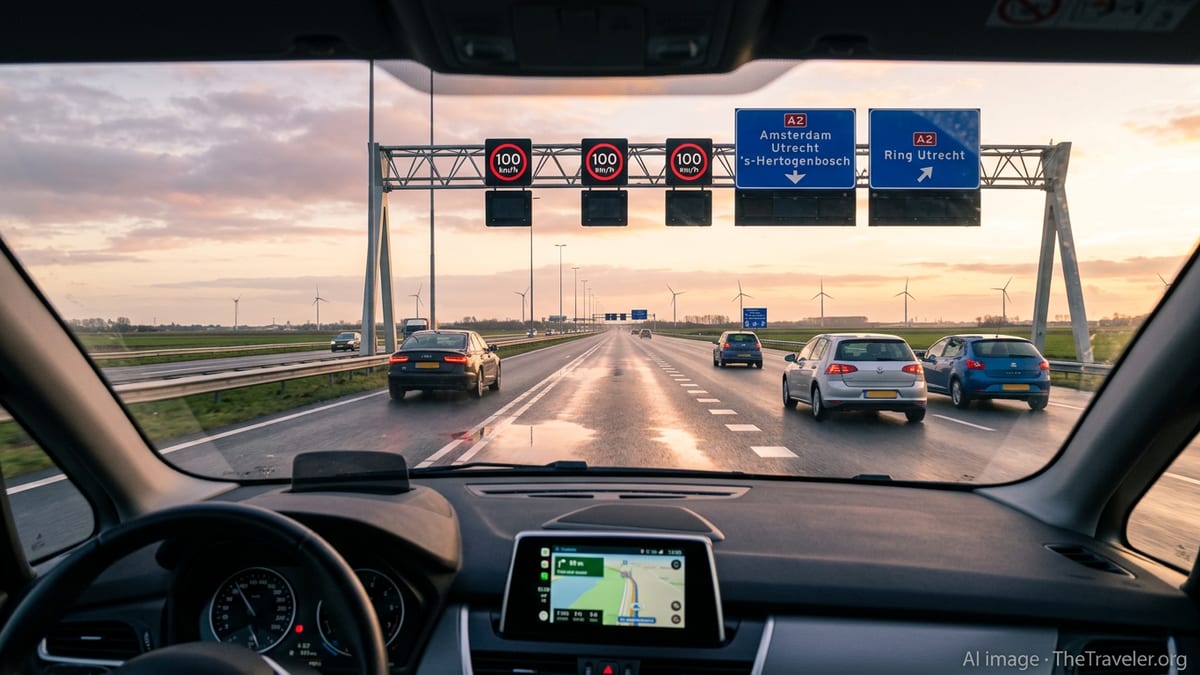
Understanding Dutch Speed Limits
The Netherlands uses a clear hierarchy of default speed limits, which change depending on whether you are inside or outside built-up areas and on the type of road. Within towns and cities, the standard limit is usually 50 km/h unless signs indicate otherwise. On many local streets, especially in residential districts and around schools, you will see 30 km/h zones designed to slow traffic and protect cyclists and pedestrians.
Outside built-up areas, typical limits increase to around 80 km/h on most rural roads, although some narrower or more local routes are capped at 60 km/h. Expressways marked with a special blue sign indicating a through-road generally allow 100 km/h unless another limit is posted. These speeds can change quickly at junctions, near villages, or where roadworks are in place, so it is important to watch the signs rather than rely solely on your navigation system.
On motorways, the general rule since 2020 is a daytime limit of 100 km/h between 06:00 and 19:00, with higher limits of up to 130 km/h allowed in the evening and at night where indicated. The higher figure only applies on stretches that are specifically signed for it, and in practice many motorway sections keep a lower maximum because of air quality considerations, noise, or safety near cities. You will often see electronic signs above the road that can lower the limit during congestion or poor weather.
For visitors, the most important point is that Dutch speed limits are treated as firm rules, not guidelines. Fixed cameras, average-speed control zones, and mobile checks are widely used on both motorways and regional roads. A small margin is usually applied before a ticket is issued, but relying on that buffer is risky and unnecessary. Setting your cruise control to the posted limit and staying in the right-hand lane except when overtaking is the simplest way to stay compliant.
Speed Enforcement, Fines, and Safe Driving Culture
The Netherlands has built its road safety record on a mix of clear rules and strict enforcement. Speeding, red-light violations, and handheld phone use behind the wheel are all subject to significant on-the-spot or mailed fines. In recent years, authorities have periodically increased penalties, and the cost of even minor infractions can be high compared with many other countries. For example, being only a few kilometres per hour over the limit in an urban area can already lead to a fine, and more serious excesses can trigger very steep penalties.
Average-speed control systems, known locally as section control, are common on busier motorways and some regional routes. Instead of capturing your speed at one point, they measure the time you take to travel between two camera gates and calculate your average. This system makes it difficult to game the limit by braking at cameras and then speeding up again. In addition, many tunnels and major junctions feature fixed cameras, and mobile teams occasionally operate radar checks in lower-limit areas.
Dutch drivers themselves often travel slightly above the posted limit in free-flowing conditions, but the general expectation is to keep close to the rules and to adapt speed in bad weather. Rain, crosswinds, and glare from low sun can all affect visibility on the flat Dutch landscape, and motorways can feel crowded around metropolitan areas. Maintaining adequate distance from the vehicle ahead, signalling lane changes clearly, and respecting truck traffic are important parts of driving safely and comfortably.
From a visitor’s point of view, the safest approach is to treat any posted limit as a hard maximum, to avoid distractions such as phones, and to remember that police and camera systems operate just as actively at night as during the day. Serious violations can lead to administrative procedures that may involve payment on the spot or follow-up correspondence to your home address, so prevention is far better than dealing with the aftermath.
Navigating Cities, Bicycles, and Priority Rules
What sets driving in the Netherlands apart from many other countries is the sheer number of cyclists and the integration of bikes into the transport system. Dedicated cycle paths often run parallel to main roads, cross intersections, and weave through city centres. Cyclists can appear quickly from unexpected directions, especially at junctions where they have their own traffic signals. As a driver, you must be prepared to yield frequently and to check mirrors carefully before turning right or left across a bike lane.
Priority rules are based on a combination of signage and standard conventions. On unmarked intersections in built-up areas, traffic from the right generally has priority unless a sign indicates otherwise. Where you see triangular yield markings on the road and signs indicating priority, the main route is clearly defined and side roads must wait. Roundabouts vary slightly: in most modern layouts, vehicles already circulating have the right of way, but older configurations can differ, so always follow the local signs and road markings.
Trams, present in cities such as Amsterdam, The Hague, and Rotterdam, deserve particular attention. They often share space with cars, cross junctions at their own angles, and sometimes have priority even over traffic that would normally have the right of way. Drivers are required to stop when passengers are boarding or alighting in the carriageway, and you should never overtake a tram closely at a stop.
Pedestrian crossings are clearly marked, and drivers are expected to stop for people who are already on the crossing or visibly about to use it. In lively city centres, where tourists may step into the road unexpectedly, keeping your speed low and anticipating sudden movements is essential. Combining this heightened awareness with a relaxed driving style will make urban driving less stressful and reduce the chance of an incident with a cyclist or pedestrian.
Parking Rules, Zones, and Costs
Parking is often the most challenging aspect of driving in Dutch cities. Space is limited, demand is high, and local authorities use pricing and regulations to manage congestion. In central districts of Amsterdam, Utrecht, Rotterdam, and other major urban areas, paid on-street parking is common every day of the week, often extending into the evening. Tariffs are set locally and can be relatively expensive, particularly in historic centres where authorities encourage visitors to use public transport or park-and-ride facilities instead.
Parking rules are signposted at the entrance to zones as well as on individual streets. In many neighbourhoods, residents enjoy permit-only parking, indicated by signs that show a zone code and conditions. In those streets you may only park if your vehicle is registered under a valid permit or if a sign explicitly mentions that visitors may pay at a meter or via a mobile app. Non-compliance can quickly result in a fine, and in some places vehicles are relocated to a depot, incurring additional towing and storage charges.
Blue zones are another feature to be aware of. These are areas where parking is free but limited in time, usually requiring the use of a parking disc placed behind the windscreen, set to the time of arrival. Locals use a specific blue disc, but many travellers keep a generic European parking disc in their rental car. The maximum stay in a blue zone varies by location, commonly between one and two hours. Time limits and operating hours are shown on nearby signs; staying beyond the allowed period can result in a ticket even though no fee is charged.
Multi-storey car parks and underground garages are widely available and are often the simplest solution for visitors. They tend to be clearly signposted from main routes and may be integrated into park-and-ride schemes where you leave your car on the edge of the city and continue by tram or metro. Daily caps or special visitor rates sometimes make these options better value than on-street spaces in busy districts, and they spare you the worry of navigating narrow canalside streets in search of a spot.
Special Parking Cases: Disabled Bays and Blue Badge Use
Travellers with reduced mobility benefit from a harmonised system of disabled parking cards across the European Union. If you hold a valid European disability parking card from another member state, you can generally use it in the Netherlands under conditions similar to those that apply to Dutch cardholders. This includes access to marked disabled bays and, in certain cases, more flexible rules in time-limited or restricted zones. Local municipalities may have additional procedures, such as issuing a residents’ permit linked to the card, so it is wise to check details for the city you plan to visit.
Disabled parking bays are clearly indicated by the wheelchair symbol on signs and often by markings on the asphalt. Some spaces are general, available to any driver displaying a valid disability card, while others are reserved for a specific licence plate, which will be shown on the sign. Parking in these bays without authorisation is treated as a serious offence and can result in a substantial fine. Even brief stops, such as waiting for a passenger, can be penalised if your vehicle is clearly occupying a reserved space.
In blue zones, disabled parking cards typically offer extended rights. In many cases, cardholders may park without observing the normal time limit, provided that both the disability card and the parking disc are correctly displayed. However, the details can vary slightly between municipalities and over time, so you should always read the nearby signage carefully. Where uncertainties remain, choosing a regular paid space or a car park is the safest option.
It is important to distinguish between areas where parking is regulated and places where stopping or parking is outright prohibited. Signs that indicate no parking or no stopping apply equally to vehicles displaying a disability card unless an exception is explicitly mentioned. Blocking driveways, standing on pavements, or parking too close to junctions or pedestrian crossings is forbidden and can lead to fines or towing, regardless of any card or permit you hold.
Renting a Car in the Netherlands: Requirements and Insurance
Renting a car in the Netherlands is straightforward, with major international brands and local companies operating at airports, rail stations, and in city centres. The minimum age to rent is commonly around 21, although some providers set higher thresholds or impose surcharges for drivers under 25. Larger vehicles, premium categories, and vans often require drivers to be at least 23 or 25 and to have held a licence for a longer period. When comparing deals, check not only the base rate but also any young-driver fees that may apply.
For most visitors from the European Union, the United Kingdom, and many other countries, a standard national driving licence in a Latin alphabet is accepted without additional paperwork. Travellers from countries with licences in a different script, or where local regulations advise it, may be asked to present an International Driving Permit alongside their home licence. It is prudent to carry both if there is any doubt, as rental agents must follow insurance rules and may refuse a car if documents are not considered valid.
Insurance is a key part of any Dutch rental agreement. Basic coverage often includes third-party liability and a collision damage waiver with an excess, which is the amount you must pay out of pocket in the event of damage or theft. You can usually reduce this excess by purchasing additional coverage from the rental company or by using a credit card that offers suitable insurance benefits. Carefully checking the condition report, noting even small scratches, and taking photos at pick-up and drop-off are sensible precautions.
Fuel policies typically operate on a full-to-full basis, meaning you collect the car with a full tank and are expected to return it full. Fuel is widely available at service stations along motorways and in towns, though prices can be higher at major motorway plazas. Using regular unleaded or standard diesel, depending on the vehicle, is usually sufficient unless the rental company has specifically marked the car for another fuel type. Returning the vehicle late, with less fuel than at pick-up, or notably dirty can all incur extra fees, so reading the rental conditions in advance will help you avoid surprises.
Practical Tips for Smooth Driving and Parking
Before you set off, take a few minutes to familiarise yourself with the car and its settings. Adjust mirrors, learn how to operate lights and wipers, and check how to set the navigation system to avoid low-emission or restricted zones if necessary. In many Dutch cities, environmental zones limit access for older or more polluting vehicles, although most modern rental cars meet the standards. Understanding whether any restrictions apply to your destination will save last-minute detours.
When planning your day, consider leaving the car at a park-and-ride facility on the edge of large cities and continuing by train, tram, or metro. These hubs often offer discounted parking combined with public transport tickets, providing a cost-effective and low-stress alternative to driving into the centre. On days when you do drive downtown, aim to choose a single car park and explore on foot or by public transport rather than moving the car repeatedly and paying multiple parking fees.
Mobile parking apps are widely used in the Netherlands and can be a convenient way to pay for on-street spaces where they are permitted. They allow you to start and stop a session and pay only for the time actually used, rather than estimating in advance at a machine. However, using a phone while driving is strictly prohibited unless it is in a proper hands-free holder and operated via voice or steering-wheel controls. Always park safely before opening an app or checking a map.
Finally, give yourself time. Dutch roads can be busy at morning and evening peaks, especially around the Randstad region linking Amsterdam, Rotterdam, The Hague, and Utrecht. Slow-moving traffic, frequent junctions, and the need to watch for cyclists and trams mean that journeys often take longer than their distance suggests. Building a margin into your schedule not only reduces stress but also makes it easier to stick to the rules and avoid risky manoeuvres.
The Takeaway
Driving in the Netherlands offers a flexible and rewarding way to explore the country, from coastal dunes and polders to medieval city centres and modern architecture. The road network is dense and well signposted, and speed limits are logically structured across urban streets, rural routes, and motorways. At the same time, strict enforcement and a strong emphasis on safety mean that understanding and observing the rules is essential.
For visitors, the biggest adjustments usually relate to sharing the road with large numbers of cyclists, navigating complex parking rules in cities, and respecting the daytime motorway limit of 100 km/h except where a higher figure is clearly signed. Renting a car is simple provided you meet age and licence requirements, carry the right documents, and choose insurance coverage that matches your risk tolerance.
By taking a cautious approach to speed, planning your parking, and staying alert to bikes, trams, and pedestrians, you can enjoy the freedom of the open road without the worry of unexpected fines. A little preparation goes a long way, and once you are familiar with local habits, driving in the Netherlands becomes a straightforward and enjoyable part of your journey.
FAQ
Q1. What are the standard speed limits in the Netherlands?
The usual limits are around 50 km/h in built-up areas, 80 km/h on most rural roads, 100 km/h on expressways, and 100 to 130 km/h on motorways depending on signs.
Q2. How does the daytime motorway speed limit work?
On most motorways you may drive up to 100 km/h between 06:00 and 19:00, with higher limits of up to 130 km/h allowed in the evening and at night where clearly posted.
Q3. Are speed limits in the Netherlands strictly enforced?
Yes. The country makes extensive use of fixed cameras, average-speed control zones, and occasional mobile checks, and even modest speeding can result in a fine.
Q4. How do parking zones and permits work in Dutch cities?
Many central streets are permit-only for residents or paid parking for visitors. Signs at the entrance to each zone and on individual streets explain who may park and under what conditions.
Q5. What is a blue zone and how do I use a parking disc?
A blue zone is a free but time-limited parking area. You place a parking disc behind the windscreen set to your arrival time and may stay only for the period shown on nearby signs.
Q6. Can I use my European disability parking card in the Netherlands?
Generally yes. A valid European disability parking card is recognised, giving access to marked disabled bays and, in many places, more flexible use of time-limited zones.
Q7. Do I need an International Driving Permit to rent a car?
Most visitors with a licence in the Latin alphabet do not, but drivers from some countries or with licences in other scripts may be asked for an International Driving Permit as an official translation.
Q8. What are the usual age requirements for renting a car?
Many rental companies rent to drivers from about 21 years old, but often charge young-driver fees and may require drivers to be 23 or 25 for larger or premium vehicles.
Q9. Is it safe to drive in Dutch cities with so many cyclists?
Yes, provided you drive calmly, check mirrors carefully, yield to cyclists where required, and watch for separate bicycle traffic lights and lanes at intersections.
Q10. Should I drive into city centres or use park-and-ride facilities?
Where available, park-and-ride sites on the edge of large cities are often cheaper and less stressful than central parking, especially in popular destinations such as Amsterdam and Utrecht.