

More news on this day
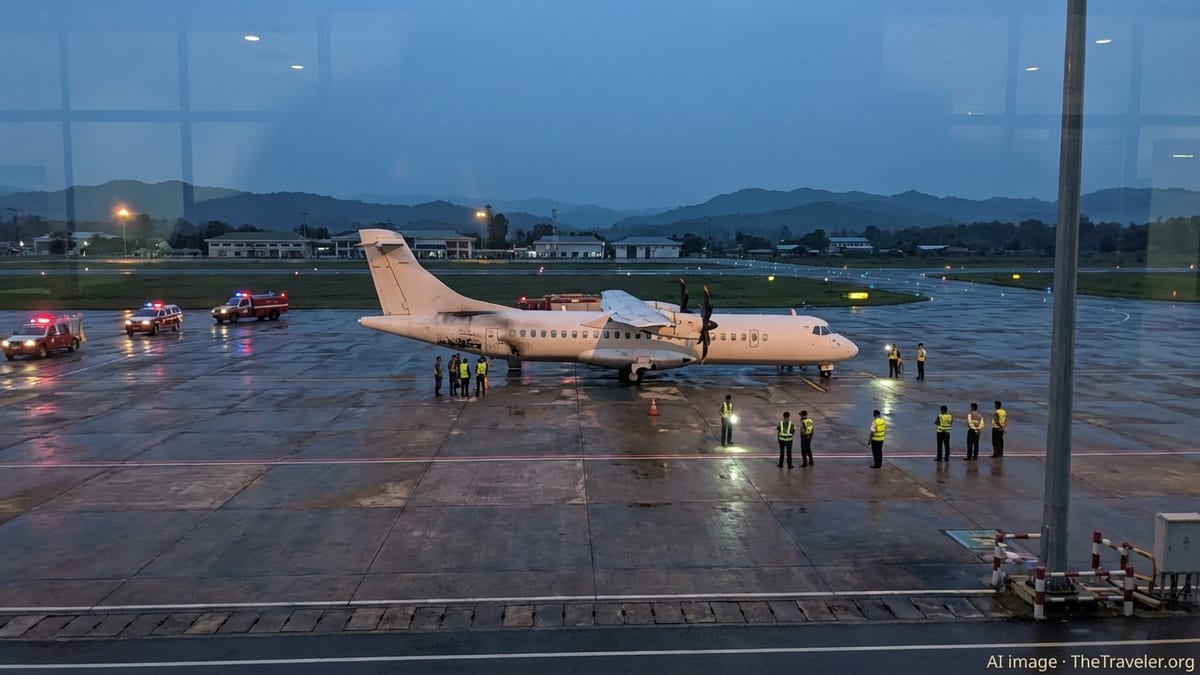
A Myanmar National Airlines passenger aircraft was struck by armed drones while preparing for departure at Myitkyina Airport in northern Myanmar on February 20, in an incident that caused visible damage to the turboprop jet and forced the suspension of flights to the regional hub, but resulted in no reported injuries among passengers or crew.
Airport Attack Highlights Escalation in Kachin Conflict
According to official statements and local media, several explosive-laden, first-person-view drones targeted Myitkyina Airport at around 8:12 p.m. local time on February 20, focusing on the apron and runway area as a Myanmar National Airlines ATR 72-600 was boarding passengers for a scheduled flight to Mandalay. Security forces reported that some of the drones were intercepted by air defence systems positioned at the airport, but at least two struck the aircraft, triggering a small fire and scattering shrapnel.
Images circulating in regional aviation outlets show the twin-engine turboprop with significant damage to its tail section and visible impact marks near the nose and cockpit windows. Officials said the aircraft sustained fragmentation damage to the nose, mid-fuselage and tail, consistent with reports that the drones were carrying warhead-style explosive charges. Despite the severity of the strike, the plane remained on the ground and was quickly surrounded by emergency vehicles.
Authorities said all passengers and crew were evacuated to safety immediately after the impacts, and that no one on board or on the ground was killed or injured. The incident follows an earlier reported drone attack on Myitkyina Airport on February 12, underscoring how the conflict in Kachin State has increasingly spilled into critical transport infrastructure.
Passengers Safe but Myitkyina Flights Suspended
The aircraft, identified in aviation databases as an ATR 72-600 operated by Myanmar National Airlines, remains parked at Myitkyina Airport while damage assessments and investigations are under way. Aviation industry monitoring sites report that the damage to the nose and tail, including broken cockpit windows and scorched fuselage panels, is extensive enough to keep the turboprop grounded for the foreseeable future.
In the immediate aftermath of the attack, all passengers were escorted from the aircraft and moved to secure areas of the terminal while security forces swept the airport for additional devices. Officials stated that explosive charges attached to other drones that crashed near the runway and airport perimeter were defused by bomb-disposal teams, reducing the risk of secondary blasts.
With security operations still active, commercial airlines have temporarily halted services to Myitkyina, a key gateway to the mountainous north of Myanmar. Myanmar National Airlines and several other domestic carriers, including Myanmar Airways International and smaller regional operators, have suspended flights to the city indefinitely, severing a vital air link between Kachin State and major urban centres such as Yangon and Mandalay.
The shutdown of scheduled flights is likely to complicate travel for residents, humanitarian workers and business travellers who rely on the airport as the fastest route in and out of the remote region. For now, travelers are being forced to reroute through distant airports or use lengthy overland journeys on roads that are themselves vulnerable to disruption.
Blame, Denials and Competing Narratives
Myanmar’s military authorities have accused the Kachin Independence Army and allied People’s Defence Force units of orchestrating the strike, describing the incident as a deliberate attack on civilian aviation and labeling the groups as terrorist organizations. State media and official press releases have argued that the flight was purely civilian in nature, facilitating passenger travel and non-military cargo, and therefore protected under international humanitarian law.
Government-aligned outlets have framed the attack as a war crime, asserting that targeting a passenger aircraft contravenes the Geneva Conventions and broader international norms on the protection of civilians and civilian infrastructure. Officials from the Ministry of Foreign Affairs have echoed that language in statements aimed at foreign governments and international organizations, seeking diplomatic condemnation of the strike.
Leaders of the Kachin Independence Army, however, have denied responsibility in comments to international media, insisting that the group does not target civilian aircraft. A spokesperson said the organization has no policy of attacking planes carrying passengers and disputed the official narrative that the Myitkyina flight was purely civilian, reflecting the wider information battle that has accompanied the conflict.
The competing accounts are difficult for outside observers to verify independently, but they underline the growing complexity and opacity of Myanmar’s internal war, where both sides seek to shape international opinion even as fighting continues on multiple fronts inside the country.
Rising Drone Warfare Threatens Civil Aviation
The Myitkyina attack has intensified concerns over how quickly combat drones have become a central feature of Myanmar’s conflict. Monitoring organizations that track global drone use in warfare have placed the country among the most heavily affected by drone operations, behind only large frontline conflicts such as those in Ukraine and Russia. In Kachin and other contested regions, armed groups have steadily adapted commercial and improvised drones to carry explosives against military outposts, fuel depots and logistics hubs.
What distinguishes the Myitkyina incident is the direct impact on a passenger aircraft at a civilian airport. Aviation analysts note that while airfields in conflict zones are often dual-use facilities with military assets on or near the grounds, attacks that result in damage to a commercial airliner carrying civilians are rare and risk crossing a threshold that could bring stronger international scrutiny and condemnation.
The drones used in the attack were described by officials and specialist publications as first-person-view suicide drones, which allow operators to steer the device with on-board cameras until impact. Reports that they carried rocket-propelled grenade type warheads, or similar improvised charges, suggest a level of technical sophistication that poses serious challenges for conventional air defence systems designed for larger, faster targets.
For airlines and passengers, the incident underscores the difficulty of guaranteeing safety in an environment where low-cost, low-flying drones can be launched from outside standard security perimeters, sometimes within minutes of a scheduled departure or arrival. While international carriers have largely withdrawn from Myanmar’s domestic market since the 2021 coup, regional aviation experts warn that the risks posed by drones to civil aviation infrastructure are increasingly global in scope.
Impact on Travelers and Regional Connectivity
Myitkyina Airport serves as the primary air gateway to Kachin State, a region known for its mountainous landscapes, jade and resource extraction, and a growing number of domestic travelers visiting family or conducting business in the north. While international tourism to Myanmar has already been curtailed by political instability and sanctions, domestic and regional travel remains a lifeline for local communities and the broader economy.
With flights to Myitkyina now suspended by major domestic carriers, travelers face significant uncertainty over upcoming trips. Many passengers who had booked tickets for business, medical appointments or family visits are being offered rebooking options or refunds, but alternative routes are limited. Overland road travel between Kachin State and central Myanmar can take many hours or more, and in some cases passes through areas of active or potential conflict.
Travel planners and regional tour operators say they are closely monitoring developments at Myitkyina Airport, though they note that foreign visitors have already been redirecting their itineraries away from conflict-affected northern states. For humanitarian agencies and civil society workers, the reduced accessibility may hinder the delivery of assistance and monitoring missions in rural districts that rely on air links for safe and timely movement.
Industry observers also point out that prolonged flight suspensions could prompt airlines to reshuffle their domestic networks, possibly shifting capacity toward relatively calmer destinations within Myanmar or to regional international routes where demand remains more predictable. For now, however, the priority for many carriers is assessing security conditions and the potential financial and reputational risks of returning to Myitkyina before adequate protections are in place.
Security Measures and Airport Defenses Under Scrutiny
Myanmar security forces have highlighted that air defence systems stationed at Myitkyina Airport detected incoming drones before they reached the core terminal area, claiming that these measures prevented an even more serious disaster. According to official statements, several devices were forced to crash on the runway and nearby fields, where their explosive payloads were later neutralized.
Yet the fact that at least two drones were able to hit the ATR 72 has prompted questions about the effectiveness of existing protective strategies for airports in active conflict zones. Conventional perimeter fencing, patrols and radar coverage were developed primarily to deter intrusions by people or larger aircraft, not small, fast, low-altitude drones that can be launched from concealed positions and guided with live video feeds.
Aviation security specialists argue that defending against such threats requires a multilayered approach, combining electronic jamming, improved radar and optical detection systems, reinforced operating procedures and closer coordination between military and civil aviation authorities. In resource-constrained environments, however, upgrading to sophisticated counter-drone technologies can be prohibitively expensive and logistically complex.
The Myitkyina attack is therefore likely to intensify debate among regional regulators, airport operators and airlines over how to balance the cost of new defensive measures with the need to maintain essential air transport links. The outcome of current investigations into how the drones evaded or overwhelmed existing defenses will be watched closely by other airports operating under similar security pressures.
Broader Implications for Myanmar’s Aviation Sector
Myanmar’s aviation sector has already been strained by years of political turmoil, economic disruption and reduced international connectivity. Domestic airlines have grappled with fluctuating demand, foreign currency shortages and sanctions-related hurdles in accessing aircraft parts and maintenance services. Against that backdrop, a high-profile drone strike on a national carrier’s aircraft threatens to further erode confidence in the safety and reliability of air travel within the country.
Even before the attack, some foreign insurers and lessors were reportedly cautious about exposure to Myanmar, given the heightened risk environment and the difficulty of conducting on-the-ground assessments. An incident involving explosive strikes on a passenger aircraft could lead to higher insurance premiums, more restrictive lease terms or even reluctance to place newer aircraft in the market, complicating fleet renewal plans for domestic carriers.
The national airline, which operates a small mixed fleet of turboprops and narrow-body jets, is a critical connector across Myanmar’s diverse geography, serving both major cities and remote communities. Damage to one of its aircraft, compounded by potential reputational fallout and heavier regulatory scrutiny, may force the carrier to adjust schedules or temporarily reduce capacity on certain routes, with knock-on effects for travelers who depend on those flights.
For the broader region, the Myitkyina incident contributes to a growing list of examples where domestic conflict intersects directly with aviation infrastructure. Analysts warn that as drone technology becomes cheaper and more accessible, similar risks could emerge in other politically fragile settings, challenging the traditional assumption that passenger airports, even in troubled states, remain relatively insulated from the front lines of conflict.