

More news on this day
Drone strikes and rolling airspace closures around Dubai International Airport are unleashing severe disruption across Middle Eastern aviation, triggering mass flight cancellations, costly reroutes, rising fuel prices, and extended delays for travelers worldwide.
Get the latest news straight to your inbox!
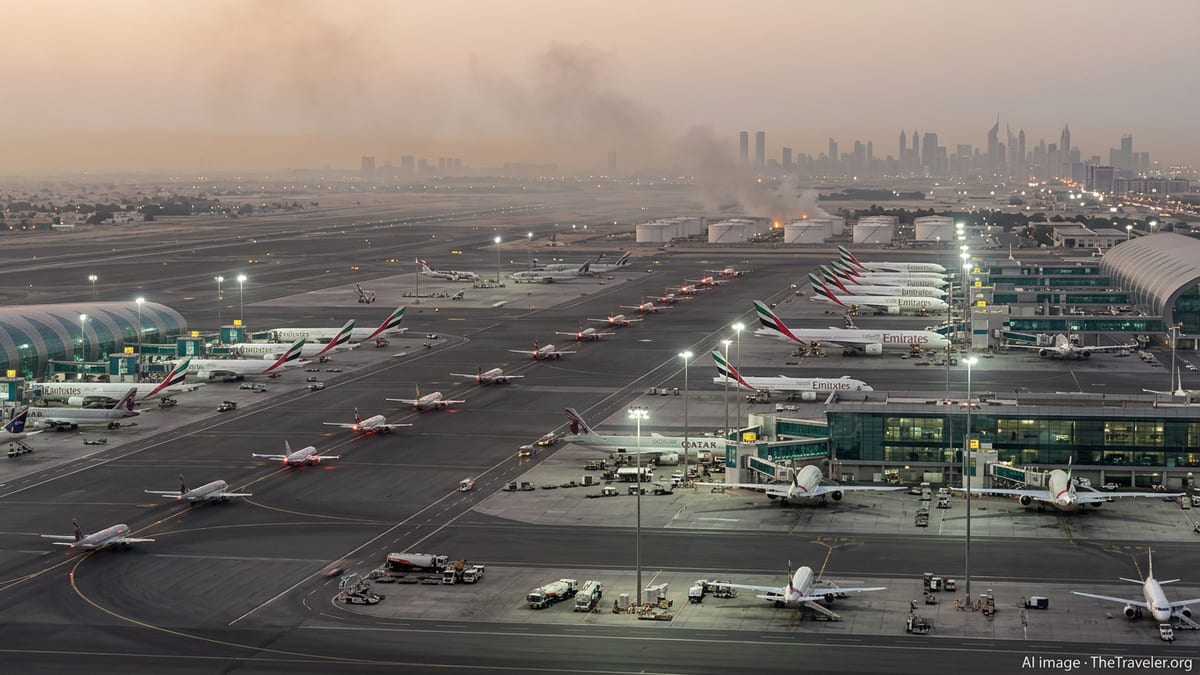
Drone Strikes Hit Key Global Hub
Dubai International Airport, one of the world’s busiest hubs for international travel, has become a frontline casualty of the escalating conflict involving Iran, the United States, and Israel. Publicly available information shows that since late February 2026, multiple Iranian drone attacks and missile salvos have targeted infrastructure across the United Arab Emirates, including facilities in and around Dubai’s main airport.
Reports indicate that a drone strike earlier in March ignited a fuel tank at Dubai International Airport, prompting an immediate suspension of flights and emergency security procedures. Subsequent incidents on March 11, when two drones reportedly fell in the vicinity of the airport, deepened concerns about the vulnerability of the region’s airspace and the safety of flight operations.
According to recent coverage from global and regional outlets, Dubai International has experienced repeated pauses in operations since March 2, with only a limited number of services allowed to operate under stringent security conditions. The irregular stop‑start pattern of closures and resumptions has made it difficult for airlines to restore predictable schedules and has left passengers facing rapidly changing travel plans.
These events form part of a wider campaign of Iranian strikes across the Gulf, including attacks near other regional airports and energy facilities. Analysts note that Dubai’s central role as a long‑haul hub means any disruption there quickly reverberates across airline networks linking Europe, Asia, Africa, and the Pacific.
Airspace Closures and Mass Cancellations
The drone activity has coincided with extensive, rolling airspace restrictions across the Middle East. Travel advisories and risk assessments released in early March describe widespread closures or severe limitations over Iran, Iraq, Syria, Qatar, Kuwait, Bahrain, and parts of the United Arab Emirates. These constraints, often imposed at short notice, have forced airlines to cancel or reroute thousands of flights.
Aviation industry analyses suggest that tens of thousands of services have been affected since the conflict flared, with one specialist publication estimating around 23,000 cancellations linked to damage at Dubai Airport and airspace shutdowns across the region. Flight‑tracking data cited in recent reporting shows aircraft placed in extended holding patterns near Dubai during suspected missile threats, while others have diverted to alternative hubs or turned back mid‑journey.
Regulatory notices and airline statements indicate that airspace around key Gulf gateways can shift from open to closed within minutes, depending on the security picture. This volatility has created significant challenges for airline operations control centers, which must constantly replan flight paths, crew duties, and aircraft rotations, often with incomplete information.
For travelers, the result has been a patchwork of cancellations, diversions, and long delays. Passengers report missed connections, unexpected overnight stays, and last‑minute rebookings as carriers juggle capacity and safety considerations in a rapidly evolving environment.
Emirates, Qatar Airways, Etihad and Others Reroute
The crisis has hit the region’s biggest carriers particularly hard. Emirates, based at Dubai International, along with Abu Dhabi’s Etihad Airways and Doha‑based Qatar Airways, collectively account for a significant share of long‑haul traffic between Europe, Asia, and the Pacific. Industry data cited in recent coverage suggests they handle roughly one third of passenger traffic between Europe and Asia, and more than half of passengers traveling between Europe and Australasia.
In response to the airspace closures over Iran, Iraq, and other nearby states, publicly available route analyses show these airlines have been forced to send long‑haul flights on lengthy detours. Services that once took direct paths over the Gulf and Iran are now being routed via the Red Sea, Egypt, and sometimes the eastern Mediterranean or Central Asia. These diversions can add two to three hours of flying time to a single sector.
Emirates has reportedly suspended many regional flights and trimmed frequencies on some long‑haul routes, focusing available capacity on core corridors while conditions remain unpredictable. Etihad and Qatar Airways are operating reduced schedules and have prioritized limited services and repatriation flights for stranded passengers. Other Gulf carriers such as flydubai and Air Arabia continue to run select services but also under constrained conditions.
Beyond the Middle East, European and Asian airlines have adjusted their own flight plans. Some have temporarily suspended Dubai services altogether, while others are rerouting passengers through alternative hubs or allowing free changes and refunds. Travel industry trackers describe a fragmented network where seat availability can change rapidly as airlines respond to the latest security and airspace updates.
Fuel Prices Spike as Conflict Hits Energy Corridors
The aviation disruption is closely linked to a parallel shock in global energy markets. The conflict has affected key shipping lanes and energy infrastructure, including attacks on commercial vessels and facilities near the Strait of Hormuz, a waterway that normally handles about one fifth of the world’s oil shipments. Coverage from financial and security analysts indicates that Iranian strikes on tankers and infrastructure have slowed traffic to a fraction of normal levels.
Oil prices have climbed sharply since the conflict escalated, with some regional media noting gains of around a quarter compared with pre‑crisis levels. Jet fuel prices have followed suit, putting further pressure on airline operating costs just as carriers are burning more fuel on extended detours around closed airspace.
Industry reports describe airlines introducing higher fuel surcharges on certain long‑haul routes and warning of further adjustments if prices remain elevated. Each additional flight hour on a wide‑body aircraft can add tens of thousands of dollars in fuel and crew costs, amplifying the financial strain on carriers that are already cutting capacity and absorbing disruption‑related expenses.
Aviation analysts caution that sustained high fuel prices could feed through to higher fares more broadly, potentially dampening travel demand if the conflict and airspace restrictions persist into the peak northern summer season. For now, many airlines are balancing short‑term surcharges with efforts to maintain competitive pricing on critical routes.
Passengers Face Uncertainty and Prolonged Disruption
For travelers, the crisis has translated into a deeply uncertain journey experience. Passenger accounts compiled from public forums and social media describe crowded terminals, long queues at transfer desks, and confusion over which flights are operating. Some travelers report being turned back from airport entrances during sudden closures, while others recount being held on runways or diverted to unfamiliar airports as security alerts were issued in mid‑flight.
Airlines across the region have introduced flexible rebooking policies, allowing date changes and rerouting in many cases without standard penalties. However, limited seat availability on remaining services means that some passengers are waiting days for onward travel. Hotels near major hubs, including Dubai and Doha, have seen spikes in demand from stranded travelers seeking accommodation while they await new flights.
Travel advisories published by risk consultancies and government agencies are urging passengers to monitor airline communications closely, allow extra time for connections, and be prepared for sudden itinerary changes. Many advisories highlight the possibility of rapid security developments and recommend that nonessential travel through heavily affected airspace be reconsidered.
With the broader conflict still unfolding and no clear timeline for a full reopening of Middle Eastern airspace, aviation experts suggest that disruption centered on Dubai and neighboring hubs could persist for weeks. For the global travel industry and the millions of passengers who normally rely on Gulf transit routes, the current wave of drone strikes and airspace closures marks one of the most severe tests since the pandemic era.