

More news on this day
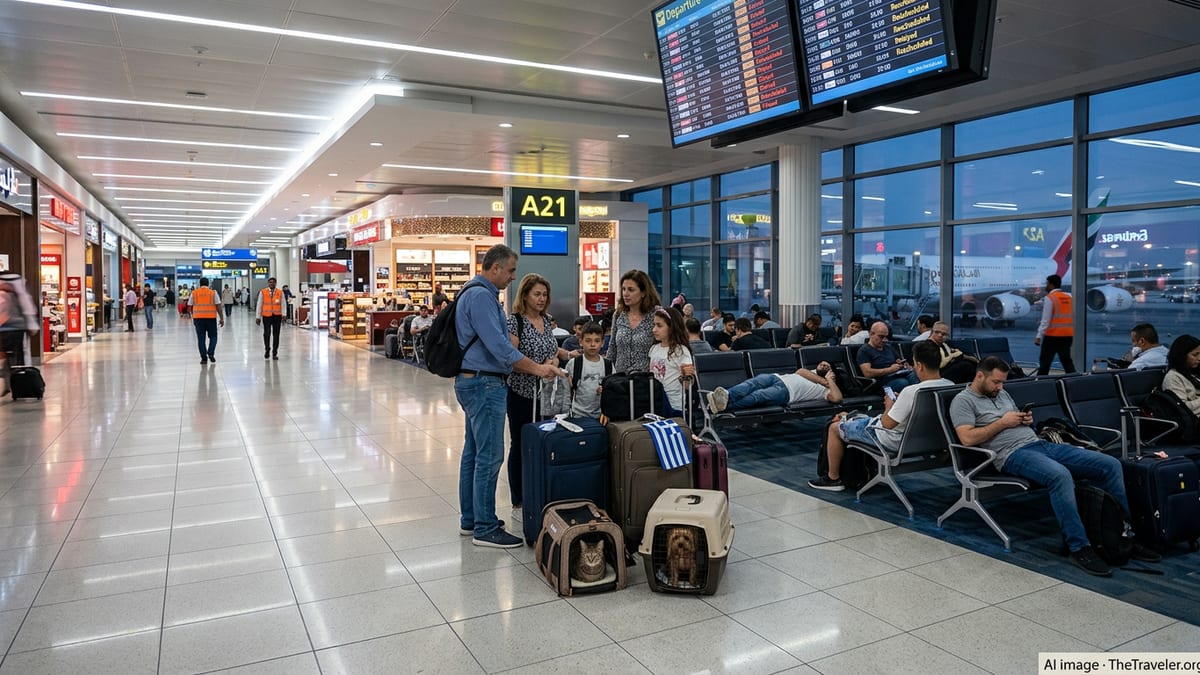
A special repatriation flight arranged for Greek nationals and their pets to leave the United Arab Emirates has been delayed following a drone-related security incident that briefly disrupted air traffic in the Gulf region, adding fresh uncertainty for stranded travelers trying to return home with their animals.
Get the latest news straight to your inbox!
Drone Activity Adds New Disruptions to Gulf Airspace
Recent drone activity over parts of the Gulf has led to tighter airspace controls and intermittent suspensions of commercial traffic at major hubs in the United Arab Emirates, according to published coverage in regional and international outlets. Reports indicate that at least one drone incident near a key UAE airport prompted a temporary halt to departures and diversions of incoming flights as aviation authorities assessed potential risks.
Publicly available information from Gulf-focused news reports describes a pattern of restricted operations at major airports, with carriers shifting to reduced or carefully scheduled services. These disruptions have affected not only regular commercial routes but also special flights organized to move foreign nationals out of the region.
Analysts quoted in open-source coverage of recent events note that drone incursions near airports typically trigger strict safety protocols, even when physical damage is limited. Runway closures, ground stops, and extra inspections can ripple through flight schedules for many hours, causing congestion and forcing operators to re-sequence departures based on safety and operational priorities.
Within this broader context, the latest drone incident has had knock-on effects for a range of evacuation and repatriation efforts, including dedicated flights chartered or coordinated for specific nationalities.
Greek Repatriation Flight Held Back After Incident
Among the operations affected was a special repatriation flight planned to carry Greek citizens and their pets from the UAE to Greece. According to Greek and regional media coverage tracking evacuation efforts, the service was designed to assist nationals who had registered for departure amid ongoing instability and restricted scheduled flights.
Reports indicate that the flight’s timing coincided with tightened safety measures after the latest drone-related disruption in UAE airspace. As a result, departures at the relevant airport were subject to delays and re-checks, pushing back the planned takeoff slot for the Greek repatriation service. Passengers already dealing with earlier cancellations and rebookings were left waiting once again in terminals or temporary accommodation.
Greek-focused coverage notes that repatriation priorities typically give precedence to the most vulnerable travelers and those with urgent medical or family needs. When airspace capacity is suddenly reduced, these operations may be rescheduled or combined, with departure sequences adjusted at short notice. The drone incident therefore translated into another layer of uncertainty for Greeks abroad who had been counting on a defined departure window.
While no major injuries were reported in connection with the specific drone episode, its impact on airport operations was significant enough to disrupt the delicate timing of special flights, including this repatriation operation for Greek nationals and their companion animals.
Travelers With Pets Face Extra Hurdles
The delay is especially stressful for passengers traveling with pets, who are already navigating complex paperwork, veterinary checks, and limited capacity for animals on board. Public commentary from travel forums and open online discussions in recent weeks highlights how the suspension or reduction of pet cargo services by some Gulf-based airlines has sharply narrowed options for expatriates trying to leave the UAE with cats, dogs, and other small animals.
In many cases, special repatriation flights represent a rare opportunity to depart with pets on the same aircraft, provided that carriers and organizers allocate sufficient in-cabin or hold space that complies with animal transport regulations. When a drone incident causes a delay or schedule reshuffle, that carefully arranged balance can be disturbed, raising questions about whether animals will remain on the same booking, whether additional health certificates will still be valid, and how long travelers can safely wait in temporary housing.
Travel advisers and relocation specialists quoted in prior public coverage of similar crises stress that veterinary documents, vaccinations, and import permits often have strict validity windows. A delay of even a few days can mean that blood tests, parasite treatments, or fit-to-fly certificates need to be renewed, adding both cost and logistical strain. For Greek nationals in the UAE whose pets were already cleared for travel on this special flight, the drone-linked disruption risks triggering a new round of appointments and approvals.
Some passengers may also face extra boarding constraints linked to aircraft type and route. Narrow-body aircraft or high-demand repatriation services often have fewer spaces for animals, meaning that any rebooking is more difficult when compared with standard commercial operations. This makes the reliance on a specific, scheduled repatriation flight particularly acute for pet owners.
Airlines Balance Safety, Capacity, and Repatriation Demands
According to publicly available airline statements and regional aviation reporting, carriers operating in and out of the UAE are currently running a patchwork of limited flights, with a strong emphasis on repatriation services for foreign nationals. Flight schedules remain fluid, and many airlines are prioritizing safety inspections and route adjustments in response to drone and missile-related risks in the wider region.
Reports from airline-facing publications describe a cautious ramp-up of operations after earlier widespread suspensions, with some carriers adding special repatriation and relief flights while still holding back from a full restoration of their pre-crisis networks. In this environment, any security incident, including a drone sighting or impact near airport facilities, can quickly unravel carefully planned rotations and crew schedules.
For Greece-linked repatriation efforts, this means that coordination between Greek authorities, local partners, and airlines must adapt in real time to changes on the ground. Aircraft availability, crew duty limits, and refueling constraints can all influence whether a special flight departs on the same day as planned, later the same night, or on a subsequent date.
Industry observers point out that while passengers naturally focus on their own flight, operators are managing an intricate puzzle of connections, aircraft positioning, and safety checks. A single delayed departure in Dubai or Abu Dhabi can affect onward services to Europe and beyond, including repatriation flights bound for Athens or other Greek destinations.
Uncertain Timelines for Stranded Greeks and Their Animals
For now, published accounts suggest that Greeks and their pets booked on the delayed repatriation service from the UAE continue to face an uncertain wait for updated departure details. Some travelers are reportedly weighing alternative routes through neighboring countries or considering private charter solutions tailored for pet transport, options that can carry significantly higher costs.
Travel experts quoted in open media discussions generally advise passengers in similar situations to remain in close contact with official travel advisories, consular announcements, and airline customer channels, while avoiding unverified rumors circulating on social networks. Given the volatile security environment and the sensitivity of drone-related incidents near airports, schedule changes are likely to continue with limited prior notice.
The experience of this delayed Greek repatriation flight underscores how quickly evolving security risks can intersect with highly personal decisions about travel, safety, and the welfare of companion animals. For many Greek nationals in the UAE who have already endured days of disruption, the wait to leave has become not only a logistical challenge but an emotional strain shared with the pets they are determined to bring home.
As Gulf airspace slowly reopens and airlines test more robust schedules, travelers and their animals remain at the mercy of regional security developments. Each new drone alert or incident has the potential to reset departure boards, turning what was meant to be a straightforward journey home into a prolonged and unpredictable ordeal.