

More news on this day
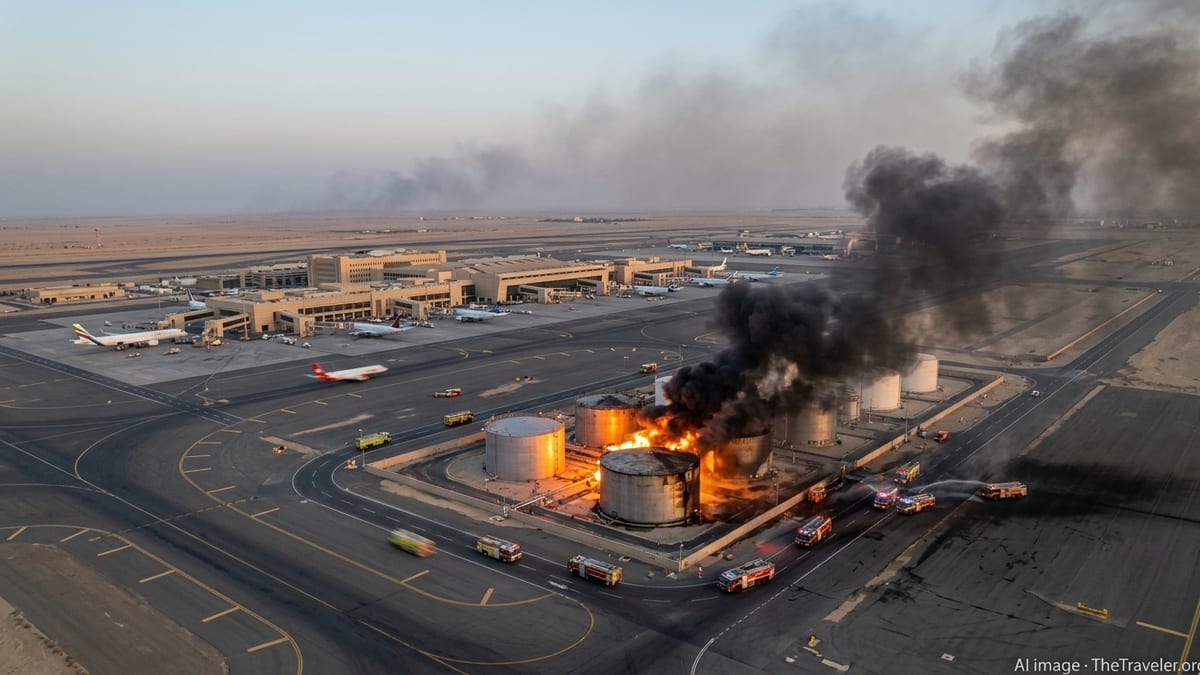
A powerful drone strike targeting fuel infrastructure at Kuwait International Airport has ignited a large fire and disrupted flight operations, intensifying concern among travelers and aviation operators already unsettled by the expanding conflict between Iran and Gulf states.
Get the latest news straight to your inbox!
Fuel Tank Hit as Drone Wave Reaches Kuwait’s Main Gateway
According to published coverage of recent Iranian strikes on Kuwait, drones struck fuel storage facilities at Kuwait International Airport, triggering a fire that sent thick plumes of smoke over the capital. Reports indicate that the latest incident followed earlier strikes and interceptions around the airport area as Iran expanded its campaign against military and energy infrastructure across the Gulf.
Initial accounts from regional media and eyewitness videos posted online describe at least one fuel tank at or near airport service areas being hit, with flames visible from surrounding neighborhoods. Publicly available information shows that emergency services worked to contain the blaze around the stricken tank while additional inspections were carried out across adjoining fuel and support facilities.
Coverage from regional newspapers and broadcasters indicates that, despite the intensity of the blaze, early official tallies pointed to damage concentrated in airport fuel and support infrastructure rather than in passenger terminals. However, the proximity of the inferno to the main hub for Kuwait’s commercial aviation has amplified fears that civilian transport facilities are becoming increasingly exposed as the conflict broadens.
Travel industry observers note that Kuwait International Airport, one of the key transfer and labor routes between the Gulf, South Asia and Europe, has now experienced multiple drone-related incidents since late February, underscoring how quickly front-line risks have moved into critical civilian infrastructure.
Flights Diverted and Delayed as Operators Assess Damage
Airlines and airport operators responded by rerouting and delaying flights while fire and structural assessments were carried out. Publicly available aviation tracking data and media reports indicate that several arriving services were placed in holding patterns or diverted to alternate Gulf airports, while some departures were temporarily suspended as smoke and firefighting operations affected airside visibility and ground access.
Industry analysts observing the disruption note that even when runways and passenger buildings remain physically intact, any damage or safety concern involving fuel infrastructure can rapidly paralyze airport operations. Inspections of pipelines, pumps and storage tanks are generally required before normal refueling can resume, prompting cascading delays across regional and long-haul networks.
Reports from airline statements and airport notifications suggest that carriers warned passengers to expect schedule changes and potential last-minute cancellations. Travelers transiting through Kuwait have been advised through publicly shared updates to monitor airline communication channels and to anticipate longer connection times as operational capacity is gradually restored.
While some services reportedly resumed after safety checks, aviation commentators caution that the pattern of repeated attacks in Kuwait and neighboring states is making it harder for airlines to plan reliably. Increased flight times due to diversions around perceived threat zones, coupled with congestion at alternative hubs, are beginning to ripple across broader Middle East and Asia–Europe travel corridors.
Part of a Wider Campaign Targeting Kuwait’s Infrastructure
The strike on Kuwait International Airport forms part of a broader sequence of Iranian missile and drone attacks on Kuwaiti territory since late February. Openly available reporting on the 2026 Iranian strikes on Kuwait cites previous incidents in which drones hit or targeted the airport, military air bases and oil refineries, as well as the nearby port and logistics hubs that support foreign forces stationed in the country.
Earlier in March, published accounts documented Shahed drones and other one-way attack systems reaching both civilian and military targets, including a tactical operations center near Port Shuaiba and bases hosting United States and European forces. These incidents resulted in military casualties and serious injuries, along with fires at energy facilities and government buildings, contributing to a sense that no part of Kuwait’s critical infrastructure is completely insulated from the conflict.
Regional political coverage notes that Kuwait and several other Gulf states have issued joint statements condemning Iranian-aligned attacks on civilian facilities, including airports and energy installations. Analysts following the region suggest that the repeated hits and near-misses on Kuwait International Airport reinforce concerns that dual-use locations serving both civilian and military functions may face elevated risk as the confrontation continues.
Travel and security briefings now routinely reference Kuwait alongside other Gulf hubs as locations where sudden escalation could influence airspace restrictions, insurance costs and route planning. Although air defenses have intercepted many missiles and drones, scattered debris and occasional successful strikes have still produced fires, localized shutdowns and anxiety among residents and travelers.
Passenger Anxiety Rises as Smoke and Sirens Dominate the Skyline
Images shared on social media platforms in the wake of the latest strike show dense black smoke rising from the airport area, visible from major highways and residential districts in Kuwait City. People posting from the city have described hearing detonations and sirens as emergency vehicles converged on the site, deepening concerns over personal safety and the reliability of key transport arteries.
Travel commentators note that such imagery, widely circulated through global news outlets and user-generated content, can significantly affect traveler sentiment even when casualty figures remain low. The perception of an airport engulfed in flames, combined with reports of repeated strikes in the same metropolitan area, has been cited by risk consultancies as a factor that may prompt travelers and corporations to reconsider non-essential trips.
Hotel operators and tour organizers watching developments report, through publicly accessible statements and updates, that some guests are shortening stays or inquiring about alternative exit routes via neighboring countries. International schools and corporate offices in Kuwait are also closely monitoring the situation, updating internal travel guidelines and contingency plans in case further attacks disrupt commercial flights or access roads to the airport.
Experts in crisis communications point out that clear, timely public information from aviation and civil defense agencies can help reduce panic and prevent congestion around the airport perimeter. However, the unpredictability of incoming drone and missile waves, and the broader tension across the region, make it challenging to offer travelers simple assurances about safety and continuity of service.
Regional Air Travel Faces a New Phase of Volatility
The fire at Kuwait International Airport underscores a new phase of volatility for regional air travel, in which the primary risk is no longer limited to overflight of conflict zones but extends directly to major hubs themselves. Insurance analysts cited in business media note that repeated incidents involving drones and ballistic missiles hitting or approaching airports and refineries in Kuwait, the United Arab Emirates, Qatar and other Gulf states may trigger revisions in war-risk premiums and coverage terms.
Airlines serving the region are already adjusting by revisiting contingency plans, adding fuel margins to accommodate diversions, and coordinating with airports that could temporarily absorb extra traffic if a hub becomes unavailable. Publicly accessible operational notices show some carriers clustering flights into narrower time windows judged to have lower threat levels, while others are exploring greater use of alternative hubs outside the immediate conflict zone.
For travelers, the immediate effect is a growing likelihood of last-minute itinerary changes, longer routings and heightened security screening at departure and arrival points. Travel advisors recommend that passengers build in additional connection time, maintain flexible tickets where possible and remain attentive to airline and airport advisories throughout their journey.
As the wider confrontation between Iran and regional states continues, the experience at Kuwait International Airport illustrates how quickly a drone strike on fuel infrastructure can ripple far beyond a single fire. The incident has temporarily reshaped flight patterns, unsettled thousands of passengers and added a new layer of uncertainty to air travel across one of the world’s busiest transit regions.