

More news on this day
A new drone incident near Dubai International Airport has triggered a significant fire and renewed disruption to flights, deepening concerns over aviation safety and regional stability as the war involving Iran, the United States and Israel escalates across the Middle East.
Get the latest news straight to your inbox!
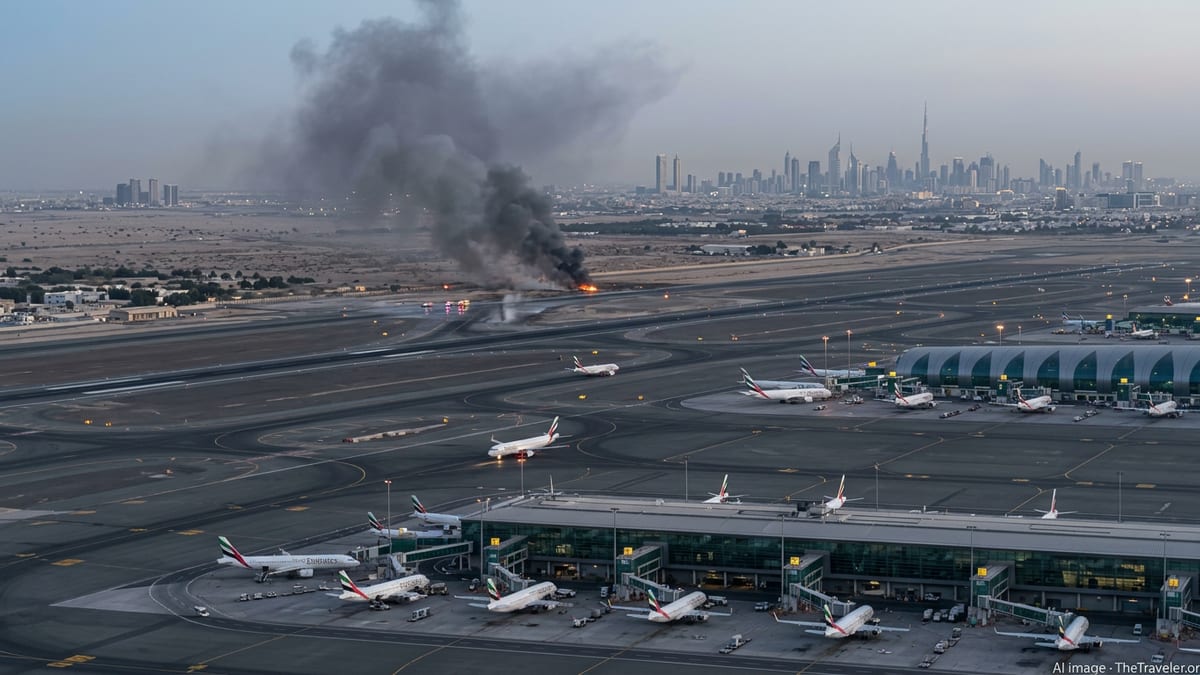
Fresh Strike Hits Airport Vicinity as Conflict Escalates
Reports emerging on March 16 indicate that Dubai International Airport, one of the world’s busiest hubs for international passenger traffic, has once again been affected by a drone-related incident, with witnesses describing a large fire visible from surrounding districts. Unverified images and videos circulating on social media show thick plumes of smoke rising near the airport perimeter, underscoring how quickly the conflict has reached the heart of the region’s commercial aviation network.
The latest strike follows a pattern of Iranian drone and missile activity across the Gulf since late February, with previous projectiles and debris already reported near the airport and other strategic locations in the United Arab Emirates. Earlier in March, publicly available information from regional outlets and aviation advisories documented at least one incident in which drones fell in the vicinity of the airport, injuring ground staff and briefly halting operations before flights gradually resumed.
This new episode appears to mark a further escalation, coming just days after Tehran publicly signaled a willingness to target major economic and transport infrastructure in Gulf states in response to joint United States and Israeli strikes. Analysts note that Dubai’s status as a global interchange for travelers and cargo makes any disruption at its main airport particularly sensitive for airlines, insurers and governments.
As of publication, detailed assessments of damage and disruptions remain limited, but early indications suggest that fire crews and airport teams have been mobilized to contain the blaze and inspect critical facilities, including fuel farms, runways and terminal areas.
Long Haul Hub Under Sustained Pressure
Dubai International Airport serves as a vital east west connector, handling tens of millions of passengers annually and acting as a primary gateway for Europe Asia, Africa and Oceania traffic. In recent weeks, schedules have already been strained by the broader airspace closures and reroutings triggered by the regional war, with carriers forced to alter flight paths away from higher risk zones and, in some cases, suspend services entirely.
Published coverage from global newswires and specialist aviation outlets shows that previous drone incidents near the airport earlier in March prompted temporary ground stops, diversions to Abu Dhabi and Sharjah, and extended holding patterns for aircraft already airborne. Travel risk advisories issued over the past week have highlighted Dubai as operating under heightened alert, but still functioning as a key alternative as other Gulf air corridors, including parts of Qatari airspace, experienced intermittent closures.
The latest fire near the airport raises concerns that a prolonged series of attacks could gradually erode the hub’s resilience. Even if core infrastructure remains intact, repeated disruptions translate into mounting operational costs for airlines, increased duty of care obligations toward stranded passengers, and complex rescheduling challenges for long haul itineraries that depend on tightly timed connections.
For airport operators, the emerging reality is a more volatile operating environment, where rapid shifts in the regional security picture can have immediate consequences for runway availability, crew duty times, and the reliability of published timetables.
Middle East Conflict Redraws Global Flight Maps
The renewed strike near Dubai comes against the backdrop of a rapidly evolving war that has already redrawn the aviation map across the Middle East. Since late February, Iranian projectiles and drones have been reported targeting or approaching airports, ports, oil facilities and military installations in several Gulf and neighboring states, prompting widespread airspace restrictions.
International carriers have increasingly diverted traffic via alternative hubs such as Muscat, Riyadh and Istanbul, while some Asian and European airlines have suspended services to selected Gulf destinations or shifted to overflying routes that avoid the Strait of Hormuz and adjacent conflict zones. Industry trackers note tens of thousands of cancellations, reroutings and schedule adjustments since the conflict intensified, with knock on effects for crew positioning, aircraft utilization and airport slot coordination.
Dubai’s role as a central junction in many round the world and multi stop itineraries means that any instability there has broader implications, potentially forcing airlines to reconfigure entire route networks. Travel media and specialist risk consultancies have warned that travelers should expect longer flight times, more technical stops, and last minute changes to routings as carriers attempt to balance safety considerations with commercial viability.
Freight operators are also feeling the impact, as disruptions to express cargo and belly hold capacity on passenger jets affect supply chains spanning sectors from luxury retail to critical pharmaceuticals, many of which routinely transit through Dubai.
Travelers Confront Growing Uncertainty and Safety Concerns
For travelers, the drone strike near Dubai International Airport adds another layer of uncertainty to a situation that was already challenging. Passenger accounts and social media posts from recent days describe abrupt gate changes, extended waits in terminal holding areas, and diversions that left arrivals scattered across alternative Gulf airports before onward travel could be arranged.
Publicly available travel advisories consistently recommend that passengers transiting the region maintain flexible itineraries, monitor their airline’s official channels for real time updates, and allow for significant additional connection time. Many airlines have put in place temporary rebooking waivers and voluntary change policies for itineraries touching the Gulf, though the exact terms vary by carrier and are subject to frequent revision as the conflict develops.
Security analysts emphasize that, despite the alarming images of fire and smoke, the layered air defense and airport protection systems around major hubs like Dubai are designed to mitigate the worst case scenarios. However, even successful interceptions can generate debris and shockwaves that pose risks to people and property near flight paths, as seen in earlier incidents elsewhere in the UAE and neighboring states.
Against this backdrop, some travelers are shifting long haul journeys away from Gulf connections entirely, opting instead for routings via Europe, Central Asia or direct transoceanic flights where available. Tour operators and corporate travel managers are closely tracking developments, balancing duty of care obligations with the logistical reality that Dubai remains, in many cases, the most practical or only option for certain city pairs.
Global Aviation and Security Implications
The fire near Dubai International Airport following the latest drone impact underscores how twenty first century conflicts are increasingly spilling into civilian airspace and commercial infrastructure. The repeated targeting of aviation hubs, ports and energy facilities across the region highlights the vulnerability of globalized transport systems to relatively low cost, long range weapons.
According to open source military and risk analysis, Iran’s expanding use of drones and missiles in the current war appears designed not only to respond to strikes on its own territory, but also to exert economic pressure by threatening key nodes in global trade and travel. Dubai, with its dense concentration of airlines, logistics firms, data centers and financial services, has become a central focus of that strategy.
Industry observers expect insurers, airport operators and carriers to reassess their exposure to drone and missile risk in the Gulf, potentially leading to higher premiums, revised operating procedures and accelerated investment in counter unmanned aircraft systems. Airports worldwide are also watching the situation closely, viewing Dubai’s experience as a test case for how a major hub copes with recurrent aerial threats while attempting to maintain operations.
As the conflict shows little sign of easing, the drone strike near Dubai International Airport stands as a stark reminder that the fallout from the war extends far beyond the immediate battlegrounds, reshaping travel patterns, economic forecasts and security planning on a global scale.