

More news on this day
Travel in and out of the United Arab Emirates has been thrown into fresh turmoil after a drone strike near Dubai International Airport disrupted fuel facilities, forced road closures around the hub, and deepened flight delays at the height of the Eid holiday rush.
Get the latest news straight to your inbox!
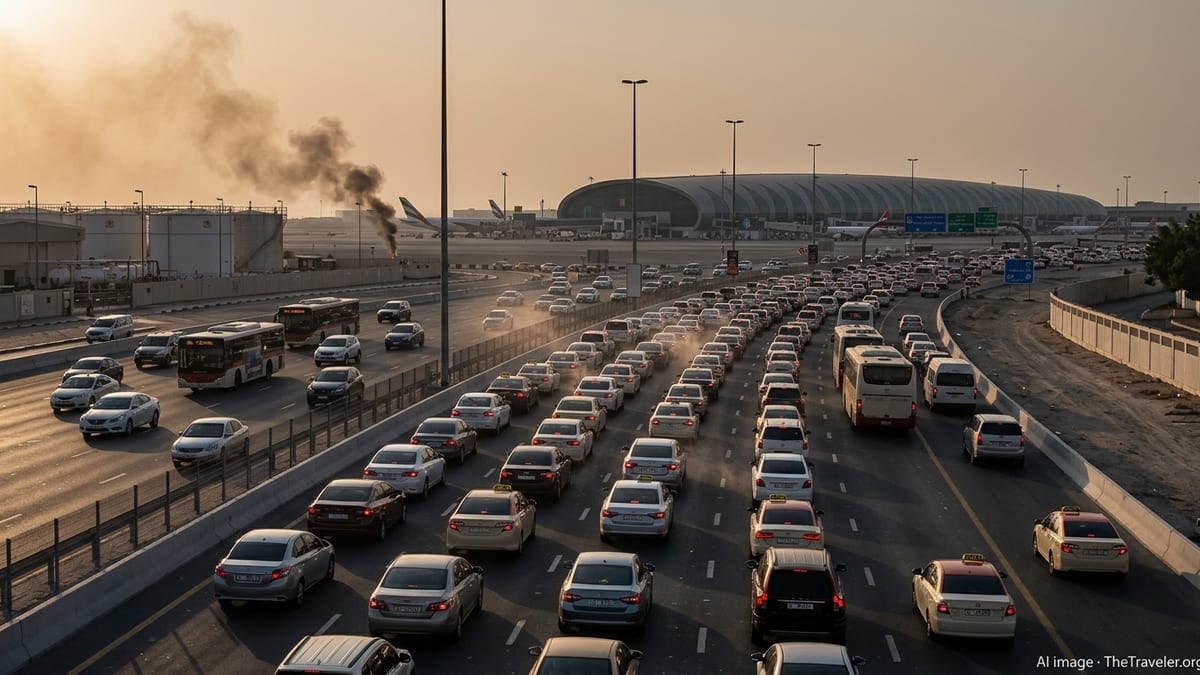
Drone Incident Near Fuel Facilities Intensifies Security Fears
According to publicly available reporting, a drone strike on or near fuel infrastructure close to Dubai International Airport on March 16 led to a fire and a temporary suspension of most flight operations at one of the world’s busiest aviation hubs. The incident forms part of a broader pattern of missile and drone activity targeting the United Arab Emirates in recent weeks, linked to escalating regional tensions.
Information compiled from regional media and security advisories indicates that air defenses intercepted multiple drones over the emirate before debris and at least one impact were reported in the vicinity of the airport. Footage circulating on social media appears to show flames and a dense plume of smoke rising from an area close to airport fuel facilities, though precise geolocation remains under review.
Open-source chronologies of the current crisis indicate that this latest attack follows earlier drone and missile incidents affecting both Dubai and Abu Dhabi since late February, including previous disruptions at Dubai International Airport. The cumulative effect has been to push the UAE’s normally resilient aviation sector into a cycle of rolling suspensions, diversions, and capacity constraints.
Publicly available summaries of the strikes state that most incoming drones and missiles have been intercepted before reaching key infrastructure, but falling debris has repeatedly caused fires and localised damage. The March 16 strike near Dubai’s main airport represents one of the most disruptive episodes to date because of its proximity to fuel storage and the resulting impact on flight safety procedures.
Road Closures Snarl Access to Dubai International Airport
Traffic disruptions around Dubai International Airport quickly compounded the aviation impact. A widely shared traffic update from local channels on March 16 indicated that while general traffic had resumed after earlier precautionary closures, Airport Road remained shut in one direction for vehicles approaching from Sheikh Mohammed Bin Zayed Road, Al Khawaneej, and the Marrakech Street intersection.
Drivers posting online described long tailbacks across eastern Dubai as vehicles were diverted away from the main access routes to the terminals. Some commuters reported abandoning attempts to reach offices in the area and returning home instead, citing standstill congestion near the airport perimeter and on key feeder roads.
Publicly available travel security guidance for the region has been warning of temporary road closures around sensitive facilities since early March, referencing the risk of both additional strikes and debris from interception efforts. The latest closures near Dubai International Airport are broadly in line with those earlier advisories, which caution that access to major transport hubs may change at short notice.
Ride-hailing drivers and airport service staff have also reported difficulty reaching pick-up zones and staff entrances, with some indicating that they were instructed to avoid certain underpasses and tunnels near the airport. The combination of road blocks, diversions, and checkpoints has added significant travel time for both passengers and workers.
Flight Suspensions, Diversions, and Mounting Delays
In the immediate aftermath of the drone incident, publicly available aviation updates indicated that Dubai International Airport curtailed most operations while emergency services responded and safety assessments were carried out. Social media posts from passengers and airline staff described aircraft placed in holding patterns, diversions to other airports, and lengthy waits on the ground.
Recent travel advisories for the Middle East note that airspace corridors across the Gulf remain vulnerable to sudden restrictions because of ongoing missile and drone activity. For Dubai, this has translated into rolling suspensions, limited arrivals and departures, and a growing backlog of displaced passengers trying to rebook scarce seats once operations partially resume.
Some carriers with large South Asian and European networks are reported by public tracking data and passenger accounts to have cancelled or consolidated flights to and from Dubai in the hours following the latest strike. Others have opted for extended delays, keeping flights on the schedule while routing aircraft through alternative flight paths that avoid the most affected segments of regional airspace.
Travelers transiting Dubai have been particularly affected, with missed connections and uncertain rebooking options. Publicly available discussions among stranded passengers describe crowded transfer desks, limited hotel availability, and difficulty reaching airline hotlines as call volumes surge.
Eid Holiday Rush Magnifies Impact on Travelers
The latest disruption has arrived at a particularly sensitive moment for the UAE’s travel infrastructure. The drone strike and subsequent closures coincided with the busy Eid period, a time when tens of thousands of residents and visitors typically fly in and out of Dubai for family gatherings, religious observances, and leisure trips.
Passenger accounts from the past several days describe unusually dense crowds at check-in areas and security lanes, as travelers attempt to navigate both standard holiday congestion and the added uncertainty of conflict-related delays. Some report arriving at the airport many hours earlier than normal in anticipation of extra screening and the risk of last-minute schedule changes.
Regional travel analysts observing the situation through open data sources note that Dubai’s role as a major global transit hub amplifies the knock-on effects of any disruption. Passengers who might not otherwise be flying to the Gulf now find their journeys affected because their itineraries rely on connections through Dubai to reach Africa, Asia, Europe, and the Americas.
The result is a complex web of delays that extend far beyond the immediate region, with ripple effects visible on flight tracking services and in operational updates from airlines on multiple continents. For many travelers hoping to reach family in time for Eid celebrations, the timing of the disruption has been particularly challenging.
Travel Advisories Urge Flexibility and Extra Caution
International risk consultancies and airline bulletins issued over the past week consistently advise travelers to the UAE and wider Gulf region to maintain flexible plans and closely monitor airline and airport announcements. These publicly available advisories highlight the potential for sudden airspace restrictions, renewed drone or missile activity, and rapid changes to airport access conditions.
Common recommendations include allowing significantly more time than usual to reach Dubai International Airport, carrying essential items in hand luggage in case of unexpected overnight stays, and ensuring that mobile devices remain charged to receive real-time updates from carriers. Many advisories also encourage travelers to confirm their flight status repeatedly on the day of departure rather than relying on earlier schedules.
Travel insurers and corporate travel departments are also updating their guidance in response to the evolving situation. Some companies are temporarily rerouting staff away from transit through Dubai where alternatives exist, while others are asking employees to delay nonessential trips until the operational picture stabilizes.
For now, publicly available information suggests that Dubai’s aviation and transport networks are operating with reduced but gradually recovering capacity, while remaining vulnerable to renewed disruption if regional hostilities intensify. Travelers planning to pass through the UAE in the coming days are being urged to stay informed and be prepared for rapidly changing conditions on both the ground and in the air.