

More news on this day
A drone strike that damaged radar infrastructure linked to Kuwait International Airport has intensified concern over air travel across the Gulf and Eastern Mediterranean, as travelers, airlines, and security analysts scrutinize whether regional hubs in Jordan, Qatar, Iraq, Bahrain, Saudi Arabia, the United Arab Emirates, Cyprus, Lebanon, and Turkey could face similar threats.
Get the latest news straight to your inbox!
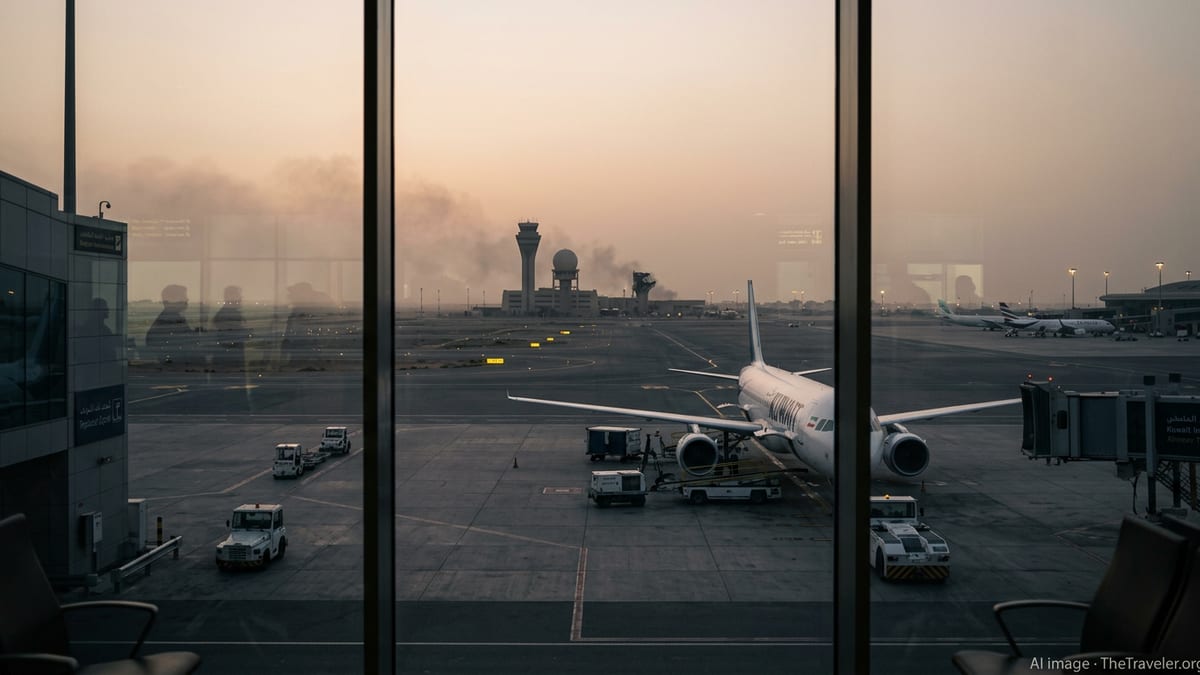
What Happened Above Kuwait’s Main Gateway
Publicly available information emerging on March 14 and 15 indicates that a drone attack targeted facilities associated with Kuwait International Airport, with government statements reported in regional media and social platforms describing damage to radar systems used for managing air traffic. Earlier in the month, Kuwaiti infrastructure including fuel tanks and nearby military-linked installations had already come under pressure amid a broader exchange of drones and missiles tied to the ongoing Iran-related conflict, placing the country’s main civilian gateway inside an increasingly contested airspace.
Coverage by regional and specialist outlets describes a pattern in which Iranian drones and missiles have been aimed at both U.S.-linked military positions and critical infrastructure around Kuwait City, including Ali Al Salem Air Base and facilities near the airport perimeter. In parallel, business aviation and airline industry publications report that passenger terminals at Kuwait International have been affected during recent strikes, with damage to aviation infrastructure compounding broader airspace closures and diversions across the Gulf.
As details of the radar incident continue to be clarified, early indications suggest that air-traffic management capacity in Kuwait has been significantly constrained, prompting temporary shutdowns and diversions in line with earlier airspace closures announced this month. Travel advisories from foreign governments and aviation risk consultancies already cited Kuwait’s skies as high risk even before the latest radar damage, and the new incident is being assessed as another major stress test for the country’s aviation safety framework.
For travelers, the immediate consequence has been uncertainty around departures and arrivals, with some flights canceled outright and others being rerouted through alternative hubs when available corridors are open. Airlines are continuously recalibrating schedules in response to dynamic notices to air missions, or NOTAMs, that reflect both the physical damage to Kuwait’s radar systems and the potential for renewed strikes.
Could Drone Threats Spread to Neighboring Hubs?
The question many travelers are asking is whether the Kuwait radar strike signals an emerging risk pattern for other regional hubs, including those in Qatar, Bahrain, Saudi Arabia, the United Arab Emirates, Iraq, Jordan, Cyprus, Lebanon, and Turkey. Aviation risk analyses published over the past week describe a multilayered conflict environment in which drones and missiles are being used across a wide geographic area, at times close to major civilian airports and flight corridors.
Reports show that Iranian retaliatory barrages in recent days have involved drones and ballistic missiles aimed at or near airports and bases in several Gulf states, including Qatar, Bahrain, the United Arab Emirates, and Kuwait. One business aviation briefing notes that terminals at Kuwait International, Dubai International, and Zayed International in Abu Dhabi have all sustained varying degrees of impact from recent strikes, prompting partial suspensions of passenger operations and the relocation of some aircraft from high-risk airports.
Risk-tracking bulletins also reference drone and missile activity transiting Iraqi and Jordanian airspace, with particular attention to Baghdad and Erbil in Iraq and to military installations that share airspace approaches with civilian operations. While there is currently no evidence of a coordinated campaign specifically aimed at civilian radar systems across all these countries, the Kuwait radar incident demonstrates that air-traffic control infrastructure can be exposed when military and civil aviation share the same airfield or surrounding airspace.
Further west, published coverage on Lebanon, Cyprus, and Turkey emphasizes heightened vigilance rather than direct strikes on civilian aviation assets. Beirut’s international airport, for example, has previously navigated periods of elevated tension by adjusting flight paths and schedules without full closure. Cyprus and Turkey, meanwhile, are being monitored mainly as diversion points and overflight corridors that could absorb rerouted traffic if parts of Gulf and Levantine airspace become unusable.
How Radar Damage Disrupts Flights and Safety Margins
Radar installations at and around major airports are central to modern flight operations, from sequencing arrivals and departures to managing en-route traffic in congested corridors. When a radar facility is damaged, air-traffic controllers may lose primary detection capability in parts of their coverage area, forcing the use of procedural separation and alternative surveillance tools that reduce capacity and increase workload.
Aviation safety documents and past case studies show that even temporary radar outages can quickly lead to delays, diversions, and ground stops, particularly at airports that already operate near their maximum traffic thresholds. In the case of Kuwait, the radar damage comes on top of existing conflict-related airspace restrictions, which means controllers and airlines are juggling both reduced surveillance capability and the need to route aircraft away from active military activity.
Some Gulf states and larger hubs such as Doha, Dubai, Abu Dhabi, Riyadh, and Jeddah rely on layered surveillance architectures, combining primary and secondary radar with ADS-B and multilateration feeds. This redundancy can help absorb the impact of damage to a single sensor, but travel-security analyses note that installations positioned at or near military facilities may be more vulnerable during cross-border confrontations. The reported strike on radar infrastructure linked to Kuwait’s airport underscores this vulnerability in a real-world scenario.
For pilots, the practical effect is tighter margins in already complex skies. Reports from international cockpit associations and recent interviews compiled by global news agencies describe crews contending with not only drone and missile threats, but also crowded reroute corridors and intermittent navigation interference. In such an environment, the loss or degradation of an airport’s radar system amplifies risks, even if no aircraft are directly targeted.
What Travelers Passing Through the Region Should Expect Now
For passengers planning to transit Kuwait or neighboring states in the coming days, the key themes are volatility and rapid change. Airlines and airports are adjusting operations in near real time, responding to evolving NOTAMs, updated security assessments, and the practical condition of infrastructure such as the damaged radar at Kuwait International Airport. Schedules that appear normal one day can see sweeping cancellations or reroutes the next, especially when new strikes or interception events occur.
Travel-industry advisories recommend that passengers with itineraries touching Kuwait, Qatar, Bahrain, the United Arab Emirates, Iraq, or Saudi Arabia monitor airline communications closely and expect extended layovers or last-minute rebookings. Some carriers have temporarily consolidated flights through a smaller number of hubs, while others have paused operations to certain destinations entirely until they can better quantify the risks to aircraft and crew.
Travelers connecting via Jordan, Lebanon, Cyprus, or Turkey may also feel knock-on effects, even if those states do not experience direct hits on aviation infrastructure. As airlines reroute around higher-risk Gulf airspace, Eastern Mediterranean hubs can see increased traffic and tighter connection windows. Passenger experiences already shared in forums and social channels describe long queues at transfer desks, shifting boarding times, and confusion over luggage handling when routes are reconfigured on short notice.
For those already on the ground in affected airports, basic preparation remains important. Industry guidance suggests keeping essential items, medications, and valuables in carry-on bags, anticipating the possibility of being stranded airside or landside for longer than planned. Travelers are also urged to keep receipts for unexpected accommodation and transport costs in case partial compensation is available later from airlines or travel insurers once the immediate crisis recedes.
Assessing Risk: Kuwait Versus Other Regional Gateways
From a comparative risk perspective, Kuwait currently sits near the center of the storm due to the combination of direct strikes, damaged radar infrastructure, and proximity to U.S.-linked military targets that appear to be among the primary objectives of recent drone and missile campaigns. Airspace over Kuwait has experienced full closures and severe restrictions multiple times since late February, and the latest radar damage is likely to prolong disruptions.
Other Gulf gateways such as Doha, Dubai, Abu Dhabi, Manama, and major Saudi airports are assessed by aviation security firms as operating in a high-risk but more managed environment, relying on layered air-defense systems, diversified radar networks, and well-practiced contingency plans. Even so, published coverage notes that several of these airports or adjacent facilities have already experienced nearby strikes or debris falls from intercepted drones, underscoring that the risk is regional rather than isolated.
Iraq and Jordan, sitting along key east–west air corridors, are exposed to overflight of drone and missile traffic, which can trigger temporary reroutes or altitude restrictions even when civilian airports are not directly engaged. In the Eastern Mediterranean, Cyprus, Lebanon, and Turkey are less likely in the near term to see radar-specific attacks of the type reported in Kuwait, based on current targeting patterns, but they remain vulnerable to spillover effects if conflict dynamics widen.
For TheTraveler.org readership, the main takeaway is that the drone strike damaging Kuwait’s radar highlights how quickly the aviation picture in the wider region can change. It reinforces the need for travelers to treat flight plans through the Gulf and surrounding airspace as provisional, to check status repeatedly before departure, and to remain flexible about routing as airports and airlines respond to an evolving security landscape above some of the world’s most strategically sensitive skies.