

More news on this day
Drone strikes and rolling airspace closures around Dubai International Airport are triggering a fresh wave of flight cancellations, diversions, and fuel price spikes across the Middle East, disrupting global travel flows through one of the world’s busiest aviation hubs.
Get the latest news straight to your inbox!
Drone Impact at Dubai Airport Triggers Shutdowns
Publicly available reporting indicates that a series of Iranian drone and missile attacks since late February 2026 has repeatedly targeted infrastructure in the United Arab Emirates, including Dubai International Airport. A drone strike on a fuel tank near the airport on March 16 reportedly set off a major fire and forced a near-total suspension of operations at the hub, which is normally the world’s busiest airport for international travel.
Coverage from international news agencies and regional outlets describes earlier incidents in early March, including debris from intercepted drones falling near airport facilities and prompting temporary closures. Civil aviation notices show that the United Arab Emirates has at times ordered full or partial shutdowns of its airspace as a precaution, leading to sudden suspensions of arrivals and departures at Dubai and nearby airports.
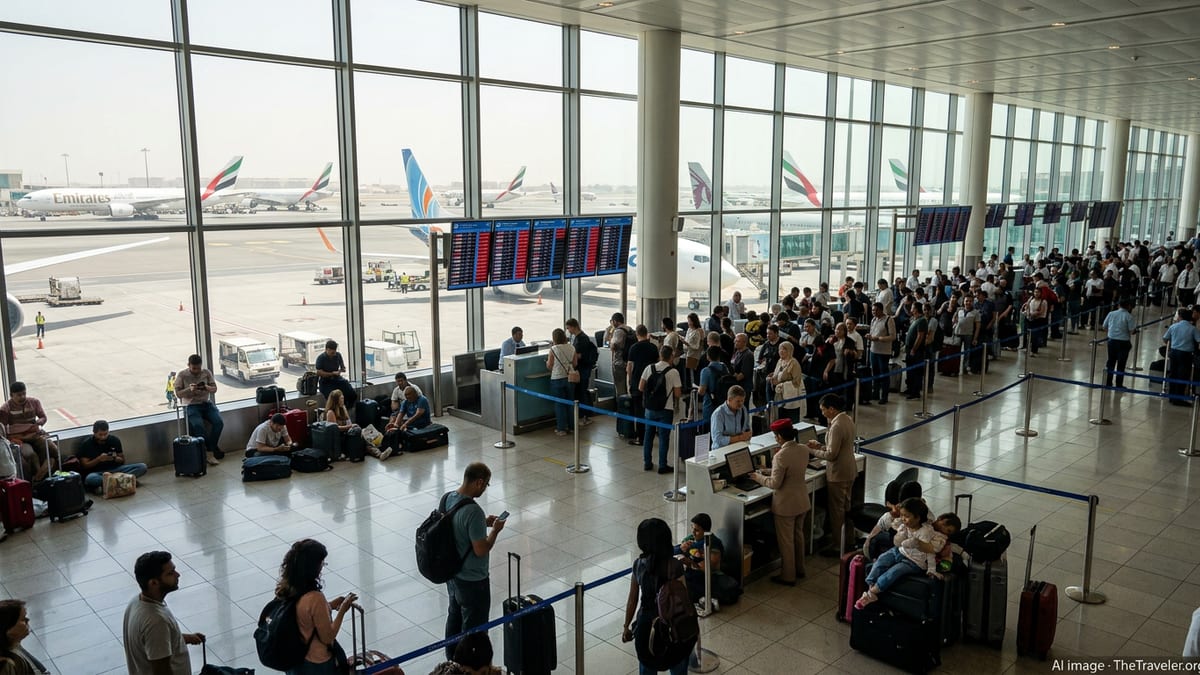
These repeated disruptions have left aircraft diverted to alternative airports such as Al Maktoum International and other regional hubs, straining ground capacity and lengthening passengers’ journeys. Images and accounts shared on public platforms in recent days describe crowded terminals, long queues at service desks, and confusion over rapidly changing departure boards as airlines race to adjust schedules.
Regional Airspace Closures Ripple Across Airline Networks
Travel advisories issued in early and mid March show that airspace over Iran, Iraq, Syria, Qatar, Bahrain, and parts of the Gulf has been intermittently closed or heavily restricted in response to the broader conflict and drone activity. Risk analysis bulletins describe “rolling” closures, with routes opening and shutting with little notice as missile and drone alerts are triggered across the region.
These restrictions have disrupted the traditional east west corridors that normally funnel long haul traffic between Europe, Africa, Asia, and Australasia through the Gulf. According to operational updates circulated by aviation security consultancies, more than ten thousand flights have been cancelled or re-routed since the start of March as airlines avoid high risk airspace and comply with new overflight bans.
Dubai’s role as a mega hub means that even a partial shutdown reverberates across global networks. Public flight-tracking data and industry commentary highlight long-haul services from Europe and North America to Asia being forced into extended detours via safer corridors over Saudi Arabia and Oman, while some carriers have temporarily suspended Dubai as a transit point altogether.
Emirates, Qatar Airways and Etihad Race to Reroute
According to airline statements and travel management alerts, Gulf carriers are implementing emergency rerouting plans in response to the evolving security landscape. Emirates, based at Dubai, has repeatedly pared back its schedule, announcing temporary suspensions of flights to and from the city after the latest fuel-tank strike before resuming a limited number of services through designated safe corridors.
Qatar Airways has faced its own disruptions following Iranian strikes and attempted attacks near Hamad International Airport in Doha, with reports noting periods of Qatari airspace closure and consequent cancellations. Public information indicates that the airline has rerouted many services around affected airspace and, in some cases, shifted capacity to alternative hubs when feasible.
In Abu Dhabi, Etihad Airways has also been operating under constraints, with Zayed International Airport reported to be only partially operational at various points in March. Regional briefings describe ad hoc repatriation flights, special charter operations, and complex multi-stop routings as carriers attempt to move stranded passengers while staying clear of active conflict zones.
Industry analysts cited in media coverage describe this as the most severe disruption to Gulf aviation since the pandemic, noting that the simultaneous impact on several key hubs makes it harder for airlines to offer simple rebooking options or same-day alternatives.
Passengers Face Cancellations, Diversions and Overnight Strands
The operational turbulence is translating into a difficult experience for travelers. Accounts shared on social media and passenger forums speak of long-haul flights turning back mid-journey, diversions to secondary airports across the Middle East and Europe, and travelers spending nights in terminal buildings awaiting updates from airline staff.
Travel advisories compiled by global risk consultancies emphasize that schedules are changing on an hourly basis, and recommend that passengers avoid going to airports without confirmed departure times. Reports mention that some carriers have set up special desks and hotlines for rebooking, but high call volumes and staff shortages are leading to long wait times and limited same-day solutions.
With school holidays and business travel planned months in advance, cancellations are affecting a wide mix of passengers, from tourists on connecting itineraries through Dubai to expatriate workers trying to return home. Publicly available information shows that some travelers have opted to re-route via more distant hubs in Europe or Asia, accepting longer journeys to bypass the Gulf entirely.
Fuel Prices and Wider Economic Fallout
The aviation crisis is unfolding alongside a sharp escalation in energy market volatility. Analysts tracking the conflict note that drone and missile activity around the Strait of Hormuz and key oil and gas facilities in the Gulf has slowed tanker traffic and disrupted production in parts of the region. As a result, benchmark crude prices and jet fuel costs have risen significantly since late February.
Industry briefings explain that higher fuel prices are compounding the financial strain on airlines already managing cancellations, diversions, and crew positioning challenges. Longer rerouted flights burn more fuel, incur additional overflight and handling fees, and complicate aircraft maintenance schedules, all of which increase operating costs at a time when carriers are also processing large volumes of refunds and compensation claims.
Travel and business groups warn in public statements that extended disruption could hit tourism revenues, trade flows, and conference and events activity across the Gulf. With Dubai in particular serving as a gateway for Africa Asia trade and a popular stopover for long-haul leisure travel, a prolonged period of reduced connectivity would likely have knock-on effects for hotels, retailers, and service providers that depend on airport traffic.
Uncertain Outlook as Security Situation Evolves
Risk assessments produced in mid March consistently describe the security environment as highly fluid, with a continued high likelihood of missile and drone activity affecting airspace decisions at short notice. Aviation regulators and air traffic authorities across the region are issuing frequent updates, and carriers are adjusting routes day by day as new information becomes available.
While some airports in the wider Middle East remain fully operational, the interconnected nature of global route networks means that instability at a handful of major hubs can continue to cause cancellations and missed connections far beyond the region. Analysts suggest that until the tempo of cross-border strikes slows and governments scale back airspace restrictions, airlines will maintain conservative routing that prioritizes safety over schedule reliability.
For travelers planning to pass through Dubai and other Gulf hubs in the coming days, publicly available guidance consistently stresses the importance of checking flight status directly with airlines, expecting potential delays, and being prepared for last-minute changes to routings or dates. With both the conflict and its economic consequences still unfolding, the outlook for Middle Eastern aviation remains uncertain.