

More news on this day
Vietnam’s central aviation hub in Da Nang has been thrown into the spotlight after a series of illegal drone incursions during the busy Tết travel rush forced runway closures, disrupted scores of flights and left thousands of passengers facing long delays and missed connections.
Fresh Disruptions Hit Vietnam’s Tết Travel Peak
Da Nang International Airport, the main gateway to Vietnam’s central and Central Highlands regions, has confirmed multiple unauthorized drone incursions into restricted airspace on February 17 and February 22, the first and sixth days of the Lunar New Year period. The incidents coincided with one of the busiest stretches of the year, when holidaymakers were returning home or heading back to major cities after family reunions.
According to airport and aviation authorities, at least three separate drones were detected operating illegally near active flight paths, at altitudes reported between roughly 360 and more than 1,100 meters. Air traffic controllers, alerted by pilots’ reports and surveillance systems, responded by suspending departures, placing arriving aircraft into holding patterns and, at one point, temporarily closing the runway for about half an hour.
Local media and airport officials say the disruptions directly affected around 50 to 50 plus flights across the two days, though knock-on delays rippled across subsequent departures and arrivals. With Da Nang handling some 310 to 340 flights a day during Tết, even a brief shutdown translated into hours of waiting for passengers and significant operational headaches for carriers.
The incidents have renewed concerns over the growing popularity of consumer drones and flycams in Vietnam’s dense urban areas, where aviation experts warn that a collision between a small unmanned aircraft and an airliner at high speed could have catastrophic consequences.
How the Drone Incursions Unfolded Over Da Nang
The first reported intrusion occurred on February 17, the first day of the Lunar New Year, when a commercial flight on approach to Da Nang spotted a drone in the vicinity of its flight path. Initial accounts describe the device flying at about 3,800 feet, placing it well within controlled airspace reserved for crewed aircraft. A few hours later, a second flight reported another drone at around 1,200 feet in the same general area south of the airport.
Those two sightings on February 17 forced air traffic controllers to immediately impose separation measures. Departing flights were held at the gate or on taxiways, while incoming aircraft were instructed to circle in holding patterns until the airspace was deemed clear. Local press reports indicate that 30 to 35 flights experienced delays ranging from 20 minutes to more than an hour on that day alone.
A second wave of disruption came on February 22, the sixth day of Tết, when the airport was operating at near peak capacity as holiday travel tapered off. Around midday, airport surveillance teams detected another drone, this time in the northern takeoff and landing area. In response, the tower ordered an emergency halt to runway operations, effectively closing the strip for more than 30 minutes while the object remained within the safety corridor.
Data compiled from air traffic records and flight tracking platforms show that at least 19 flights were directly impacted by the February 22 incursion. Nine departures were forced to wait on the ground, while 10 inbound aircraft circled overhead or diverted to alternate holding points, burning fuel and compressing already tight schedules when normal operations resumed.
Travelers Stranded, Schedules Shattered During Holiday Rush
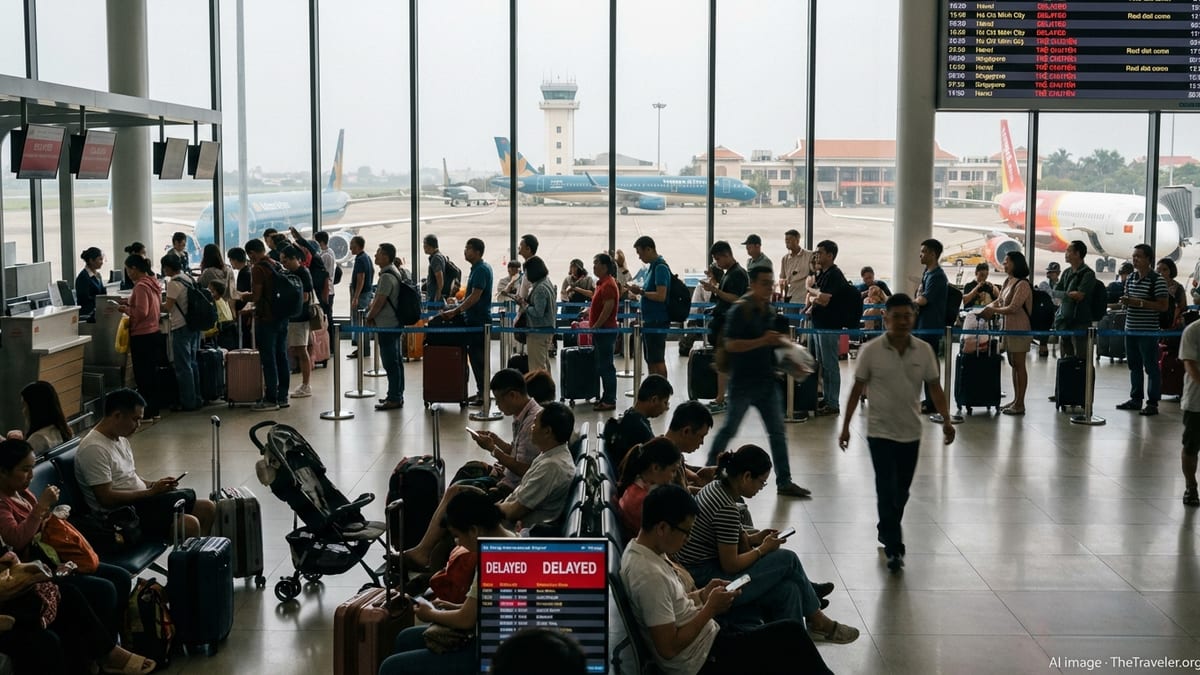
For passengers, the drone incidents translated into long, anxious waits and last minute scrambles to rework carefully planned itineraries. Witnesses at Da Nang airport on February 22 described scenes of confusion as departure boards flashed rolling delays and announcements informed travelers that all movements had been temporarily paused for safety reasons.
Thousands of passengers were believed to have been caught up in the knock-on disruption, including families with young children, tour groups and overseas Vietnamese returning to work abroad after celebrating Tết with relatives. Some reported circling above Da Nang for extended periods before finally touching down, while others were left sitting in packed departure halls as aircraft lined up idly on the apron.
With Da Nang serving as a crucial transit point for central Vietnam’s beach destinations and UNESCO-listed attractions, the delays also rippled into the tourism sector. Travelers heading to nearby Hoi An, Hue or coastal resorts saw transfers and hotel check-ins pushed back, adding stress at the tail end of the holiday period when roads and rail lines were already congested.
Airlines operating the affected routes now face a complex tally of fuel costs, compensation claims and crew duty time adjustments. Industry analysts note that even brief closures have an outsized impact during peak seasons, when tight turnarounds leave limited room for recovery once operations resume.
Safety Risks and Vietnam’s Rules on Drones Near Airports
The incidents have underscored the serious safety risks posed by unmanned aerial vehicles when they enter controlled or restricted airspace. Aviation specialists point out that modern jet engines are designed to withstand impacts with small birds, but are not tested against rigid drone components such as batteries and metal frames, which can cause far more severe damage if ingested.
Under Vietnamese law, operating drones, flycams, ultralight aircraft, large balloons, kites or high intensity lights within designated airport safety corridors is strictly prohibited without permission from competent authorities. The rules are particularly stringent within the immediate vicinity of runways and approach paths, where any unexpected object can force pilots and controllers to alter flight profiles at short notice.
Despite the regulatory framework, enforcement remains a challenge as consumer drones become more affordable and popular with hobbyists, photographers and content creators. Da Nang airport, located at the heart of the city, is especially vulnerable, as residential neighborhoods and riverfront areas lie close to approach routes that may seem attractive to amateur drone operators seeking dramatic footage of planes, skylines or sunset scenes.
Officials have stressed that ignorance of the rules is no defense. They warn that those responsible for illegal drone flights near airports could face heavy administrative penalties and, in serious cases where safety is endangered, potential criminal liability under national aviation security and air defense statutes.
Authorities Respond With Urgent Measures and New Proposals
Following the twin waves of disruption during Tết, Da Nang International Airport has submitted formal reports to municipal leaders and national aviation regulators, calling for a coordinated crackdown on unauthorized drone activity in the city’s skies. Airport management has outlined a package of proposed measures to strengthen surveillance and deterrence in and around restricted zones.
Among the steps under consideration are the installation of additional drone detection sensors, including radar and radio frequency scanners, to better identify small unmanned aircraft approaching from urban neighborhoods or over Da Nang Bay. Authorities are also studying the deployment of electronic countermeasures, such as signal jammers, which can disable or force the landing of rogue drones that stray into no fly areas.
In parallel, the airport has urged closer cooperation between civil aviation officials, local police, the city’s military command and Vietnam’s air defense units. The goal is to build a faster response chain so that, once a drone is detected, ground teams can quickly trace its operator, secure evidence and apply sanctions without relying solely on temporarily halting flights.
Officials say they will also push for tighter controls on the sale, import and rental of consumer drones, particularly in districts near the airport, and clearer requirements for registering devices and obtaining flight permits. These regulatory refinements are designed to differentiate between legitimate commercial use and reckless, ad hoc flying that jeopardizes public safety.
What Passengers Need to Know for Upcoming Trips
For travelers planning to pass through Da Nang in the coming days and weeks, authorities emphasize that flight operations have returned to normal and that the incidents were contained without any physical damage to aircraft or injuries to passengers. However, they also acknowledge that the Tết disruptions serve as a reminder of how quickly conditions can change when safety is at stake.
Airlines and travel agents are advising passengers to build in extra buffer time for connections during busy seasons, especially when traveling through major hubs like Da Nang, Hanoi and Ho Chi Minh City. Keeping contact details updated in airline profiles can help ensure that travelers receive timely notifications about any schedule changes or gate reassignments triggered by unforeseen events.
Passengers are also encouraged to monitor airport and carrier announcements closely, both in the terminal and via official apps, and to avoid relying solely on third party flight trackers, which may lag behind real time air traffic control decisions. In cases of extended delay, understanding the airline’s policies on meal vouchers, hotel accommodation and rebooking options can make navigating disruptions less stressful.
For those flying with tight onward itineraries, such as same day international departures or tour departures from nearby cities, experts suggest discussing contingency plans with travel providers ahead of time. While drone intrusions remain relatively rare, the recent Tết episodes demonstrate that they can upend even the best laid schedules when they occur at peak periods.
Balancing Drone Innovation With Aviation and Tourism Growth
The controversy in Da Nang is unfolding against a broader backdrop of rapid drone adoption in Vietnam, where unmanned aircraft are increasingly used for photography, filmmaking, agriculture and infrastructure inspection. Advocates argue that drones bring clear economic and creative benefits, particularly in a tourism driven region eager to showcase dramatic coastal and mountain landscapes.
Yet the Tết disruptions have highlighted the need to balance that innovation with stringent safeguards around critical infrastructure such as airports and military facilities. Tourism operators and local officials worry that repeated incidents could damage Da Nang’s reputation as a smooth, convenient entry point to central Vietnam, just as the region is competing aggressively for international visitors.
Industry voices are now calling for more structured education campaigns targeted at drone owners, including clear maps of no fly zones, simple online permit systems for approved operations and visible signage in popular filming locations near flight paths. By setting practical, well communicated boundaries, they argue, authorities can allow legitimate drone use to continue without compromising aviation safety.
For Vietnam’s booming travel sector, the stakes are high. As Da Nang recovers from the Tết turbulence and investigators work to identify the culprits behind the illegal flights, the city is under pressure to demonstrate that it can both harness new technologies and keep its skies safe for the millions of passengers who rely on them.