

More news on this day
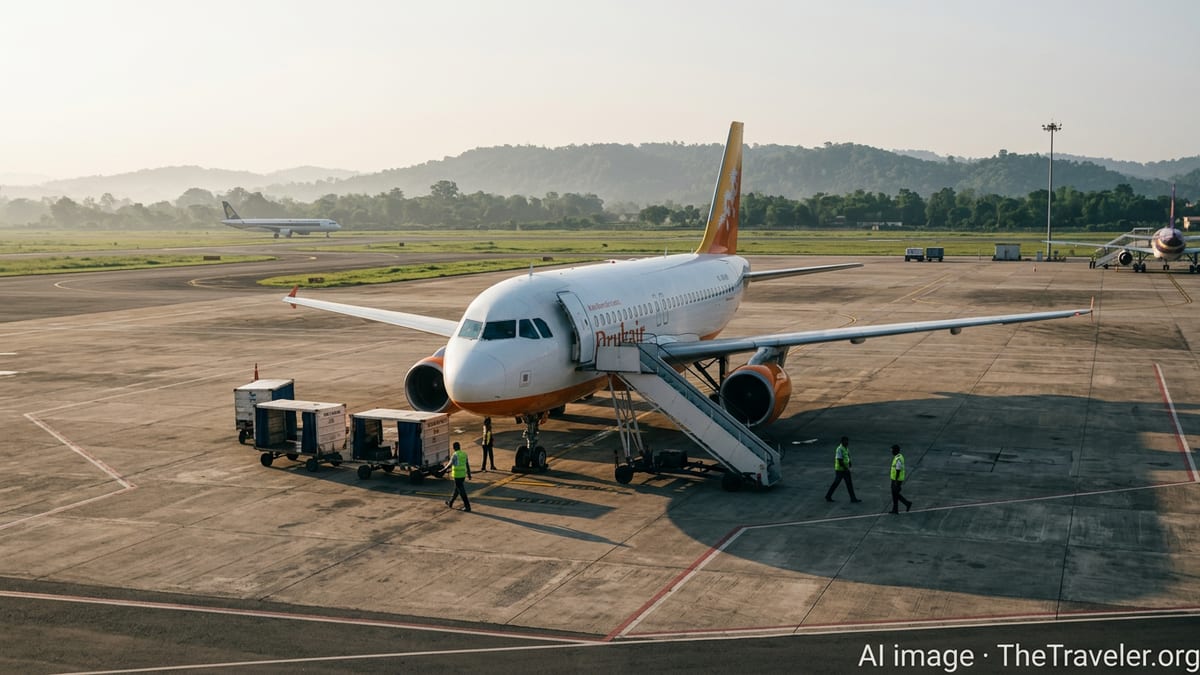
Bhutan’s national carrier Drukair has restored and expanded its multi-country network through Guwahati, re-establishing scheduled links between Paro, Bangkok and Singapore that had been curtailed during the pandemic and subsequent schedule cuts.
Get the latest news straight to your inbox!
What the Resumed Network Looks Like
Recent published schedules show Drukair once again using Guwahati’s Lokpriya Gopinath Bordoloi International Airport as a regional junction, with flights connecting Bhutan’s Paro International Airport to both Bangkok and Singapore. The structure effectively creates a same-airline bridge between the Himalayan kingdom, northeastern India and two of Southeast Asia’s most important hubs.
According to publicly available timetable documents, Drukair operates services on the Paro–Guwahati–Singapore routing under flight numbers in the KB540/KB541 series, as well as linked Bangkok services under the KB153 designation. These flights combine to form directional flows between Paro and Singapore, and between Bangkok and Paro, with Guwahati serving as the intermediate point for technical stops and passenger transfers.
Industry schedule trackers indicate that the Paro–Guwahati–Singapore flight typically departs Paro in the early morning, arriving in Guwahati after under an hour of flying before continuing onward to Singapore in the late morning. The return Singapore–Guwahati–Paro service is scheduled around midday departure from Singapore, arriving in Guwahati mid-afternoon and in Paro by late afternoon.
Planned rotations later in 2026 also show Drukair’s Bangkok–Paro services paired with Guwahati–Singapore sectors on specific days, effectively aligning Bangkok, Guwahati and Singapore within the same operational pattern. This pairing reflects the carrier’s strategy of using Guwahati as a multi-directional node rather than a simple technical stop.
Key Flight Times, Frequencies and Aircraft
Timetable information for 2025 and 2026 indicates that Drukair’s Paro–Guwahati–Singapore operation generally runs with two weekly frequencies, often clustered around midweek and weekend departures. Exact days of operation can vary from season to season, and notes in the carrier’s distribution materials highlight that all flights remain subject to regulatory approvals and operational changes.
The Singapore–Guwahati–Paro leg, reflected as KB541 in current winter and early 2026 schedules, is typically shown departing Singapore around midday, arriving in Guwahati in the mid-afternoon and reaching Paro before evening. The corresponding outbound from Paro to Singapore, referenced as KB540 in some schedule and route guides, usually leaves Paro shortly after sunrise, reaching Singapore in the afternoon after a brief stop in Guwahati.
For Bangkok, recent schedule PDFs list flight KB153 combining Bangkok–Paro operations with Guwahati–Singapore sectors on certain days from late March 2026. This arrangement allows passengers from Bangkok to connect onward through the same aircraft pattern toward Singapore, while also supporting inbound flows from Singapore to Bangkok via Guwahati and Paro on specific rotations.
Drukair primarily deploys its Airbus A319 aircraft on these multi-leg international services. The A319’s performance characteristics are well suited to Paro’s challenging terrain and short runway while still offering enough range to serve Singapore and Bangkok with a single stop in northeastern India. The carrier also operates an A320neo and ATR 42, but currently available schedules indicate the legacy A319 remains central on the Guwahati-linked routes.
Why Guwahati Matters in the New Expansion
Guwahati has emerged as a crucial element of Drukair’s broader regional strategy. Public data on the airport shows robust passenger growth in recent years and identifies Drukair as one of only a small number of foreign airlines operating scheduled international services there, underlining the significance of the Bhutanese carrier’s commitment to the city.
Using Guwahati as a through-point enables Drukair to connect Bhutan not only with India’s northeast, but also with onward international markets. For travelers originating in Paro, the route through Guwahati shortens the path to Singapore compared with routings through more distant Indian metros. For passengers in Assam and neighboring states, the Guwahati–Singapore segment offers a comparatively direct link to a major global hub, with the added option of continuing on to Bhutan on the same airline.
From a network-planning perspective, combining Bangkok–Paro and Guwahati–Singapore operations within the same aircraft rotation can create efficiencies in fleet utilization. Rather than operating isolated point-to-point services, Drukair is effectively stitching multiple regional flows together into one pattern, which can help sustain thinner markets such as Guwahati–Singapore by pairing them with stronger city pairs.
The revived and restructured services also contribute to tourism and trade flows among Bhutan, India and Southeast Asia. Readily available tourism guidance materials already highlight the Guwahati stop as a brief refueling and transit point on the way between Paro and Singapore, underscoring how integral the city has become to the overall journey design.
What Travelers Need to Know Before Booking
Because the Guwahati-linked services are operated as through-flights rather than as fully independent sectors in all cases, passengers should pay close attention to how their tickets are constructed. Travel specialists focusing on Bhutan typically sell the Paro–Guwahati–Singapore routing as a single itinerary, with Guwahati listed as a technical or short transit stop. This structure means that baggage is usually checked through to the final destination and that the brief ground time in Guwahati is spent within the secure side of the airport for most international passengers.
However, entry rules differ depending on nationality and ticket type. Travelers who wish to start or end their journey in Guwahati, or who plan to connect to separate domestic Indian flights, may need a valid Indian visa, as they are likely to clear immigration and customs. By contrast, passengers simply remaining on board or within the international transit process on a through-ticket typically follow a different procedure. Prospective travelers are advised to check current visa, transit and health requirements with official government sources before departure, as regulations can change.
Timings for the Guwahati stop are typically in the range of 40 to 60 minutes for refueling and handling, according to multiple operator and agency schedules. While this is usually sufficient for aircraft servicing and basic transit processes, it leaves little room for discretionary activities in the terminal. Travelers should plan to remain close to the gate and monitor airport screens, as last-minute operational adjustments are not uncommon in regional aviation.
Given that schedule PDFs and online tools are updated periodically, it is also important to review the most recent timetables close to the intended travel date. Seasonal adjustments, aircraft rotations and regulatory approvals can lead to day-of-week changes, temporary suspensions or additional frequencies, particularly on secondary routes such as Guwahati–Singapore.
Booking Options, Fares and Future Growth
Seats on the revived Paro–Guwahati–Singapore and Bangkok-linked services are available through Drukair’s own sales channels as well as through specialist Bhutan travel agencies that aggregate air and land arrangements. Public fare discussions on consumer forums suggest that tickets on these routes can be relatively costly compared with some regional low-cost alternatives, reflecting both the niche nature of Paro flights and the limited competition on Guwahati–Singapore sectors.
Some travelers report that working with experienced Bhutan-focused agents can help secure more favorable combinations, particularly where multi-city itineraries are involved. For example, itineraries that weave together Bangkok–Paro, Paro–Guwahati and Guwahati–Singapore segments under a single booking may offer better value than purchasing isolated one-way legs, though pricing ultimately depends on demand and seasonal factors.
Looking ahead, Drukair’s publicly announced fleet expansion, including additional Airbus A320neo and A321XLR aircraft in the coming years, signals an ambition to deepen its international reach. Industry commentary has pointed to the likelihood that Guwahati, Bangkok and Singapore will continue to play a central role in that strategy, given their established routes and growing demand from both tourism and business travel.
For now, the restored flights through Guwahati represent an important step in reconnecting Bhutan with its key Southeast Asian gateways. For travelers, they reopen a relatively streamlined way to move between Paro, Bangkok and Singapore while offering a rare glimpse of northeastern India from the air, all on a single regional carrier.