

More news on this day
Drukair, Royal Bhutan Airlines, is reinforcing its role as a regional connector by resuming and expanding services that link Bhutan with Thailand and Singapore through Guwahati, turning the northeast Indian city into a strategic hub for travelers navigating between the eastern Himalayas and Southeast Asia.
Get the latest news straight to your inbox!
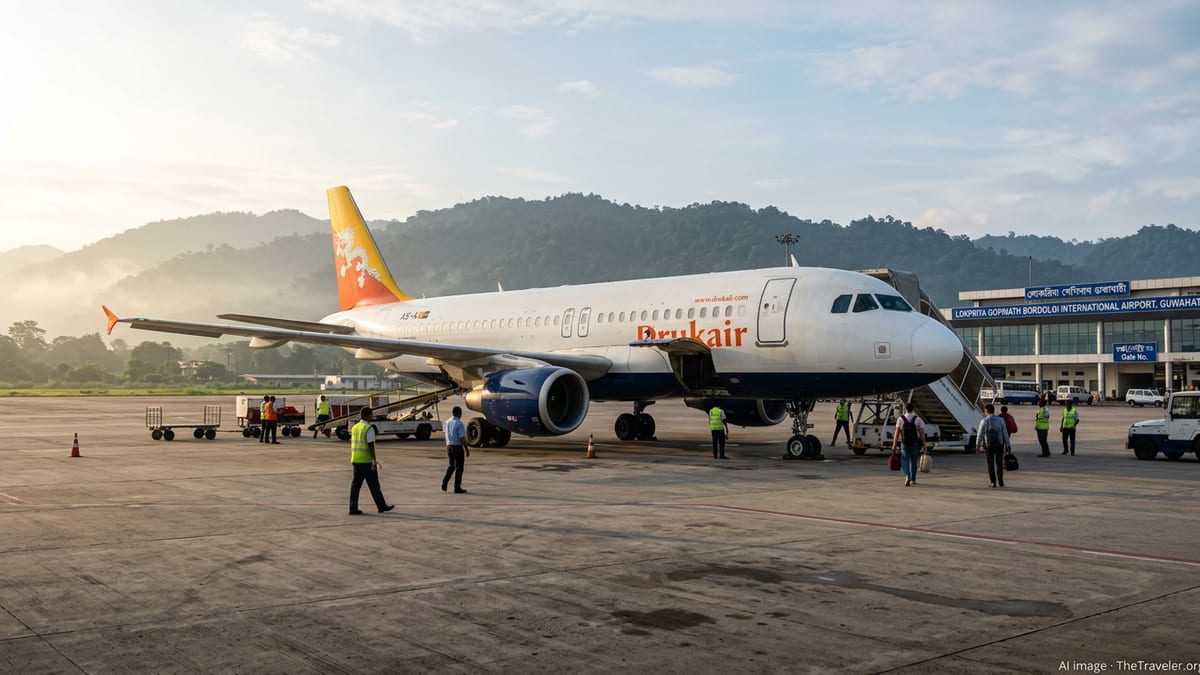
How the Revived Guwahati Corridor Connects Three Gateways
Publicly available schedules show that Drukair is once again using Guwahati as a key intermediate point on routes that connect Paro in Bhutan with Bangkok and Singapore. The configuration allows passengers from Bhutan to reach two of Asia’s busiest international hubs while also giving travelers from Thailand and Singapore a more direct entry to the Himalayas and Northeast India.
Drukair has a long history of operating Paro to Bangkok services and of linking Guwahati and Singapore, but these routes were disrupted and reduced during the pandemic years. Timetables published for 2025 and 2026 indicate that Guwahati is regaining importance within the network, with scheduled Guwahati to Singapore sectors and Bangkok to Guwahati flights feeding onward connections to Paro.
Information compiled from airline and airport data indicates that Guwahati’s Lokpriya Gopinath Bordoloi International Airport now sits at the center of this triangle. Travelers moving between Bhutan and Singapore or Bangkok can do so on a single ticket, while Guwahati serves both as a technical stop and as a limited origin and destination point for select services.
This structure effectively links three distinct travel markets: outbound visitors from Thailand and Singapore seeking Himalayan holidays, Bhutanese travelers heading to Southeast Asia, and residents of India’s Northeast looking for faster connections to major global hubs.
Current Flight Patterns and What Travelers Can Expect
Recent Drukair schedules for 2025 and early 2026 list a Guwahati to Singapore sector with a typical departure in the morning and mid-afternoon arrival in Singapore, operated by Airbus A319 equipment. Companion listings show Bangkok to Guwahati flights that arrive in time for the Guwahati to Singapore leg on specific operating days, forming a multi-stop corridor linking Bangkok, Guwahati and Singapore via Bhutan’s network.
On the Bhutan side, Paro remains the primary origin and destination. Paro to Bangkok flights operate multiple times per week, and seasonal variations include additional sectors routed via Indian cities for pilgrimage-focused itineraries. In parallel, Paro to Singapore services continue to include a brief technical stop in Guwahati, where passengers generally remain on board while the aircraft refuels and local formalities are completed.
Frequency on each sector varies by season. Schedules for different months show adjustments in weekly services on the Paro to Bangkok and Guwahati to Singapore legs, reflecting demand patterns, weather considerations in the Himalayas and broader fleet planning. Travelers planning multi-country itineraries are advised by tourism operators to check the specific operating days, as the Bangkok, Guwahati and Singapore flights are often carefully timed to interconnect.
Aircraft type is another point of interest for aviation-focused travelers. Drukair continues to rely primarily on Airbus narrowbody jets for these international routes, with A319s and A320-family aircraft serving the Paro, Bangkok, Guwahati and Singapore network. These aircraft are configured for short to medium-haul regional operations, compatible with Paro’s challenging airfield and Guwahati’s expanding international role.
Why Guwahati Matters for Regional Tourism and Trade
Guwahati’s inclusion in Drukair’s renewed routing has significance beyond a mere refuelling stop. Lokpriya Gopinath Bordoloi International Airport is the principal international gateway for Northeast India, and reports indicate that it has steadily increased its international services in recent years. The presence of a direct Guwahati to Singapore sector operated by Drukair adds a premium regional link between this emerging Indian hub and one of Asia’s leading financial and aviation centers.
For Bhutan, the routing through Guwahati offers additional reach into India’s Northeast, a region that shares cultural and environmental affinities with the Himalayas. Tourism boards and travel firms in the area have previously highlighted that nonstop and through services help shorten travel times for visitors heading to and from Bhutan, while providing opportunities for combined itineraries that include both Himalayan and Northeast Indian destinations.
From Singapore’s perspective, enhanced connectivity to Bhutan via Guwahati adds another specialized route for travelers seeking niche adventure, wellness and cultural experiences. Travel agencies that focus on high-value, low-impact tourism point to Bhutan’s controlled visitor regime and unique attractions, including monastery treks and dzong architecture, as strong draws for regional travelers who can now access the country with fewer flight changes.
The corridor also has implications for business and trade. Shorter and more frequent links between Guwahati, Bangkok and Singapore make it easier for entrepreneurs, educational institutions and officials from Bhutan and Northeast India to participate in events, conferences and training in Southeast Asia, and vice versa, fostering deeper economic and people-to-people ties.
Practical Guidance for Booking and Transit Through Guwahati
Public information from airline sales channels indicates that many Paro to Singapore flights are marketed as a single through service, even though the aircraft performs a brief stop in Guwahati. In these cases, passengers from Singapore to Paro or the reverse typically do not clear Indian immigration or collect their baggage in Guwahati, and the stop is treated as a technical halt for operational reasons.
For travelers starting or ending their journey in Guwahati, the situation differs. Dedicated Guwahati to Singapore sectors are bookable on select days, and passengers use Guwahati as a true origin or destination point. Travel agents in the region generally advise that itineraries combining Guwahati with Paro or Bangkok should be constructed on a single booking where possible, to safeguard connections and minimize visa complexity.
India’s visa and transit rules remain an important consideration. Because Guwahati is on Indian territory, passengers who intend to exit the international transit area or start their journey there must comply with current Indian entry requirements, which can vary by nationality. Travelers are encouraged by tourism operators to verify visa needs for India, Bhutan, Thailand and Singapore well in advance, especially when planning multi-stop trips.
Schedules published by Drukair also include standard caveats that timings and operating days are subject to change. Seasonal weather in the Himalayas, operational constraints and regulatory approvals can lead to adjustments. As a result, many Bhutan-focused tour operators recommend confirming flight details directly with airline booking systems shortly before travel, particularly for those relying on precise connections between Bangkok, Guwahati and Singapore.
Looking Ahead: Network Growth and New Himalayan Gateways
Drukair has signaled broader regional ambitions, including fleet renewal plans that feature additional Airbus narrowbody aircraft capable of flying longer sectors across Asia. Analysts following the airline note that such investments are intended to deepen Bhutan’s links with Southeast Asia, reinforce existing hubs like Bangkok and Singapore, and potentially open new city pairs as demand grows.
The increasing use of Guwahati as a connector fits into this strategy. As infrastructure at the airport continues to improve and traffic rises, the city is well positioned to act as a bridge between the Himalayan kingdom and the wider region. Observers of South Asian aviation development point out that the combination of niche tourism appeal and growing regional trade flows could sustain more regular and diversified services over time.
There is also growing attention on Bhutan’s efforts to develop additional gateways within its own borders, such as new or upgraded airports aimed at handling regional traffic. While these projects are at various stages of development, the existing Paro–Guwahati–Bangkok–Singapore pattern demonstrates how targeted routes can significantly expand the country’s reach without relying on a large network of domestic hubs.
For travelers, the key takeaway is that Bhutan is becoming more accessible from major Southeast Asian cities, with Guwahati playing a central role in routing. As Drukair refines its schedule and introduces new aircraft, industry observers expect the Bhutan–Thailand–Singapore corridor via Guwahati to remain an important avenue for both tourism and business travel in the eastern Himalayas.