

More news on this day
Air travel through Dubai, one of the world’s busiest aviation hubs, has been plunged into turmoil as escalating conflict between the United States, Israel and Iran triggers sweeping airspace closures, prompts airBaltic to suspend services to the emirate, and leaves thousands of passengers stranded across Europe, the Gulf and beyond.
airBaltic Halts Dubai Flights As Conflict Engulfs Regional Skies
airBaltic has temporarily suspended flights to and from Dubai as the widening Iran war sends shockwaves through Middle Eastern airspace and renders key Gulf corridors unsafe for civilian traffic. The Riga-based carrier, which only recently expanded into the Gulf market, has joined a growing list of European and regional airlines pausing services while military operations continue and authorities keep large swaths of sky closed.
The decision follows unprecedented missile and drone exchanges after coordinated US-Israeli strikes on Iran on 28 February, which prompted Iran to retaliate with barrages targeting, among others, the United Arab Emirates and Qatar. In response, the UAE and several neighboring states imposed full or partial airspace closures, forcing the shutdown of Dubai International Airport for more than 48 hours and triggering a cascading series of cancellations across global networks.
For airBaltic, Dubai represented a strategic long-haul link for passengers connecting from the Baltics and Northern Europe to Asia and the Indian Ocean via the Gulf. With Dubai’s role as a mega-hub severely compromised, the airline has opted to ground its Dubai operation rather than attempt complex and uncertain diversions around conflict zones.
The carrier has said affected passengers will be offered rebooking on later dates where possible or refunds under its disruption policy. However, the timeline for restoring normal operations remains unclear and will depend on security assessments and the gradual reopening of restricted routes over the coming days and weeks.
Dubai Hub Under Strain As Airspace Closures Ripple Worldwide
The suspension of airBaltic’s Dubai services is a microcosm of a much larger crisis hitting the global aviation system. Since the first strikes on Iran, authorities in Iran, Iraq, Kuwait, Bahrain, Qatar, the UAE, Syria and Israel have enacted sweeping airspace bans or tight controls, effectively shutting some of the world’s most important east west corridors and grounding operations at major hubs, including Dubai, Abu Dhabi and Doha.
Dubai International Airport, normally one of the busiest airports on the planet, experienced a near-total halt in operations for two days before cautiously resuming limited services. Even as a trickle of flights returns, airlines are operating heavily reduced schedules, prioritising stranded passengers and essential travel while warning that ad hoc closures and last minute reroutes remain possible as the conflict evolves.
Analysts estimate that thousands of flights have been cancelled or diverted since the start of the crisis, affecting hundreds of thousands of travelers. Long haul routes between Europe and Asia that typically overfly the Gulf are being rerouted around the Arabian Peninsula where possible, adding hours to journey times, complicating crew scheduling and driving up fuel costs at a moment when airlines are still recovering from years of pandemic disruption.
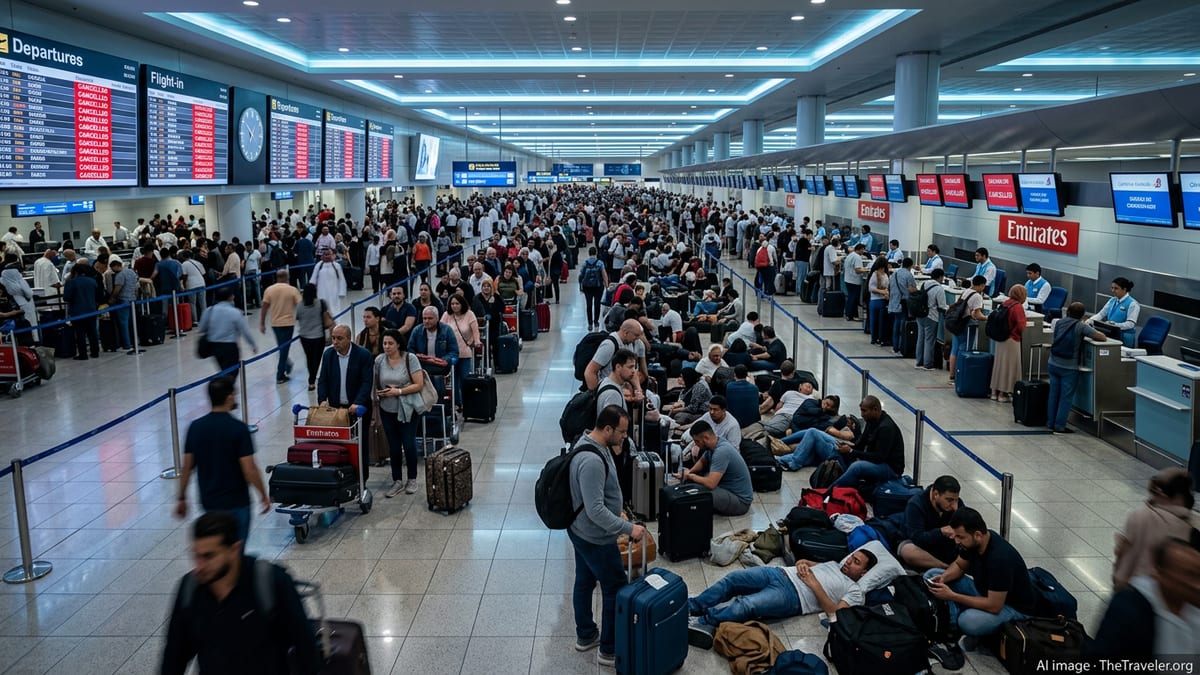
Airport terminals from Dubai to major European gateways such as London, Frankfurt and Istanbul have been packed with confused and fatigued passengers, many of whom had planned simple one stop connections via the Gulf and instead now face multi leg itineraries or uncertain wait times for repatriation flights.
Thousands Stranded As Airlines Juggle Evacuations And Limited Capacity
For individual travelers, the impact has been immediate and stark. Passengers booked on airBaltic’s Dubai services, particularly those connecting onward via the UAE to South and Southeast Asia, have found themselves stuck at origin airports or marooned midway through their journeys as transit hubs closed with little warning. Many report struggling to get through to airline call centers and facing long queues at service desks as staff work through complex rebooking scenarios with limited alternatives.
Regional network carriers based in the Gulf have mounted select repatriation and evacuation flights, but capacity is extremely tight and seats are being prioritized for citizens, residents and travelers who have already spent days in airport holding areas. European and Asian airlines, meanwhile, are scrambling to reconfigure schedules that avoid conflict airspace altogether, sometimes using longer northern routes through Central Asia or southern tracks over the Arabian Sea when permitted.
Even where air corridors are technically open, the practical challenges are immense. Air traffic control systems in neighboring countries that remain accessible are heavily saturated as rerouted flights converge on a small number of safe pathways. Slots are scarce, turnaround times are stretched and aircraft and crew often end up out of position, compounding knock on delays well beyond the Middle East.
Travel industry experts warn that, with no clear diplomatic off ramp in sight, the disruption could continue for weeks. That prospect has prompted some governments to advise against non essential travel to the broader region, further depressing demand and complicating planning for airlines that must balance safety, commercial viability and mounting passenger frustration.
What airBaltic Passengers And Dubai Bound Travelers Should Do Now
For travelers holding airBaltic tickets to or from Dubai in the coming days, the most important action is to verify the current status of their booking directly with the airline before heading to the airport. Schedules are being revised frequently as security conditions and airspace notices change, and many flights listed in older confirmations are no longer operating.
Passengers whose flights have been cancelled should expect the airline to offer either a refund or rebooking on a later date, in line with its standard disruption policies. However, rebooking options may be limited in the near term, especially for itineraries relying on Dubai as a connection point. Where possible, travelers may wish to consider alternative routings that avoid the Gulf entirely, even if that means additional stops or longer travel times.
Travelers already in Dubai or the wider region are being urged by aviation and consular officials to avoid going to airports without a confirmed seat and departure time. Terminals at Dubai and Abu Dhabi remain under pressure, with access in some cases restricted to ticketed passengers only. Those with urgent need to travel should remain in close contact with their airline, monitor official advisories and be prepared to move quickly if a seat becomes available on a short notice evacuation or repositioning flight.
Given that many travel insurance policies exclude coverage for disruptions directly linked to war or armed conflict, passengers should also review their policy wording carefully. Some providers may still offer limited assistance with rebooking and customer support, but reimbursement for extended hotel stays or missed onward connections may not be guaranteed in this scenario.
Outlook: No Quick Resolution As Conflict Reshapes Regional Aviation
While Dubai has begun a cautious, partial restart of operations, aviation authorities and industry executives acknowledge that a full return to pre crisis normality is unlikely in the immediate future. The continued exchange of missile and drone fire, along with the possibility of further strikes on or near civilian infrastructure, means that regulators are likely to keep restrictions in place until they are confident that the risk to commercial aircraft has subsided.
For airBaltic and other international carriers serving Dubai, the path forward will hinge on both the evolution of the conflict and the availability of safe, economically viable routings. In the short term, travelers should brace for rolling schedule changes, extended block times on flights that detour around closed skies and a patchwork of carrier specific policies governing refunds and rebookings.
Industry observers note that the crisis is also exposing just how dependent modern global travel has become on a handful of mega hubs in the Gulf. With Dubai, Abu Dhabi and Doha all affected to varying degrees, long haul networks that once relied on seamless one stop itineraries are being forced to rediscover older, more circuitous patterns of connectivity through Europe, Central Asia and Africa.
For now, the advice to anyone planning to travel through Dubai or the wider Middle East is clear: stay flexible, stay informed, and be prepared for plans to change at short notice as airBaltic and its peers navigate one of the most complex and volatile operating environments the aviation industry has faced since the early days of the pandemic.