

More news on this day
An intense fire at Dubai International Airport has forced the last-minute cancellation of a special Greek repatriation flight, abruptly delaying the return of dozens of Greek nationals and their pets to Athens amid continuing disruption to air travel across the Gulf region.
Get the latest news straight to your inbox!
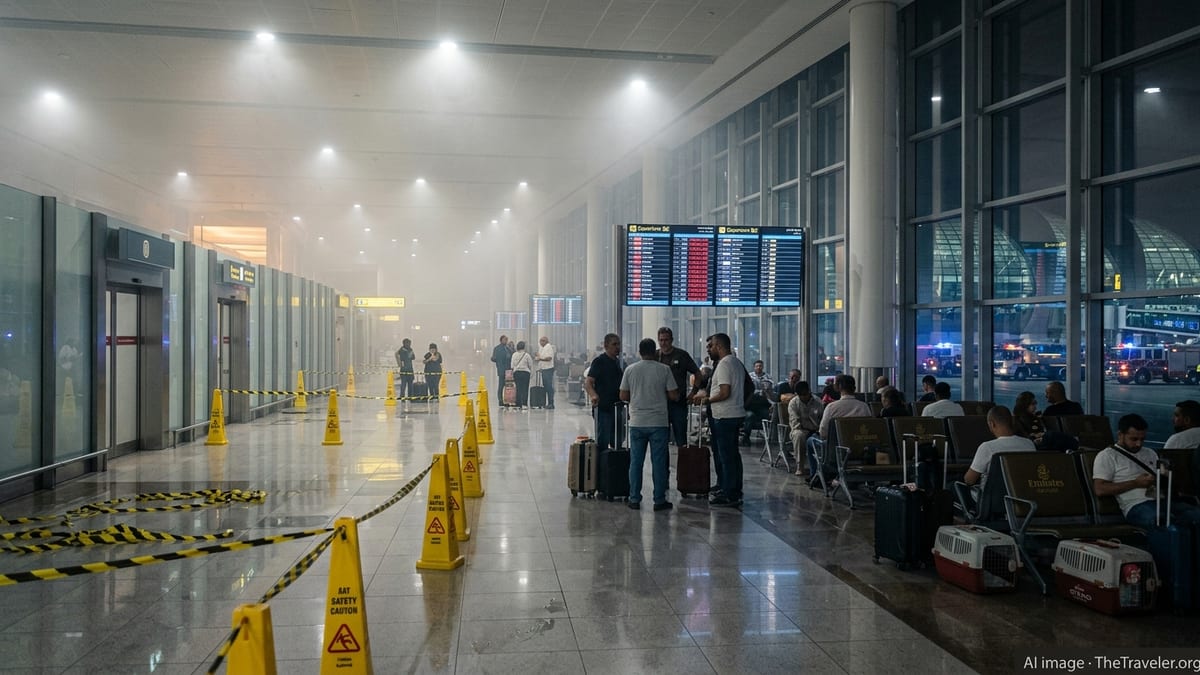
Airport Fire Deepens Ongoing Gulf Air Travel Turmoil
Publicly available information on the evolving security crisis in the United Arab Emirates indicates that Dubai International Airport has faced serious disruption following recent attacks that damaged infrastructure and triggered a large fire at the hub. The incident, described in regional coverage as part of a wider wave of Iranian strikes on targets in the UAE, has compounded an already fragile aviation situation in the Gulf, where closures and restrictions have repeatedly grounded commercial and repatriation services.
In this volatile context, a Greek-organised repatriation operation designed to bring home nationals and their companion animals from the United Arab Emirates and neighboring states was due to depart from Dubai. The flight was intended to complement recent state-coordinated departures that have already carried hundreds of Greek citizens from Gulf airports to Athens, forming part of a broader emergency airlift from conflict-affected parts of the Middle East.
Instead, the outbreak of fire at Dubai International forced a sudden halt in operations and brought the specially arranged repatriation flight to an unexpected standstill. Passengers and their animals who had secured places on the service now face renewed uncertainty, as airport authorities and airlines reassess safety conditions and capacity at one of the world’s busiest international hubs.
The cancellation reflects how quickly localised damage at a major airport can reverberate through complex evacuation planning. Even as limited movements have resumed in phases across the region, individual events such as terminal fires or airfield closures continue to derail carefully constructed schedules for governments and airlines attempting to extract citizens from high-risk zones.
Greek Evacuation Efforts Thrown Off Schedule
Over the past days, reports from Greek and international outlets have highlighted a sustained effort by Athens to repatriate citizens stranded across the Gulf, often via special and military flights operating outside regular commercial timetables. One such operation recently brought several hundred people to Athens from Dubai on a dedicated service arranged in cooperation with local carriers and diplomatic missions.
The now-cancelled flight from Dubai had been organised as a follow-up leg, focusing particularly on Greek nationals who had remained in the United Arab Emirates with their pets due to the complexity of relocating animals under crisis conditions. According to published coverage of related flights, Greek authorities have been working to align foreign ministry logistics, aviation partners and animal transport rules in order to avoid forcing owners to abandon their pets abroad.
With the fire at Dubai International interrupting that plan, affected passengers have effectively been pushed back into limbo. Travel watchers in Greece note that securing alternative routes is challenging, as nearby airports are operating with reduced capacity or handling priority flights tied to other national evacuation programs. This constricted network leaves few immediate options for rerouting a planeload of people and animals to Athens on short notice.
The disruption also underscores the delicate timing of such missions. Repatriation flights are typically slotted into narrow operational windows negotiated between multiple states and aviation and security agencies. A single event such as an airport fire can close that window within minutes, forcing planners to restart the approval process and compete again for scarce aircraft, crews and viable air corridors.
Stranded Travelers and Stress for Companion Animals
For the Greeks who had gathered in Dubai with dogs and cats in approved carriers, the sudden cancellation is more than an administrative setback. Many had already navigated stringent vaccination, microchipping and documentation requirements in both the United Arab Emirates and Greece, along with airline-specific pet transport policies that often confine animals to the aircraft hold rather than the cabin.
Animal welfare specialists frequently highlight that companion animals are especially vulnerable during prolonged travel disruptions. Extended waits in crowded terminals, repeated check-in and offloading cycles, and uncertainty over feeding and relief breaks can heighten stress for pets, even before they are placed on board. In the current situation, those concerns are magnified by the security context that has produced intermittent missile alerts, airspace closures and visible damage at transport hubs.
Reports from recent successful Greek repatriation flights that included pets describe highly emotional scenes upon arrival in Athens, with owners relieved not only to be home but to have kept their animals safe. The delay triggered by the Dubai airport blaze postpones that moment for the latest group of evacuees and may require renewed veterinary checks and paperwork if original clearances expire before a replacement flight can be confirmed.
Travel industry observers note that while airlines and airports in the region have previously managed significant disruption caused by storms or technical failures, the current combination of security threats, infrastructure damage and large-scale evacuation demand presents a more complex challenge. Ensuring humane conditions for companion animals in this environment adds another layer to already stretched operational planning.
Limited Alternatives as Regional Airspace Remains Constrained
Across the Gulf, only a portion of the usual network has returned to service following recent missile strikes and defensive actions that led multiple states to limit or temporarily close their airspace. Industry analyses point to waves of cancellations and diversions affecting flights to and from the UAE, Qatar, Bahrain and other key hubs, as carriers adjust routings to avoid high-risk zones and comply with evolving government directives.
Some airlines have reportedly shifted to operating targeted repatriation and cargo flights while keeping most regular passenger services on hold. These limited rotations are often focused on national citizens, essential workers and strategic destinations, leaving little spare capacity for additional chartered operations such as pet-inclusive evacuation flights. In this constrained environment, reallocating an aircraft and crew for an extra Athens-bound sector is far from straightforward.
Travel updates from regional media indicate that passengers are being advised not to proceed to certain airports unless they hold confirmed tickets on flights that are explicitly cleared to operate. Those with cancelled bookings, including the Greeks affected by the Dubai airport fire, are typically instructed to await direct contact from airlines or consular services regarding rebooking options, rather than attempting ad hoc transfers via neighboring states.
For pet owners, alternatives such as overland movement to other Gulf airports or maritime routes are complicated by border veterinary regulations and carrier-specific rules on animal transport. Some regional commentators have noted increasing interest in specialist pet relocation services, but these providers also rely on the same limited pool of safe air corridors and operational airports, making rapid solutions unlikely while the current security situation persists.
Uncertain Timeline for Rescheduled Greek Pet Flight
As of the latest publicly accessible reports, no firm date has been announced for a rescheduled Greek repatriation flight from Dubai dedicated to passengers traveling with pets. Aviation experts suggest that planners will first need clarity on the full extent of damage from the airport fire, including any impact on terminals, baggage systems and aircraft stands required for loading animals in compliance with international welfare guidelines.
Once local authorities and airport operators stabilise operations, focus is expected to shift to restoring a minimal schedule of priority services, including further evacuation and repatriation flights. Previous experience from other large-scale disruptions indicates that such missions tend to be phased, with initial departures carrying those in the most vulnerable circumstances before later rotations accommodate travellers who can safely wait longer.
For Greece, the challenge lies in balancing the urgent needs of citizens and residents still scattered across the wider region with the specific commitments made to those who remained behind in order to keep their animals with them. Public commentary in Greek media has increasingly framed companion animals as family members rather than cargo, placing additional moral weight on efforts to secure their passage home.
Until a new departure is finalized, Greek nationals and their pets who were due to fly out of Dubai remain in an uneasy holding pattern, caught between the promise of an organised return to Athens and the hard reality of a regional aviation system strained by conflict and now further disrupted by a destructive airport fire.