

More news on this day
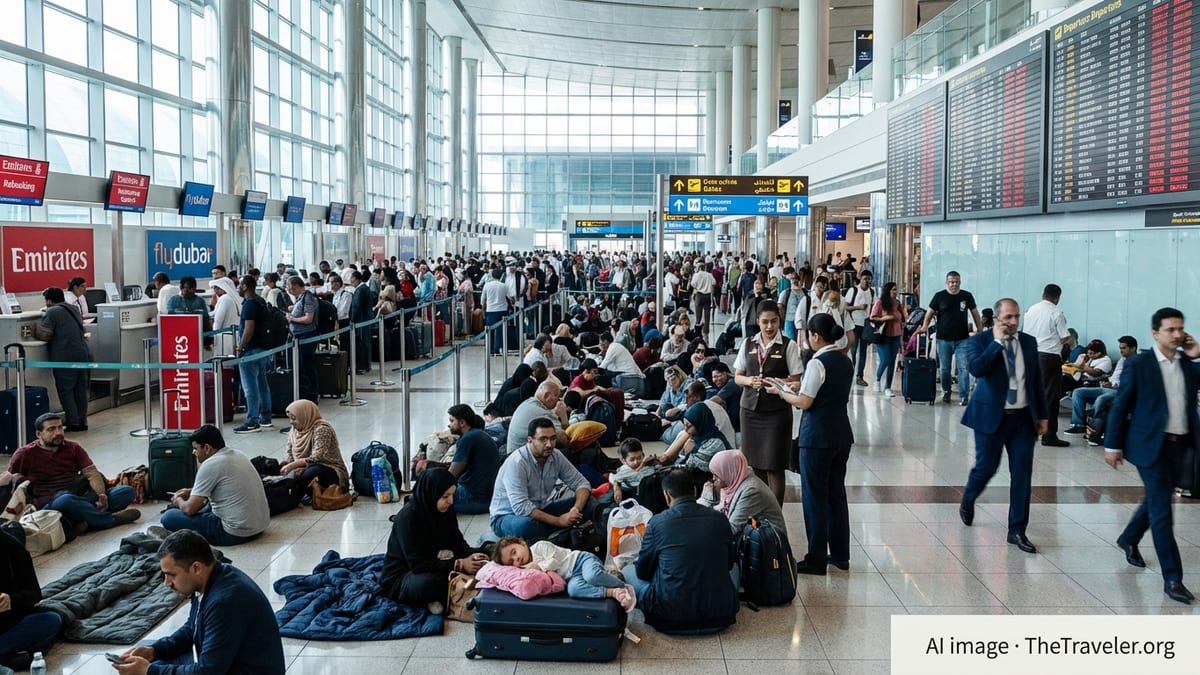
Thousands of stranded passengers were left sleeping on floors and queuing for hours at Dubai International Airport on March 1 as the United Arab Emirates locked down its airspace following joint US-Israeli strikes on Iran, triggering more than a thousand flight cancellations across key Middle East hubs.
UAE Closes Skies as Regional Conflict Escalates
The UAE’s General Civil Aviation Authority ordered a temporary closure of national airspace over safety concerns after the overnight strikes on Iranian targets and subsequent retaliatory fire across the Gulf region. The move effectively grounded operations at Dubai International Airport, the world’s busiest airport for international traffic, and at Dubai World Central, with state operator Dubai Airports confirming a suspension of all flights until further notice.
Flight tracking platforms showed near-empty skies over Iran, Iraq, Israel, Jordan and parts of the Gulf as aviation authorities from Qatar, Kuwait, Bahrain and others imposed their own restrictions. The cascading shutdown turned one of the world’s most vital aviation corridors into a no-fly zone, forcing long-haul carriers between Europe, Asia and Africa to scramble for alternative routings or cancel flights outright.
Aviation analysts said the immediate impact would be felt most acutely at the big Gulf hubs, but warned that the knock-on effects would extend far beyond the region. With multiple conflict zones overlapping major air corridors, airlines now face longer flying times, higher fuel burn and severe scheduling dislocation.
Emirates, Saudia, FlyDubai and Regional Carriers Freeze Operations
Dubai-based Emirates, which normally operates hundreds of daily departures through its Dubai International hub, announced a full halt to flights to and from the city amid the airspace closure, apologising to passengers and pledging to rebook or refund affected tickets. Its low-cost sister carrier FlyDubai also suspended operations, stranding transit passengers who had been connecting between secondary cities in Asia, Eastern Europe and Africa.
Saudi Arabia’s flag carrier Saudia reported extensive disruption across its network as regional airspace closures forced cancellations on routes touching the Gulf, Iran and the Levant. Kuwait-based Jazeera Airways, Royal Jordanian, Air Arabia and several other regional operators similarly froze or sharply curtailed services, contributing to a tally of roughly 1,117 cancellations and at least 117 significant delays across the wider Middle East within hours of the initial strikes.
Etihad Airways in Abu Dhabi temporarily halted all departures from Zayed International Airport for much of Sunday, advising passengers not to travel to the airport unless their flight was listed as operating. Qatar Airways, a key competitor based in Doha, suspended many flights as Qatari airspace was also restricted, with the carrier warning of continuing delays even after any phased reopening.
Scenes of Confusion and Fatigue at Dubai International
Inside Dubai International’s vast terminals, the sudden shutdown quickly translated into scenes of overcrowded concourses and growing passenger frustration. Travellers arriving on flights that had taken off before the airspace closure found themselves unable to continue onward, funneled instead into rapidly lengthening lines at transfer and immigration desks as airport staff tried to triage cases.
Many passengers reported stretching out on terminal carpets or finding a patch of floor near charging points as hotels filled and airline-arranged accommodation struggled to keep pace with demand. Families with young children and elderly travellers were among the most visible in the queues for food vouchers, rebooking desks and information counters, as departure boards lit up with red cancellation notices.
Airport authorities stressed that safety remained the overriding priority and urged passengers to stay in contact with their airlines via apps and call centres rather than heading directly to the airport. However, the fluid security situation and the absence of a clear timeline for reopening meant many travellers were left unsure whether to exit the airport into the city or remain airside in the hope of a rapid resumption of flights.
Global Ripple Effects and Rerouting via Saudi Skies
The temporary loss of UAE and other Gulf airspace disrupted not only point-to-point traffic but also the intricate web of global connections built around hubs in Dubai, Abu Dhabi and Doha. Carriers from Europe, North America and Asia that typically overfly the Middle East on their way to destinations in India, Southeast Asia and East Africa were forced to divert, adding hundreds of nautical miles to some routes.
With Iran, Iraq and parts of the Levant also closing their skies, Saudi Arabia emerged as the primary alternative corridor for east-west traffic, placing its air traffic management system under intense pressure. Industry experts warned that increased congestion and longer routings could push up operating costs and, over time, ticket prices on affected routes, even after a partial normalization of airspace access.
Major international carriers including Turkish Airlines, Air India, British Airways, Lufthansa and several US airlines announced temporary suspensions or rerouting of services to Gulf and Levant destinations. Many offered one-time waivers allowing passengers to change travel dates or destinations without additional fees, but availability on alternative flights remained extremely limited as aircraft and crews were left out of position across multiple continents.
Uncertain Timeline and Advice for Travellers
Officials and industry analysts cautioned that, while the most stringent airspace closures might be eased within days if military activity subsides, the broader recovery of schedules will take considerably longer. Crews displaced by diversions, aircraft stranded away from their home bases and passengers requiring reaccommodation all add layers of complexity that airlines will need time to unwind.
Travel agencies and consular officials across the region urged passengers to monitor official airline communications closely, keep itineraries flexible and expect extended layovers. Those with nonessential trips have been advised to consider postponing travel through Gulf hubs until there is greater clarity on the stability of air corridors and airport operations.
For now, thousands of travellers caught in the immediate aftermath of the US-Israel strikes on Iran remain in limbo in Dubai and other regional airports, their journeys interrupted by a sudden and dramatic reminder of how quickly geopolitical tensions can upend the global aviation system.