

More news on this day
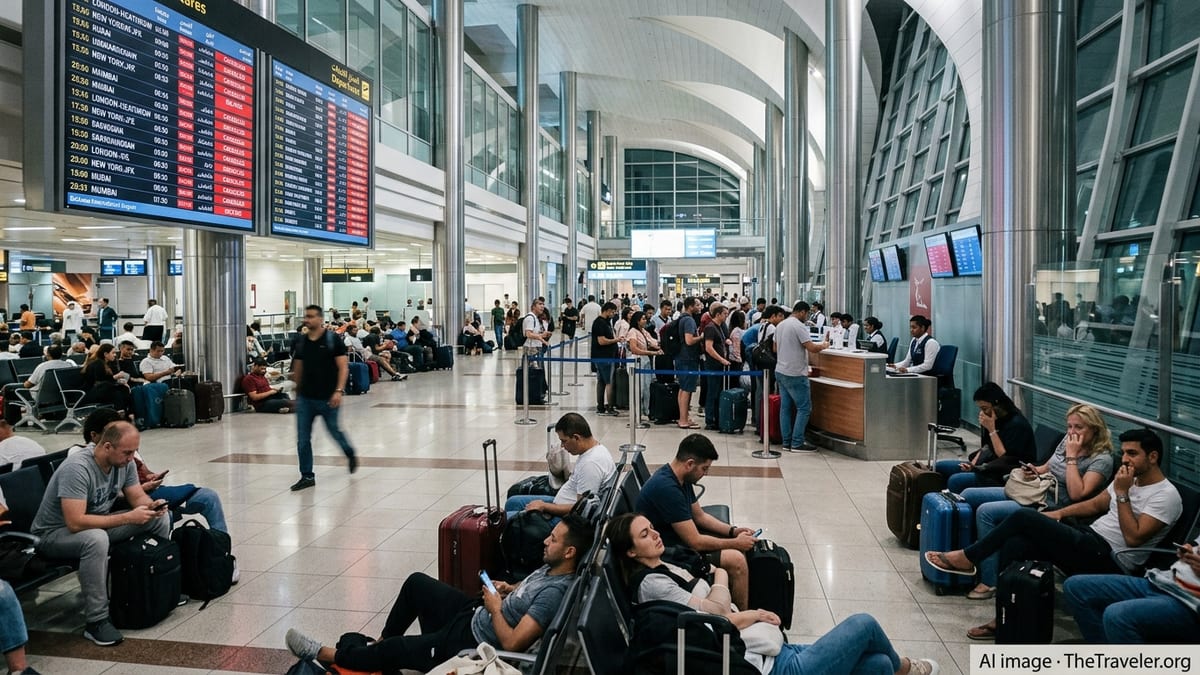
More than 30 flight cancellations at Dubai International Airport in recent days have left scores of passengers stranded, as the wider regional conflict and repeated security incidents continue to squeeze one of the world’s busiest aviation hubs.
Get the latest news straight to your inbox!
Conflict and Security Concerns Behind the Latest Wave of Cancellations
Publicly available information indicates that the latest round of disruptions at Dubai International Airport is closely tied to the ongoing conflict involving Iran and the wider Gulf region. Since late February 2026, airstrikes, drone activity, and missile interceptions have repeatedly affected airspace over the United Arab Emirates, prompting large-scale flight suspensions and a cautious, stop-start resumption of services.
Accounts from travel advisories and operational updates describe periods when airspace over much of the Gulf was partially or fully restricted, effectively grounding scheduled commercial flights or forcing airlines to reroute at short notice. In Dubai, reports point to at least one incident involving debris or a strike near airport fuel facilities in mid March that led to a temporary suspension of operations, intensifying an already fragile operating environment.
These security-driven constraints have directly translated into cancellations at Dubai International Airport, with individual days seeing more than 30 flights scrubbed from departure and arrival boards. While some services have been converted into repatriation or special relief flights, regular commercial schedules remain heavily reduced compared with typical March traffic.
The result is a patchwork of operating patterns: some long haul services are running on limited frequencies, others remain suspended, and regional connections in particular are vulnerable to same day cancellations when airspace conditions change.
How Operations at Dubai International Airport Have Changed
Before the current crisis, Dubai International routinely handled hundreds of departures and arrivals each day, serving as a major intercontinental transfer point between Europe, Asia, Africa, and the Americas. Since late February, this volume has been sharply curtailed. Reports from early March describe the airport moving from a near-total shutdown toward a gradual reopening, with only a “small number” of flights allowed to operate initially.
By the second week of March, publicly available FAQs and travel advisories were still describing Dubai International Airport as operating with “limited services,” warning that flights could be changed or cancelled at short notice. Major carriers based in the UAE have been restoring routes in phases, prioritizing certain trunk destinations and essential connections while postponing the full return of their preconflict schedules.
On days when new security incidents have been reported near the airport or in UAE airspace, the fragile recovery has been interrupted. These periods have seen sharp spikes in cancellations, at times exceeding 30 flights, and widespread knock-on delays. On other days, a more modest but steady stream of cancellations continues as airlines adjust to routing constraints, crew duty limits, and aircraft positioning challenges.
Travel industry monitoring shows that the situation remains fluid. Even when airport terminals are open and some flights are operating normally, individual services may be cancelled only hours before departure when risk assessments or airspace restrictions change.
Passenger Impact: Stranded Travelers, Long Queues, and Limited Alternatives
For travelers caught in the middle of these disruptions, the experience has often been one of uncertainty and long waits. Accounts shared on public forums and community platforms describe passengers stranded in Dubai on disrupted itineraries, with connecting flights cancelled and rebooking options limited by constrained capacity across the region.
Several travelers report spending many hours in terminal queues attempting to reach airline desks or call centers, particularly during early March when operations were just starting to resume from an almost complete halt. In some cases, passengers say they received cancellation emails while airport or airline apps still showed flights as “scheduled,” leading to confusion about whether to remain at their hotel or proceed to the airport.
Others recount last minute price spikes when trying to secure alternative routes home with different carriers, reflecting high demand for a small pool of operating flights. Reports from recent days continue to reference passengers stuck in Dubai after onward legs via Doha, Abu Dhabi, or other Gulf hubs were cancelled, underscoring how interconnected the region’s aviation networks are.
While some airlines have organized repatriation services and limited special flights to clear backlogs, the combination of airspace closures, security reviews, and crew constraints means that not every stranded traveler can be accommodated quickly. As a result, multi day delays, unexpected hotel stays, and unplanned expenses remain common themes in passenger accounts.
What Affected Travelers Should Do Right Now
Given the continued volatility in flight operations, travel experts and advisory notices are urging passengers to avoid heading to Dubai International Airport without a confirmed, operating booking. Publicly available FAQs emphasize that schedules can change several times within a single day, and that many services that appear in booking systems may still be subject to late cancellation as conditions evolve.
Instead, passengers are advised to rely on direct communication from their airline by email, SMS, or app notifications, and to frequently refresh official flight status tools before leaving for the airport. Where flights are cancelled, standard airline policies on rebooking or refunds generally apply, although processing times can be longer than usual because of the volume of affected travelers.
Travel advisories issued in recent weeks also encourage passengers transiting through Dubai to ensure that both sectors of their journey are confirmed and operating, not just the first leg into the UAE. Some carriers are only accepting transit passengers whose onward connection is also running, in an effort to prevent additional people from becoming stranded in Dubai with no available onward seats.
For those yet to start their trip, flexibility is critical. Travelers with nonessential journeys through Dubai are being encouraged by many advisory services to consider postponing, rerouting through unaffected regions, or selecting fully refundable fares that allow changes at short notice without substantial penalties.
Outlook for Dubai Travel in the Coming Weeks
Looking ahead, the pace at which Dubai International Airport returns to more stable operations will depend heavily on how the wider regional security situation develops. Economic analyses of the conflict point to large daily totals of flight cancellations across multiple Gulf states, and there is no firm public timeline for a complete reopening of all airspace corridors.
Airlines based in the region are continuing to publish rolling updates on which routes are operating, often day by day. As more data becomes available and air defense patterns stabilize, schedules may gradually become more predictable. However, recent incidents near the airport show that setbacks remain possible, and that even a largely functioning schedule can experience abrupt cuts of dozens of flights in a single day.
For travelers, that means continued vigilance. Those with travel booked through Dubai in late March and into April may find that flights appear normal when purchased, only to be altered closer to departure. Regularly checking booking details and maintaining backup options, where budgets allow, will remain a prudent strategy while the situation evolves.
Despite the current disruptions, Dubai’s role as a key global hub suggests that airlines and airport operators are working toward restoring connectivity as soon as conditions permit. In the meantime, the pattern of intermittent cancellations, including days with more than 30 flights lost from the schedule, is likely to remain part of the travel landscape for anyone passing through the city.