

More news on this day
Dubai International Airport, the world’s busiest hub for international passengers, has been forced into an extraordinary lockdown as sweeping airspace closures across the Gulf abruptly halted flights, stranding tens of thousands of travelers and rippling disruption across global aviation networks.
A Sudden Shutdown at the World’s Busiest International Hub
The crisis began unfolding on February 28 when joint US and Israeli strikes on Iran triggered a wave of retaliatory threats and missile activity across the region. Within hours, aviation authorities from Iran to the United Arab Emirates started closing sections of airspace, citing the risk to civilian aircraft. What began as a security measure quickly cascaded into a near-total freeze over some of the world’s most strategically important flight corridors.
Dubai International found itself at the epicenter. State airport operator Dubai Airports confirmed that all flight operations at both Dubai International and Dubai World Central were suspended until further notice as the UAE implemented a temporary, partial airspace closure as a precautionary measure. For a hub that typically handles close to 90,000 connecting passengers a day, the halt was without precedent in scale and speed.
By March 2, more than 2,000 flights to and from key Gulf airports had been cancelled, with Dubai accounting for a substantial share. Long-haul links between Europe and Asia that rely on Dubai as a connecting bridge suddenly went dark, forcing airlines to cancel services outright or embark on lengthy, fuel-intensive diversions that only a fraction of flights could realistically operate.
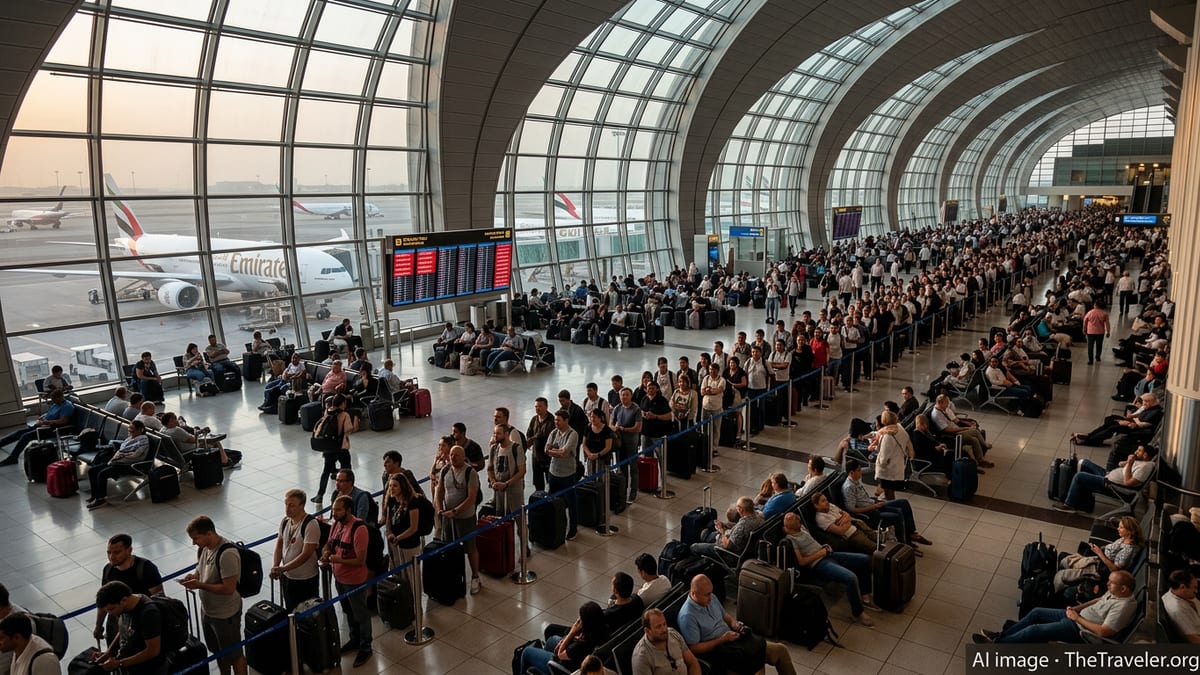
Inside the terminals, departure boards flipped from green to red in a matter of hours. Emirates and flydubai ground staff were left to manage growing lines of confused and frustrated passengers as security teams and airport police tightened access to airside areas, moving the facility into what one aviation source described as “lockdown mode.”
Emirates Grounds Its Network as Gulf Airspace Narrows
Home carrier Emirates, the world’s largest long-haul airline, responded by suspending all operations to and from Dubai, initially through March 2 and then extending the suspension to at least 3 pm UAE time on March 3. The carrier advised passengers they could rebook for travel later in March or request refunds, but it acknowledged that call centers and airport service desks were under severe strain.
Other UAE-based airlines moved in lockstep. Flydubai halted its schedule from Dubai, while Etihad Airways suspended all flights to and from Abu Dhabi for extended periods as authorities closed or restricted national airspace. Low-cost operator Air Arabia cancelled services across its UAE bases. Together, the decisions effectively shut down the Gulf’s core aviation system, cutting off transit flows that connect cities from Sydney and Mumbai to London, New York and Johannesburg.
Beyond the UAE, Qatar Airways, Saudia and a long list of regional and international carriers suspended or rerouted flights, with many European and Asian airlines choosing to avoid Iranian, Iraqi and Gulf airspace entirely. Some, including major European flag carriers, extended their Dubai cancellations several days into March while they reassessed risk bulletins from regulators and insurers.
Industry analysts warn that even a short-lived halt can take days to unwind. Aircraft and crews are out of position, maintenance windows are disrupted and connecting itineraries collapse in on themselves. For airlines already grappling with restricted Russian airspace over the Ukraine conflict, the sudden loss or constriction of Gulf corridors leaves them with few efficient alternatives between Europe and Asia.
Scenes of Confusion and Fatigue Inside a Locked-Down DXB
For travelers on the ground, the crisis has been less about geopolitics and more about immediate survival. At Dubai International’s sprawling Terminal 3, passengers woke to messages informing them their onward flights were cancelled or indefinitely delayed. Those already in transit, many arriving from overnight long-haul sectors, stepped off aircraft into a terminal where almost no onward connections were leaving.
Lines quickly snaked around transfer desks as families, business travelers and backpackers queued to be rebooked or seek hotel vouchers. With operations frozen, hotels near the airport and along Dubai’s main corridors reported an abrupt surge in stranded guests, as Emirates and other carriers scrambled to secure rooms as part of their disruption policies. Some travelers, unable to clear immigration due to visa or documentation constraints, were left to camp out in waiting areas, leaning against carry-on bags and sleeping on the floor.
Airport concessions also felt the pressure. Cafes and convenience outlets remained open but were inundated as passengers stocked up on food and bottled water, bracing for long waits. Staff described a tense but largely orderly atmosphere, with occasional flare-ups as travelers demanded clearer timelines for when flights might resume.
Information remained fluid and often contradictory. Official updates urged passengers not to travel to the airport unless their flight was confirmed as operating, but many still arrived in hope of a last-minute departure or reroute. Inside the terminals, public-address announcements cycled through apologies and instructions, reinforcing that cancellations were driven by airspace closures and security advisories outside the airport’s direct control.
Global Aviation Feels the Shockwaves
The closure of Dubai’s airspace has had an outsized impact because of the city’s role as a linchpin in long-haul travel. Airlines that once funneled Europe to Asia and Africa traffic through the Gulf now face limited options for safe and economically viable routing. With overflight of Iran, Iraq and parts of the Gulf constrained, many carriers are being forced either to cancel flights or to send aircraft on long detours that add hours to flight times and significantly raise fuel costs.
Major European and North American airlines have issued waivers allowing passengers to change Middle East itineraries without fees, while some Asian carriers have suspended services into Dubai and other Gulf hubs entirely for several days. Aviation analytics firms report that cancellations and diversions number in the thousands regionwide, with knock-on disruptions reaching as far as North America, Europe, Southeast Asia and Australasia as aircraft and crews remain displaced.
The timing compounds existing industry vulnerabilities. Airlines are still managing high fuel prices, aircraft delivery delays and lingering staffing shortages. War-risk insurance premiums for flights that even skirt conflict-adjacent airspace are rising rapidly, squeezing margins at the same time that rerouting increases operating costs. Analysts caution that if airspace restrictions persist, carriers may cut capacity on some long-haul routes or temporarily withdraw from markets that depend heavily on Gulf connections.
Airport operators, duty-free retailers and tourism boards across the Middle East are also bracing for a sharp short-term hit, particularly in destinations like Dubai where international connectivity is central to the economy. With tourism freezes reported across multiple Gulf states, hotel and hospitality sectors that rely on high volumes of transit and short-stay visitors are facing an abrupt and costly slowdown.
Uncertain Timelines and What Travelers Should Expect Next
As of March 3, authorities and airlines are signaling that any reopening of Dubai’s airspace and terminals will be gradual and tightly controlled. Official statements suggest that limited operations could resume once security agencies deem the skies safe for civilian overflight and regulators lift their strongest warnings, but there is no firm timeline for a full return to normal traffic levels.
Even after aircraft begin to move again, passengers should expect rolling delays, last-minute cancellations and irregular connections as airlines work through days’ worth of disrupted schedules. Priority will likely be given to repositioning aircraft and handling stranded passengers with existing tickets before carriers restore broader sale of new seats through Dubai.
Travel advisers are urging anyone with imminent itineraries involving Dubai or other Gulf hubs to stay in close contact with their airline or travel agent, monitor flight status tools frequently, and avoid going to the airport without a confirmed departure. Flexible plans, including willingness to reroute through alternative hubs in Europe or Asia, may be essential for those who must travel in the coming days.
For now, Dubai International, a symbol of the hyper-connected age of global travel, remains an illustration of how quickly that connectivity can be severed when conflict encroaches on the world’s most vital air corridors. The terminals are full, the runways are quiet and the countdown to a safe reopening is dictated not by airline schedules, but by events far beyond the airport perimeter.