

More news on this day
Thousands of passengers were left sleeping on terminal floors at Dubai International Airport on Sunday after the United Arab Emirates locked down its airspace in the wake of joint United States and Israeli strikes on Iran, triggering at least 1,117 flight cancellations and 117 delays across airlines including Emirates, Saudia, FlyDubai, Jazeera Airways and Royal Jordanian.
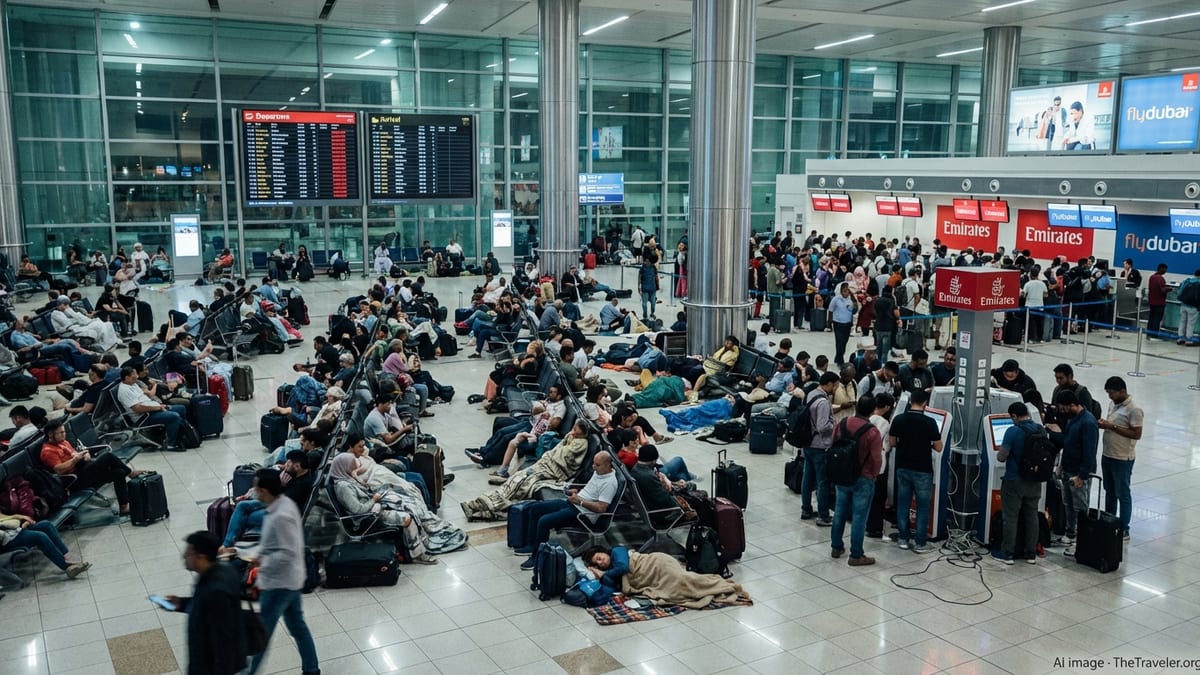
Airspace Lockdown Turns Dubai Into Ground Zero of Travel Chaos
The sudden closures began in the early hours of February 28, 2026, when the UAE, along with Iran, Israel, Iraq, Jordan, Qatar, Bahrain and Kuwait, moved to shut significant portions of their airspace following a wave of US–Israeli strikes on Iranian military and leadership targets. Within hours, Dubai International, the world’s busiest airport for international passengers, suspended all arrivals and departures, with its secondary hub, Al Maktoum International, also brought to a standstill.
By Sunday morning, Dubai’s main terminals had turned into a vast, improvised holding zone for stranded travelers. Families with young children camped out near baggage belts, business travelers recharged phones on every available socket and long queues formed at overwhelmed airline service desks as ground staff struggled to rebook passengers with no clear timeline for when airspace would reopen.
UAE aviation authorities confirmed that the country’s airspace was only accepting a limited number of state, emergency and cargo flights, effectively freezing its role as a global transfer bridge between Europe, Asia and Africa. Flight-tracking data showed near-empty skies across much of the Gulf, with aircraft forced into wide detours over Saudi Arabia and the eastern Mediterranean, adding hours of extra flying time and fuel burn.
Officials described the measures as precautionary but necessary amid concerns that further missile or drone exchanges could threaten civilian aircraft. As military tensions continued through the weekend, industry analysts warned that even a short-lived shutdown at hubs like Dubai could ripple through global networks for days.
Emirates, Saudia, FlyDubai and Regional Carriers Forced to Freeze Schedules
Home carrier Emirates, which on a normal day operates hundreds of flights through Dubai, moved quickly to halt all passenger operations to and from its hub once the UAE airspace restrictions took hold. Its low cost sister airline FlyDubai followed suit, cancelling or postponing nearly its entire schedule as routes across Iran, Iraq and the Gulf became unusable or unsafe.
Beyond the UAE, Saudi Arabia’s flag carrier Saudia, Kuwait-based Jazeera Airways, Royal Jordanian and a host of other regional airlines implemented large scale cancellations, particularly on routes linking the Gulf to Levant and Iranian destinations. Industry data compiled on Sunday indicated at least 1,117 flights across the wider Middle East had been scrapped since the strikes began, with a further 117 classified as heavily delayed as crews and aircraft were left out of position.
In Abu Dhabi, Etihad Airways suspended all departures from Zayed International Airport until at least early Sunday afternoon, disrupting connections for long haul passengers heading to Europe, North America and Australasia. Doha based Qatar Airways, normally one of the region’s most reliable transfer airlines, was also forced to ground or divert services as Qatari airspace tightened in response to the escalating conflict.
International carriers from Europe, India, East Asia and North America added to the cancellations tally. Airlines including Air India, Turkish Airlines, Lufthansa, British Airways and major US carriers either suspended flights into Gulf hubs or rerouted services to avoid closed skies, contributing to a global wave of diversions and missed connections.
Passengers Sleep in Terminals as Airlines Race to Manage Disruption
Inside Dubai International’s Terminals 1 and 3, the human impact of the crisis unfolded in real time. Passengers described scenes of confusion as arrival screens flipped almost entirely to red, showing flights as cancelled or indefinitely delayed. With hotels near the airport quickly filling up and road traffic snarled by anxious families arriving to meet relatives, many travelers opted to stay inside the terminal rather than risk missing potential rebooked flights.
Airport staff struggled with the sheer volume of stranded passengers needing food, water, accommodation and updated itineraries. Makeshift queuing systems snaked around check in islands, while airline agents issued meal vouchers, handed out blankets and attempted to prioritize elderly travelers, families with infants and those on critical journeys such as medical or humanitarian trips.
Some long haul passengers reported being caught in what they called flights to nowhere, with aircraft that had already departed for Dubai forced to circle or divert mid route before eventually landing in alternate cities such as Istanbul, Rome or Jeddah. Others arrived in Dubai just as the airspace closure took effect and then found themselves unable to continue on to final destinations in Africa, South Asia or Australia.
Social media carried images of crowded gate areas and baggage halls, with travelers describing the experience as an airport meltdown. Despite the visible strain, airport authorities insisted that security and essential services remained intact and urged passengers to stay in close contact with their airlines rather than travel to the terminals without confirmed bookings.
Global Flight Networks Strained by Reroutes and Safety Concerns
The Middle East has, over the past decade, become a critical aviation corridor linking Europe and Asia as Russian and Ukrainian airspace remained restricted for many Western airlines. The sudden loss or severe curtailment of key Middle Eastern routes after the US–Israeli strikes on Iran has therefore had an outsized impact on timetables far beyond the region.
With the airspaces of Iran, Iraq, Israel, Jordan, Qatar, Bahrain, Kuwait and the UAE either fully or partially closed, flight planners were forced to draw elongated paths looping over Saudi Arabia, Egypt, the Red Sea and the eastern Mediterranean. These diversions can add between one and four hours to long haul segments, significantly increasing fuel costs, crew duty time and the risk of aircraft and staff being out of position for subsequent rotations.
Aviation safety regulators in Europe and elsewhere reiterated conflict zone advisories covering parts of the Gulf and Iran, urging airlines to avoid flying near active military operations and missile trajectories. While no civilian jet was reported directly hit in the opening hours of the confrontation, debris and the risk of miscalculation in such a dense air corridor kept risk assessments elevated.
Analysts warned that extended closures would pressure airline profit margins and potentially push up fares on some of the world’s busiest long haul routes. Smaller regional carriers, which lack the financial buffers of global giants, could be particularly exposed if the crisis drags on, they said, even as they emphasized that passenger and crew safety remains the industry’s overriding priority.
Uncertain Timeline for Reopening Leaves Travellers in Limbo
By Sunday afternoon local time, there was still no clear, unified timetable for a full reopening of Middle East airspace. UAE officials signalled that restrictions would be reviewed in line with evolving security assessments, while airlines spoke cautiously of gradual resumptions once military activity and missile alerts decrease.
For passengers caught in the current disruption, the uncertainty has proved as stressful as the initial cancellations. Many have been rebooked on itineraries that involve long detours, overnight layovers or last minute changes in routing as carriers attempt to thread remaining safe corridors and secure scarce landing slots at alternative hubs.
Travel agencies and airline call centres have been inundated with requests for refunds, travel waivers and insurance claims, particularly from customers reluctant to fly through the region until the situation stabilizes. Some governments have issued updated travel advisories urging citizens to avoid non essential journeys via the Gulf and surrounding states, further depressing near term demand.
Industry observers say that once the immediate security crisis passes, carriers and regulators will face renewed questions about risk management, contingency planning and the concentration of global traffic through a handful of politically exposed hubs. For now, however, the priority remains more immediate and personal: getting thousands of stranded passengers out of Dubai and other regional airports, and safely on their way to where they need to be.