

More news on this day
Dubai International Airport has restarted flight operations in stages after a drone strike near its fuel facilities triggered a major fire, forcing a temporary shutdown that rippled across global air routes and left thousands of passengers facing delays, diversions, and cancellations.
Get the latest news straight to your inbox!
Fuel Tank Fire Triggers Emergency Shutdown
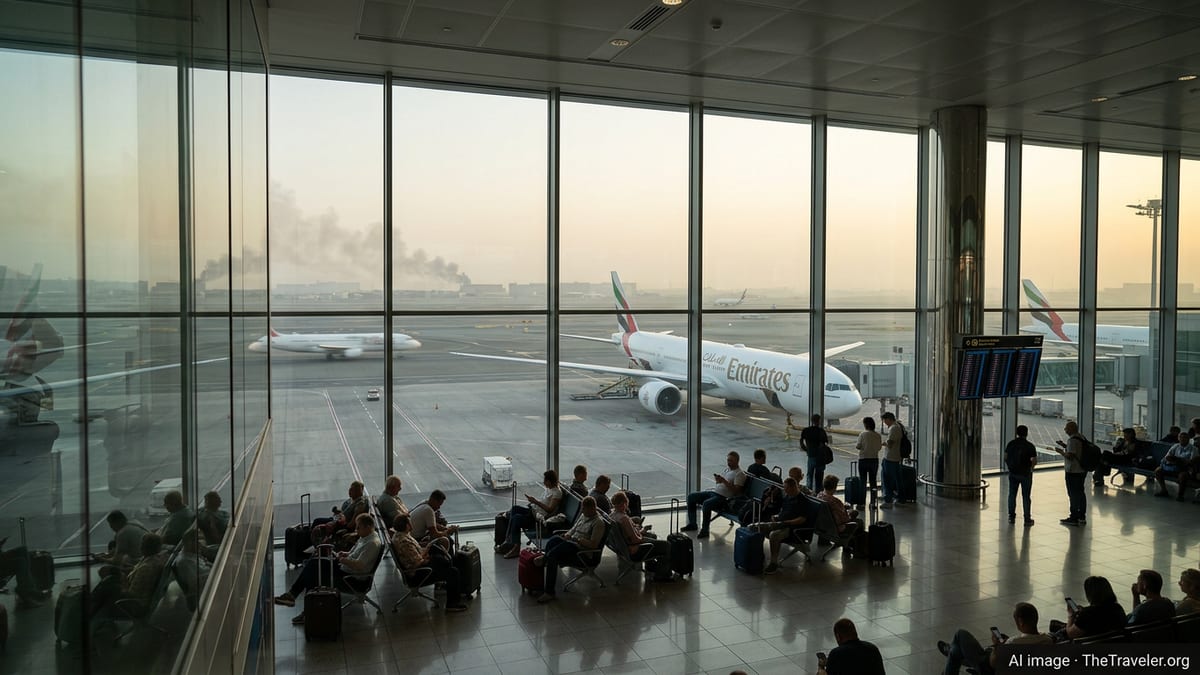
The incident occurred on Monday, 16 March 2026, when a drone attack linked to the wider regional conflict struck an area close to Dubai International Airport’s fuel infrastructure. Publicly available information indicates that the impact set at least one fuel tank ablaze, sending thick smoke over the vicinity of the airport and prompting an immediate aviation safety response.
Operational data and local coverage describe airport movements being rapidly curtailed as firefighters and emergency teams worked to contain the blaze. Flights already in the air and bound for Dubai were diverted to alternative airports in the region, including Abu Dhabi and Al Maktoum International, while inbound departures from major hubs in Europe and Asia were held or cancelled.
The fire near the tank farm was reported to be intense enough to raise concerns about damage to fueling systems and nearby service roads. Drone activity in and around critical energy and aviation infrastructure across the Gulf had already been elevated in recent weeks, and the strike at Dubai reinforced fears that airports and fuel depots have become key targets in the ongoing confrontation.
By later in the day, regional emergency bulletins indicated that the fire had been contained and that there were no widespread casualties within the terminal complex itself, though four airport staff were reported injured in earlier attacks during the same campaign. Assessments of structural and systems damage around the fuel area are continuing.
Flight Operations Resume in Phases
After several hours of suspended movements and heavy disruption, Dubai International Airport began to reopen its runways to limited traffic. Airport statements and flight-tracking data show that arrivals were prioritized as operations restarted, with a small number of Emirates and Flydubai services landing first while most departures remained on hold.
According to published coverage, the resumption followed confirmation from the UAE’s civil aviation authorities that air traffic operations across national airspace could return to normal parameters, subject to heightened security and air defense monitoring. At Dubai International, the process translated into a phased reopening, with capacity well below usual levels and extended turnaround times as ground crews worked around restricted zones near the fuel facilities.
Airlines based outside the region have largely taken a more cautious stance. Reports indicate that several major European and Asian carriers, including British and continental operators, have temporarily suspended services to Dubai, leaving the hub heavily reliant on home carriers such as Emirates and Etihad to restore connectivity. Some long-haul services have been re-routed through alternative hubs in the Gulf, Turkey, or Europe to bypass lingering bottlenecks.
Travel advisories issued in multiple markets warn passengers that even with the airport technically open, schedules remain unstable and last-minute changes are likely. Many international services remain cancelled or rerouted while airlines await further risk assessments and operational guidance.
Global Air Traffic Feels the Shockwaves
Dubai International is one of the world’s busiest airports for international passengers and a key junction on Europe–Asia and Africa–Asia corridors. The shutdown following the drone strike sent immediate shockwaves through global aviation, compounding disruptions that have built up since late February amid repeated missile and drone incidents across the Gulf.
Data drawn from industry trackers and security bulletins point to thousands of daily cancellations and diversions across the broader region in recent weeks, as airspace over parts of Iran, Iraq, and neighboring states has been intermittently restricted. Dubai’s closure, even for part of a day, added fresh congestion, as aircraft already in the air were forced into lengthy diversions and crew duty-time limits led to unexpected overnight stays for passengers.
According to economic analyses of the ongoing conflict, airlines have been burning additional fuel and incurring higher operating costs to navigate around no-fly zones and high-risk airspace, with schedules on trunk routes between Europe and Asia especially affected. The temporary loss or reduction of capacity at Dubai and Abu Dhabi has also put pressure on alternative hubs from Doha to Riyadh, where airports are absorbing diverted traffic alongside their own scheduled operations.
Travelers transiting through Dubai are reporting extended queues, crowded terminal areas and difficulty securing onward connections, as airlines juggle rebooking, aircraft rotation, and crew logistics. While some carriers have introduced repatriation or special relief flights, these remain limited compared with normal traffic volumes through the hub.
Tourism and Business Travel to the UAE Under Strain
The repeated interruptions to Dubai International’s operations are beginning to weigh heavily on the United Arab Emirates’ tourism and business travel sectors. Visitor numbers depend heavily on the smooth functioning of the airport as a global connector, and each new closure or partial reopening adds to perceptions of uncertainty among both leisure travelers and corporate planners.
Travel industry reports suggest that some conference organizers and tour operators are already shifting events or group bookings to alternative destinations viewed as less exposed to direct spillover from the conflict. At the same time, Dubai’s extensive hotel inventory and established reputation as a stopover hub mean that many passengers stranded by diversions are still funneled into the city for overnight stays, generating short-term demand even as longer-term booking patterns soften.
The UAE has invested heavily over the past two decades in positioning Dubai as a stable, high-connectivity gateway between continents. The recent cycle of drone and missile incidents, culminating in a direct hit on fuel infrastructure near the airport, challenges that narrative and underscores the wider economic stakes of regional security. Analysts note that a prolonged period of intermittent airspace restrictions could reshape routing strategies and hub hierarchies for years to come.
For now, publicly available information indicates that authorities and airport operators are focused on restoring confidence through visible security measures, robust contingency planning, and clear communication with airlines. The pace at which carriers choose to restore full schedules to Dubai will serve as a key barometer of how the aviation industry assesses risk in the Gulf in the weeks ahead.
Heightened Security and Ongoing Regional Risks
The attack on fuel infrastructure near Dubai International forms part of a broader pattern of strikes on airports, ports, and energy facilities across the Gulf since the escalation of hostilities on 28 February 2026. Earlier incidents have hit oil terminals at Fujairah and damaged infrastructure in Abu Dhabi, illustrating an evolving strategy that targets both military and economic assets.
Security assessments circulated to airlines and corporate travelers in early March classify aviation risk in the region as high, citing repeated drone and missile activity near major airports, the possibility of miscalculation, and the challenges posed by electronic warfare and GPS interference. These reports recommend that operators build in greater schedule flexibility, anticipate rolling airspace closures, and maintain detailed contingency plans for diversions and extended crew layovers.
Dubai’s rapid move to resume flight operations after the latest fuel-tank fire reflects a determination to keep critical transport corridors open, but it also highlights the fine balance between operational resilience and safety in an active conflict environment. Even as air traffic over the UAE returns to more normal patterns, further incidents cannot be ruled out while the wider confrontation remains unresolved.
Aviation experts note that the region’s role as a global crossroads ensures that any renewed disruption at Dubai International would be felt far beyond the Gulf, affecting passengers, freight operators, and supply chains across Europe, Asia, Africa, and Oceania. Travelers planning to transit through Dubai in the coming days are being urged, through airline and airport advisories, to monitor their flight status closely and be prepared for last-minute changes as the situation continues to evolve.