

More news on this day
Dubai International Airport has resumed limited flight operations after a drone strike ignited a fuel tank near the hub, triggering a major fire, hours of airspace restrictions and cascading disruptions across global air traffic networks.
Get the latest news straight to your inbox!
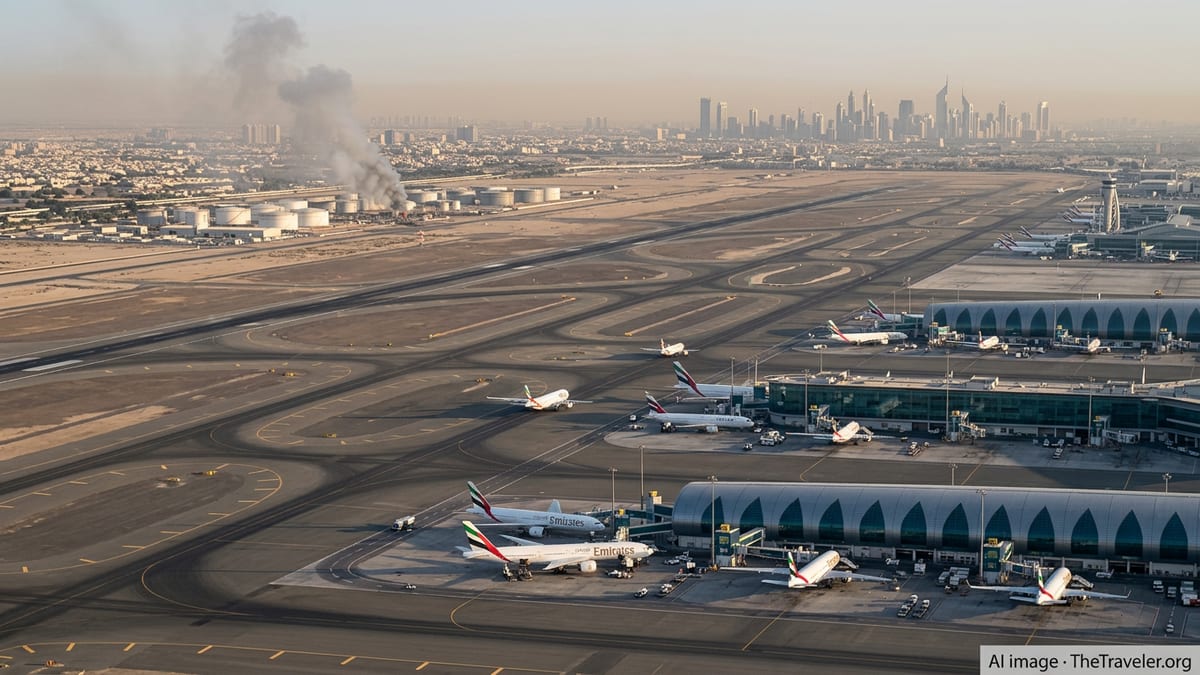
Fire Contained After Drone Strike Near Airport Fuel Facility
According to publicly available information from regional media and international newswires, the incident began when a drone struck a fuel storage tank in the vicinity of Dubai International Airport, igniting a large blaze and sending thick smoke over parts of the city. The impact occurred near, but not directly on, passenger terminals and runways, which helped prevent wider structural damage to core airport infrastructure.
Reports indicate that Dubai Civil Defence and airport emergency crews moved quickly to contain the fire, focusing on preventing the flames from spreading to adjacent tanks and fuel lines that supply the airport’s busy runways. Images and video circulating on social media showed a towering column of smoke and an intense localized fire, reinforcing concerns about the vulnerability of aviation fuel facilities in a period of heightened regional tensions.
Publicly available updates from local authorities describe the situation as “under control” after several hours of firefighting and cooling operations at the affected tank. Early casualty figures shared in regional coverage suggest a small number of injuries among staff working near the fuel installation, but no mass-casualty event within the passenger terminals themselves.
Security analysts quoted across multiple outlets note that the nature of the strike, targeting fuel infrastructure rather than aircraft on the ground, aligns with a wider pattern of drone and missile activity affecting strategic energy and transport sites across the Gulf.
Hours of Flight Suspensions Ripple Across Global Air Traffic
Once the fire was confirmed, inbound flights to Dubai International were diverted, delayed or canceled as airspace restrictions were put in place around the airport. Tracking data compiled by aviation intelligence platforms showed long-haul services from Europe, Asia and North America entering holding patterns over the Gulf before being rerouted to alternative airports in the United Arab Emirates, Oman and Saudi Arabia.
Airlines with large operations in Dubai, including Emirates and flydubai, temporarily halted departures while ground handlers cleared aircraft away from stands closest to the affected fuel area. Passengers already on board reported extended delays at gates and on taxiways as crews awaited clearance to return aircraft to parking positions or to disembark travelers back into the terminal.
International carriers with more limited exposure to the UAE hub took a more cautious stance, with several European and Asian airlines suspending flights to Dubai for at least one operational cycle while they reassessed risk and insurance conditions. Travel industry analysts note that a combination of war-risk insurance premiums, crew safety considerations and uncertainty around the stability of fuel supplies all factored into these decisions.
The knock-on effects quickly spread beyond the Gulf. Long-haul return flights that rely on Dubai as a turnaround point were withdrawn from schedules, disrupting connections as far away as London, Frankfurt, Singapore and Sydney. Passengers faced missed onward connections, extended layovers in third countries and, in some cases, last-minute rebookings via alternative hubs such as Doha, Istanbul and Riyadh.
Gradual Resumption With Limited Capacity and Diversion Strategies
After several hours of shutdown, publicly available airport updates began to confirm that flight operations at Dubai International were resuming on a limited basis. Initial movements focused on priority arrivals already in the air, with a small number of departures allowed once air traffic controllers and safety teams were satisfied that the immediate fire risk had subsided.
Aviation operations bulletins seen by travel industry observers describe a phased restart, with aircraft movements prioritized according to fuel availability, crew duty limits and the ability to sequence departures away from the area affected by the fire. To ease congestion, some long-haul flights that would normally depart from Dubai International were temporarily reassigned to the city’s secondary hub at Al Maktoum International Airport, as well as to airports in Abu Dhabi and Sharjah.
Travel advisories compiled by airlines and tour operators urge passengers to check flight status frequently and to allow extra time at the airport, noting that queues at check-in, security and transfer desks remain longer than usual. With hundreds of flights disrupted during the shutdown window, airlines are still working through a significant backlog of stranded passengers, missed connections and repositioning of aircraft and crew.
Industry specialists point out that even as runways reopen, restoring full connectivity typically takes days rather than hours. Aircraft and crews are now out of position across multiple continents, and many airlines will opt for trimmed schedules and larger aircraft on key trunk routes in the short term to clear the backlog more efficiently.
Traveler Experience Marked by Cancellations, Crowding and Uncertainty
For travelers passing through Dubai, widely shared first-hand accounts describe a day marked by cancellations, crowded terminals and limited real-time information. Some passengers reported being turned away from the airport access roads at the height of the incident, while others already inside terminals waited for hours as departure boards repeatedly updated with rolling delays and cancellations.
Several international carriers announced 24-hour suspensions of services to Dubai, leaving passengers scrambling to secure hotel accommodation or alternative routing. Meanwhile, travelers on regional flights within the Gulf experienced last-minute diversions to nearby airports, sometimes arriving in neighboring countries before being bussed or rebooked onward to their intended destination.
Travel forums and social platforms reflect a mix of frustration and relief. While many passengers expressed concern about safety and the shock of witnessing a major fire near an active airport, others noted that terminal operations remained orderly and that staff attempted to manage crowds despite rapidly changing conditions. The incident also underscored the importance of comprehensive travel insurance with disruption and war-risk coverage, which can help offset the cost of unexpected hotel stays and rebooked tickets.
Holidaymakers and business travelers with upcoming itineraries routed through Dubai are now weighing whether to proceed as planned or to seek alternative connections. Travel advisors recommend closely monitoring airline advisories, being flexible about departure dates and routing, and considering backup plans through other regional hubs if schedules remain volatile.
Regional Security Tensions and Aviation Risk Outlook
The drone strike near Dubai International Airport’s fuel facilities comes amid a period of elevated military activity across the wider Middle East, including reported Iranian-linked strikes on energy and transport infrastructure in several Gulf states. Analysts tracking these developments emphasize that major airports are attractive symbolic and logistical targets, even when attacks focus on surrounding infrastructure rather than passenger terminals.
Publicly accessible risk assessments compiled by aviation security consultancies highlight the growing challenge of defending large, open fuel storage areas and runway approaches from low-flying drones and stand-off munitions. While many Gulf airports have invested in radar, jamming technologies and hardened fuel lines in recent years, the latest incident illustrates that no system offers complete protection in a complex conflict environment.
For the travel and tourism sector, the resumption of operations at Dubai International is an essential step in restoring confidence, but uncertainty remains. Airlines, insurers and corporate travel managers are likely to conduct fresh reviews of routing policies through the region, potentially leading to more conservative scheduling and higher ticket prices if war-risk premiums stay elevated.
Despite the disruption, early indicators suggest that Dubai will seek to keep its role as a global hub intact, relying on its extensive airport infrastructure, alternative routing options and established crisis-management protocols. Much will depend on whether further attacks occur in the coming days and weeks, and on how quickly carriers and passengers feel comfortable treating the latest strike as an isolated event rather than a recurring risk.