

More news on this day
Dubai International Airport’s abrupt shutdown following an Iranian drone strike on fuel facilities has unleashed a fresh wave of disruption across global aviation, with flights from major UK hubs forced to turn back, divert or cancel as carriers scramble to avoid increasingly volatile Middle East airspace.
Get the latest news straight to your inbox!
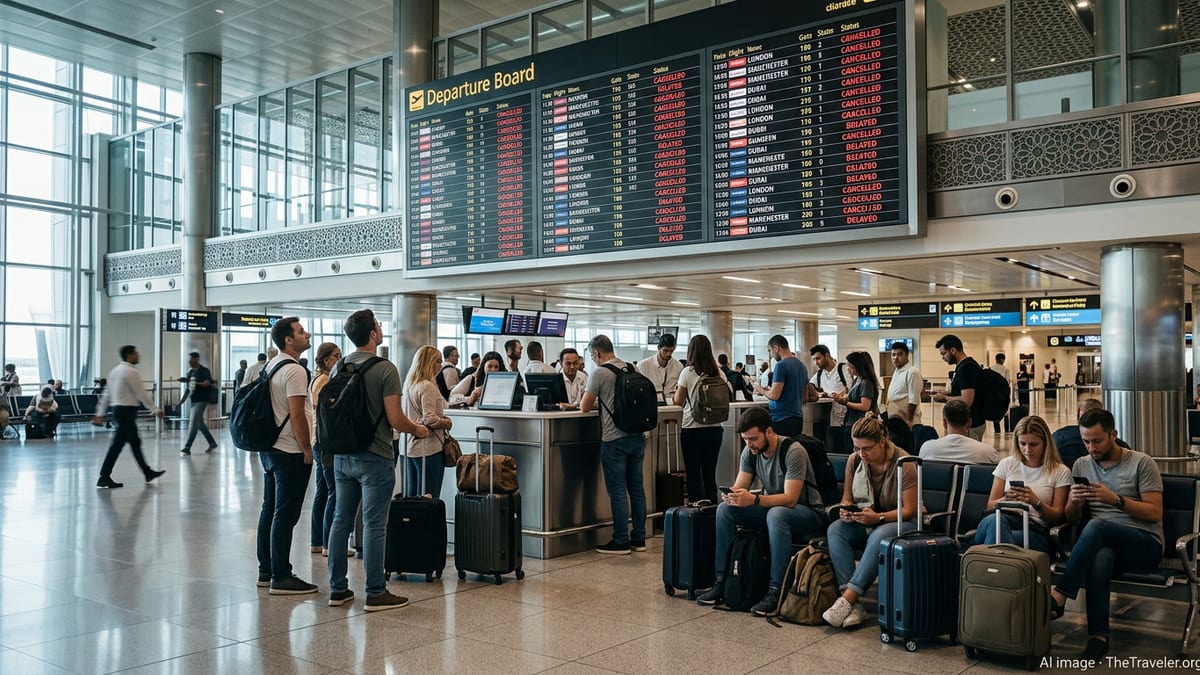
Drone Strike Forces Sudden Halt at World’s Busiest International Hub
Publicly available information indicates that a drone attack linked to the wider Iran conflict struck fuel infrastructure near Dubai International Airport in recent days, triggering a large fire and an immediate suspension of flights. Dubai’s main gateway, routinely described as the world’s busiest international hub, had already been operating under strain after a series of regional missile and drone incidents since late February.
Reports from regional and international outlets describe a rapidly evolving situation in which airport access roads were temporarily closed, flights were halted, and operations were reduced to a limited schedule focused on essential services and repatriation. The latest shutdown has intensified what analysts are calling the most severe disruption to Gulf air travel since the pandemic, with the impact now radiating far beyond the Middle East.
While some services have gradually resumed on a restricted basis, aviation briefings and local coverage suggest that the airport’s capacity remains sharply curtailed. Infrastructure checks, heightened security procedures and ongoing airspace risk assessments are together slowing any return to normal operations, prolonging uncertainty for airlines and passengers worldwide.
UK Departures Turn Back, Divert and Reroute Mid-Flight
Flight tracking data and media coverage show that services from London Heathrow, Gatwick, Manchester and Edinburgh to Dubai and other Gulf destinations have been among the hardest hit. Several long-haul flights bound for Dubai have been recorded turning back to their departure airports over Europe, while others diverted to alternative hubs such as Muscat or secondary airports in the United Arab Emirates.
According to airline statements and schedule databases, British and European carriers have preemptively cancelled or rerouted a significant share of flights to the wider region, citing regional airspace closures and changing risk assessments. Some UK services that previously transited Iranian or adjacent airspace now face extended routings over Turkey, the eastern Mediterranean or the Red Sea, adding hours to journey times and putting additional pressure on crew and aircraft availability.
Passenger accounts shared through social media and broadcast reports describe overnight turnbacks, unexpected landings and lengthy waits on the tarmac as crews awaited clearance decisions. Many travellers connecting in Dubai to onward flights to Asia, Africa and Australasia are instead finding themselves back in the UK or stranded at unscheduled transit points while airlines attempt to rebuild fragmented networks.
Ripple Effects Across Global Travel Networks
Dubai’s central role as a connecting hub means even a partial shutdown has immediate global consequences. Travel industry assessments note that the airport normally handles hundreds of thousands of passengers a day, funnelling traffic between Europe, the Middle East, Africa, Asia and Oceania. With this crucial node constrained, knock-on delays and cancellations are appearing across multiple continents.
Published analysis of aviation data indicates that since the latest Iranian strikes on Gulf infrastructure, thousands of flights in and out of the broader Middle East have been delayed, diverted or cancelled. Carriers that rely heavily on Dubai for eastbound connections from Europe are being forced to consolidate services, prioritise repatriation flights and reduce frequencies on secondary routes.
Travel insurers and corporate travel managers are warning of extended disruption as airlines work through backlogs and reposition aircraft. Business travellers are postponing trips to the region, while leisure travellers are racing to rearrange holidays that hinge on Dubai stopovers. Travel agencies report surging demand for routings that avoid the Gulf entirely, often at significantly higher prices and with longer total journey times.
Airspace Closures and Security Concerns Redraw Flight Maps
The shutdown of Dubai’s airport is part of a wider reshaping of regional aviation triggered by the escalation between Iran, the United States, Israel and Gulf states. Since late February, governments across the Middle East have periodically restricted or closed airspace, prompting aircraft to detour around the Gulf and the Strait of Hormuz. Publicly available flight tracking maps show dense clusters of diversions and holding patterns as airlines attempt to navigate rapidly changing no-fly zones.
Security briefings circulated to corporate clients and travel-risk consultancies describe the current pattern of Iranian missile and drone launches against Gulf infrastructure as fluid and unpredictable. Even when airports remain physically undamaged, the risk of debris from aerial interceptions and the possibility of renewed strikes are influencing decisions on whether to maintain passenger operations, reduce frequencies or switch to cargo and repatriation flights only.
For UK and European travellers, this shifting airspace environment translates into longer great-circle routes, additional fuel burn and tighter crew scheduling margins. Aviation experts cited in recent coverage suggest that airlines are likely to maintain conservative routings for weeks or months, even if active attacks subside, in order to comply with internal safety thresholds and regulatory expectations.
What Travellers from the UK Need to Know Now
For passengers booked to travel from the UK to Dubai or through the emirate to onward destinations, publicly available guidance consistently stresses the importance of checking flight status repeatedly in the 24 hours before departure. Schedules that appear confirmed one day can still be altered or cancelled at short notice if airspace conditions deteriorate or airport capacity is reduced again.
Travel industry advisories recommend allowing extra time for security screening and potential rerouting, as well as ensuring that contact details are up to date in airline booking systems so that passengers can receive real-time updates. Flexible tickets and comprehensive travel insurance with disruption coverage are being highlighted as particularly important while the regional situation remains volatile.
Analysts expect that Dubai will retain its status as a major global hub over the longer term, but the current shutdown and partial restart underscore the vulnerability of tightly interconnected aviation networks to geopolitical shock. For now, travellers from London, Manchester, Edinburgh, Gatwick and other UK airports face an extended period in which every journey through the Gulf may come with an extra layer of uncertainty.