

More news on this day
Dubai International Airport’s latest shutdown following an Iranian drone strike has unleashed a fresh wave of air travel turmoil, with flights from London, Manchester, Edinburgh, Gatwick and other major UK hubs forced to turn around midair, divert to secondary airports, or cancel altogether as safety concerns ripple through global aviation networks.
Get the latest news straight to your inbox!
Drone Strike Sparks Sudden Halt at World’s Busiest Hub
Publicly available information indicates that a drone launched from Iran struck fuel facilities close to Dubai International Airport, triggering a fire and plumes of smoke that led to an immediate suspension of flights on Monday, 16 March 2026. The incident follows a series of Iranian missile and drone attacks across the Gulf that began in late February, making this at least the third significant disruption at the airport in recent weeks.
Reports from regional media and wire services describe a rapid shutdown of runways and nearby road links as emergency services responded to the blaze. Dubai International, which normally handles more than 4,000 flights a day at peak periods and is frequently described as the world’s busiest hub for international passengers, saw large segments of its schedule abruptly halted or delayed as aviation authorities suspended operations for safety checks.
Earlier this month, the airport briefly halted flights after separate drone activity and falling debris near the airfield, and flight trackers documented repeated waves of cancellations and diversions. The latest strike has intensified concerns that the strategic hub is now a recurring target within the wider regional conflict, with aviation infrastructure repeatedly caught in the crossfire.
Coverage from Gulf-based newspapers suggests that even as limited operations resume in phases after each incident, recurring closures are creating severe operational challenges for airlines headquartered in the United Arab Emirates and for international carriers that rely on Dubai as a primary transit point between Europe, Asia and Africa.
UK Departures Forced to Turn Around, Divert and Delay
The cascading impact was immediately visible in UK skies. Flight-tracking data and airline advisories show that services from London Heathrow, London Gatwick, Manchester and Edinburgh bound for Dubai were abruptly ordered to hold, divert or return to their origin airports as news of the sudden shutdown filtered through on Monday morning.
According to publicly shared flight maps, some long-haul services from the UK to Dubai had already traversed large portions of their routes when airspace restrictions tightened over the Gulf, forcing crew to reverse course and head back to Britain or divert to alternative airports such as Dubai World Central, Doha, or other regional hubs able to accept traffic. Passengers found themselves on unscheduled “flights to nowhere,” landing back where they started after hours in the air.
British and European carriers serving the Middle East have already trimmed schedules in recent weeks in response to earlier Iranian strikes and the closure of multiple Gulf airspaces. Community updates from frequent fliers and airline staff note that many services to Dubai, Abu Dhabi and Doha from the UK had been operating under special routings and extended flight times before this latest interruption, leaving little slack to absorb further disruption.
For affected travelers, the result has been a patchwork of rebookings, overnight airport stays and complex re-routing via secondary hubs. Online forums show passengers from UK cities attempting to reach destinations as varied as Australia, India and South Africa via Dubai now scrambling to be reprotected via European or Asian hubs as the Middle East corridor remains unstable.
Regional Airspace Closures Ripple Across Global Routes
The Dubai shutdown is part of a wider pattern of regional airspace closures triggered by the ongoing conflict between Iran, the United States, Israel and Gulf states. Aviation bulletins and publicly shared notices indicate that the United Arab Emirates, Qatar, Kuwait and other neighboring countries have, at various points in recent days, closed their skies to most civilian traffic or imposed tight restrictions on overflights for security reasons.
Commentary in regional business press characterizes the resulting disruption as the most extensive since the pandemic, with thousands of flights across the Middle East grounded or forced into lengthy diversions. Dubai’s role as a central connector between continents means that interruptions there do not remain local; they quickly radiate across Europe, Asia, Africa and Oceania as missed connections and aircraft out of position ripple through airline networks.
Some carriers have adapted by flying more northerly or southerly routings to avoid contested airspace, adding hours and fuel costs to journeys between Europe and Asia. Others have temporarily suspended services to Gulf hubs altogether, pointing travelers instead toward alternative connection points such as Istanbul or major European gateways. Analysts note that these workarounds can only partially offset the loss of capacity through the Gulf’s mega-hubs.
Industry observers caution that as long as missile and drone activity continues in proximity to key airports and air corridors, international carriers will likely take a conservative approach, prioritizing avoidance and cancellation over risk, even if that means sustained disruption to some of the world’s busiest long-haul routes.
Emirates and Global Airlines Struggle to Restore Schedules
Dubai-based airlines, led by Emirates and flydubai, have spent much of March in recovery mode. Public updates shared by the carriers and summarized by travel forums show cycles of near-total suspension followed by gradual resumption of a “limited number” of flights to selected destinations, including key UK cities such as London, Manchester, Edinburgh and Gatwick, whenever security conditions allow.
However, the latest drone strike has again left aircraft and crew out of place. Aviation enthusiasts tracking operations report that some inbound flights to Dubai are being operated empty for repositioning purposes, while outbound flights focus on evacuation-style services to repatriate stranded travelers. This creates a highly unbalanced network, with airlines prioritizing getting people home rather than maintaining regular commercial schedules.
Beyond the Gulf, major European and Asian carriers that rely on Dubai as a connecting point are also grappling with rolling disruption. Publicly available information from airline websites and customer advisories indicates that many are offering fee-free changes, flexible rebookings and, in some cases, refunds for passengers whose journeys intersect the affected airspace during the current crisis.
With the conflict in the region still ongoing and no clear timeline for a stable security environment, analysts suggest that airlines may need to plan for a prolonged period of irregular operations. This could mean extended deployment of contingency schedules, additional spare aircraft to recover from disruptions, and a heavier reliance on alternative hubs to keep long-haul traffic moving.
Passengers Urged to Monitor Flights and Prepare for Disruption
For travelers, the events surrounding Dubai’s latest shutdown underscore the volatility now baked into global travel plans that pass through the Middle East. Travel advisories and consumer guidance from aviation-watch sources consistently recommend that passengers check flight status directly with airlines before leaving for the airport and be prepared for last-minute changes, even after boarding.
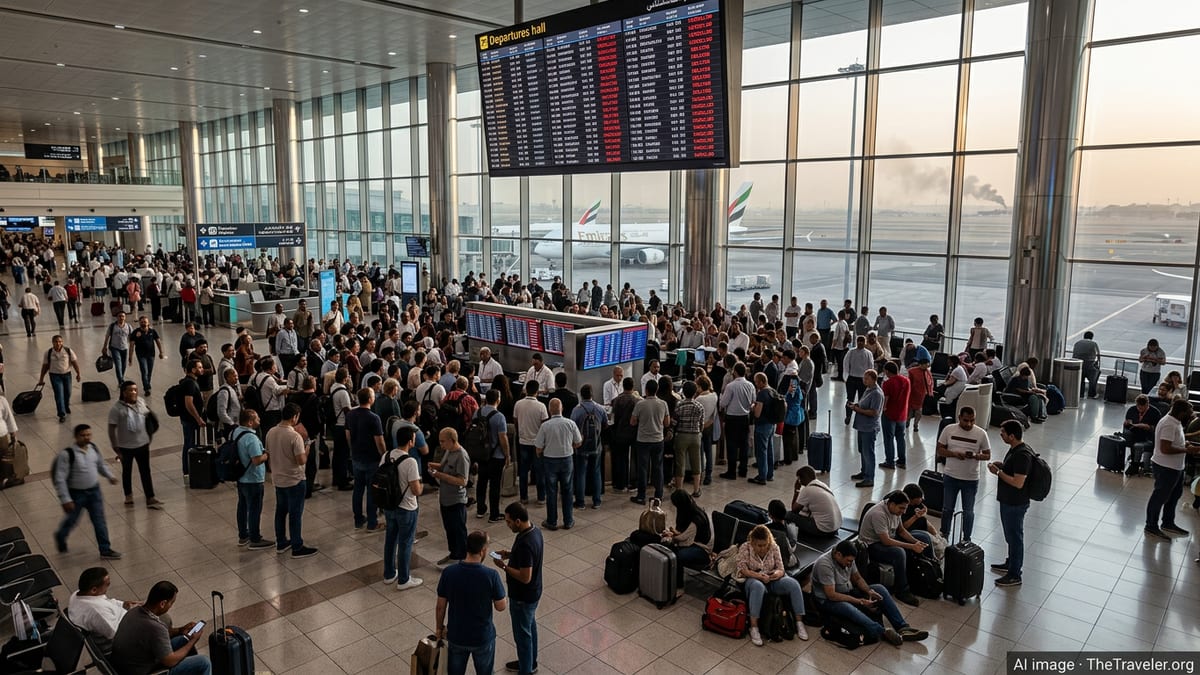
Reports from passengers caught in earlier waves of cancellations in early March describe crowded terminal halls, lengthy waits for information and a rush to secure hotel rooms as large numbers of travelers suddenly needed overnight accommodation. Similar scenes are likely whenever operations are suspended again, complicating travel for families, business travelers and those in transit to onward long-haul destinations.
Travel experts quoted across public coverage advise allowing extra time, carrying essential medications and critical items in hand luggage, and maintaining flexible itineraries wherever possible when routing through the Gulf. Those with non-essential trips are being encouraged by some commentators to consider postponement or re-routing via alternative hubs until the security situation stabilizes.
With Iranian drone and missile activity still affecting a swath of airspace from the Gulf to the eastern Mediterranean, and Dubai’s strategic airport once again forced into sudden shutdown, global aviation appears set for further turbulence. For now, passengers departing from UK airports and beyond face an unpredictable landscape in which even a routine overnight flight to Dubai can quickly become part of a wider travel nightmare.